Description
Valve Life Cycle Testing Machine
Product Introduction
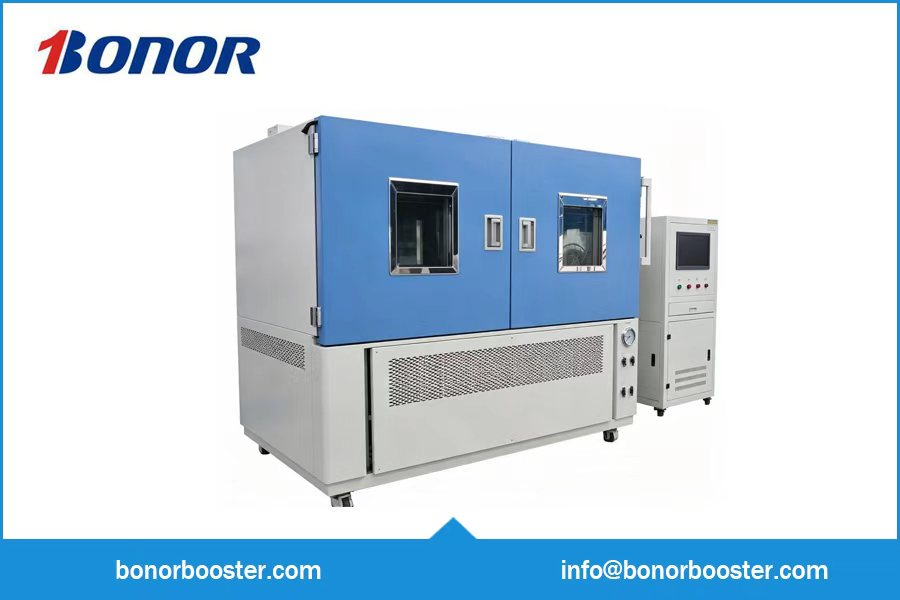
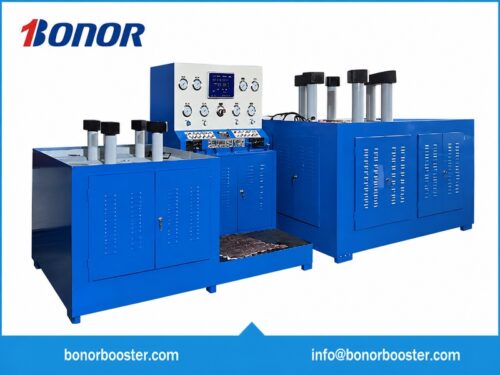
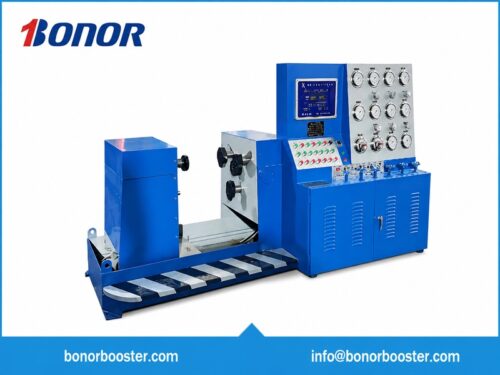
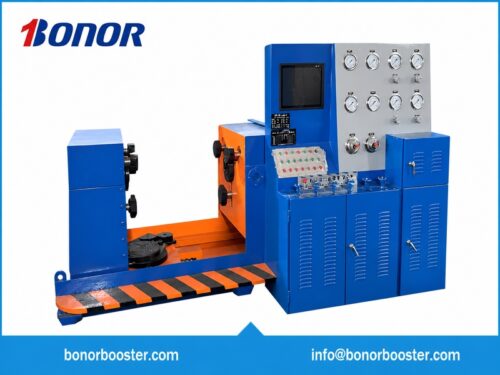
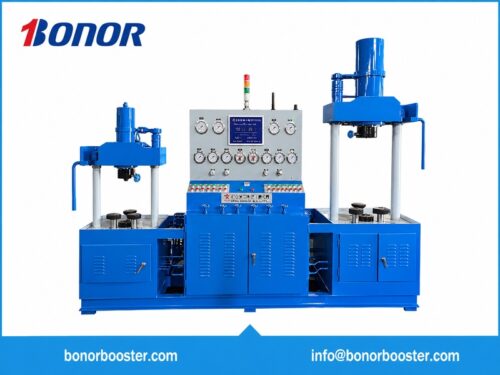
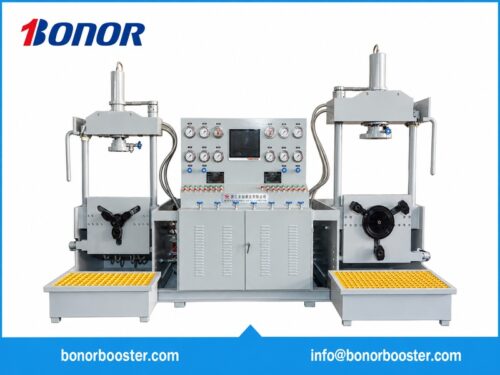
BONOR Valve Life Cycle Testing Machine is designed to evaluate the service life, sealing performance and mechanical durability of industrial valves through repeated opening and closing cycles under controlled pressure conditions.
Equipped with a computer-based control system, the machine can perform automated cycle testing, monitor pressure changes and record key testing data throughout the process. It helps valve manufacturers verify product performance, identify potential leakage issues and improve quality control before delivery.
BONOR provides customized testing solutions for different valve types, pressure ranges, test media and testing requirements, with liquid pressure configurations up to 800 MPa and gas pressure configurations up to 210 MPa.
Key Features
- Automated Life Cycle Testing: Performs repeated valve opening and closing cycles according to preset testing procedures.
- High-Pressure Testing Capability: Supports liquid pressure up to 800 MPa and gas pressure up to 210 MPa, depending on the selected configuration.
- Precise Pressure Control: Control accuracy of ±0.05 MPa, with pressure sensor accuracy of 0.5% FS.
- Real-Time Data Acquisition: Records pressure and cycle data with a sampling rate of up to 1 kHz.
- Automatic Test Reports: Generates pressure curves and test reports for performance evaluation and quality documentation.
- Flexible Test Stations: Available in single-station and multi-station configurations, with 1–4 test stations.
- Customized Control Software: C# and LabVIEW-based software solutions can be configured for different valve testing procedures.
Working Principle
The Valve Life Cycle Testing Machine simulates the repeated operation of industrial valves under specified pressure conditions.
The control system operates the test valve through preset opening and closing sequences while monitoring relevant pressure parameters and cycle counts.
During the testing process, the data acquisition system records pressure changes and operating data in real time. The software generates pressure curves and test reports for further analysis.
By evaluating the valve’s performance throughout the test cycles, users can assess sealing integrity, mechanical endurance and operating stability.
Technical Specifications
| Category |
Parameter |
Value |
Standard |
| Pressure Range |
Liquid pressure |
0–800 MPa |
Custom |
| Gas pressure |
0–210 MPa |
Custom |
| Accuracy |
Control accuracy |
±0.05 MPa |
GB/T 9251 |
| Sensor accuracy |
0.5% FS |
ISO 3766 |
| Data |
Sampling rate |
1 kHz |
Custom |
| Report output |
Automated curve + PDF |
Custom |
| Capacity |
Test stations |
1–4 stations |
Custom |
| Environment |
Power supply |
220V/50Hz |
Custom |
| Air supply |
0.6–0.8 MPa |
Custom |
Core Components
The machine uses selected pressure control and data acquisition components to support stable operation and accurate test data collection.
- Pressure Transducers: 0.5% FS accuracy for pressure monitoring.
- High-Pressure Valves: FITOK high-pressure components, selected according to the required pressure rating.
- Booster Pump: BONOR-developed air-driven liquid booster pump for high-pressure applications.
- Data Acquisition System: 16-bit data acquisition card with a sampling rate of up to 1 kHz.
- Control Software: C# and LabVIEW-based software for test sequence control, data monitoring and report generation.
Testing Process and Quality Control
Each machine undergoes inspection and functional testing before delivery.
The main quality control procedures include:
- Incoming inspection of pressure transducers, valves and other critical components.
- Inspection of pressure system connections and manifold assemblies.
- Pressure testing of assembled systems according to their rated working pressure.
- Control system commissioning and calibration.
- Functional testing with a reference valve.
- Test data verification and report generation.
Factory acceptance testing and third-party inspection by SGS, TÜV or BV can be arranged according to project requirements.
Applications
BONOR Valve Life Cycle Testing Machine is designed for valve manufacturers, quality inspection departments and industrial testing laboratories.
Typical applications include:
Oil and Gas Industry
Testing the operating durability and sealing performance of industrial valves used in oil and gas pipelines and related equipment.
Hydrogen Energy
Testing high-pressure gas valves and evaluating their operating performance under specified hydrogen service conditions.
Industrial Valve Manufacturing
Performing repeated opening and closing tests to evaluate valve service life, mechanical wear and operating reliability.
Fire Protection Equipment
Testing relevant gas valves used in fire suppression and gas storage systems.
Testing Laboratories
Providing controlled pressure testing, automated data acquisition and test reports for product verification and quality inspection.
Customized Testing Solutions
Different valve types and applications require different testing conditions. BONOR provides customized Valve Life Cycle Testing Machines based on customer requirements.
Available customization options include:
- Liquid and gas pressure ranges.
- Water, oil, nitrogen, hydrogen, natural gas, methane and other specified test media.
- Single-station and multi-station configurations.
- Customized valve connections, including quick-connect, flange and threaded connections.
- Programmable testing sequences and cycle profiles.
- Customized software interfaces and test report formats.
Our engineering team can develop suitable testing configurations according to valve specifications, operating conditions and applicable testing requirements.
Customization and Production Process
- Requirement Confirmation: Review valve specifications, pressure requirements, test media and cycle profiles.
- Solution Design: Develop the equipment configuration and control system according to the testing requirements.
- Equipment Manufacturing: Assemble the pressure system, test fixtures and control components.
- System Commissioning: Configure testing procedures, pressure control and data acquisition functions.
- Factory Acceptance Testing: Perform functional testing and verify the equipment before shipment.
Why Choose BONOR?
BONOR is a professional manufacturer of pressure testing and control equipment in China, with over 20 years of industry experience.
We focus on the design and manufacturing of pressure testing equipment for industrial applications, providing customized solutions for valve manufacturers and testing facilities.
- Over 20 years of experience in pressure testing equipment.
- In-house engineering and equipment manufacturing.
- Customized high-pressure testing solutions.
- Integrated pressure control and data acquisition systems.
- Technical support and after-sales service.
- Factory-direct supply for international customers.
Applications of the valve test bench
Every industrial valve leaves the factory with two questions attached: does the body hold pressure, and does the closure seal. The Valve Life Cycle Testing Machine answers both on one fixture, with the clamping, the pressure circuits and the record that a valve test procedure expects.
- Water and HVAC contractors — pressure testing of butterfly, gate and ball valves before commissioning.
- Valve manufacturers — routine shell and seat testing at the end of the assembly line.
- Pipeline and EPC contractors — incoming inspection of valves before installation, against API 598 or the project specification.
What to specify before we build yours
- Valve type and size range — ball, gate, globe, butterfly, check or control; each needs a different clamping and sealing arrangement.
- Pressure class — the bench must exceed the highest class in scope, usually with a margin for the shell test multiplier.
- Test medium — water, air or gas; the seat-leak measurement method changes with the medium.
- Test sequence automation — manual valve switching, or a programme that runs shell, seat A and seat B in order and logs each result.
Currently configured as: Control accuracy: ±0.05 MPa. Other ranges and fixtures are built to order.
How to choose a valve test bench
The fixture, not the pump, is what makes a valve bench usable day after day:
- Look at how the valve is clamped. End-loading rams seal against the flange faces; a clamping table holds the body from outside. End-loading is faster for flanged valves, a table is more flexible for threaded and welded-end bodies.
- Confirm both seat directions are testable. A seat test has to be repeated on the upstream and downstream side of the closure; if the fixture cannot isolate each side, the operator will improvise with blind flanges and lose the cycle time.
- Decide how leakage is measured. Water gives a visible drip count, air gives a bubble count or a pressure decay, gas gives a flow reading. The bench should report the unit your standard specifies.
Frequently asked questions
What is the difference between a shell test and a seat test?
A shell test pressurises the whole valve body with the closure open or removed, to prove the pressure boundary. A seat test pressurises one side of the closed closure and measures leakage past the seat. Both are required by API 598 and equivalent standards, and they use different circuits.
Can the bench test both metal-seated and soft-seated valves?
Yes. The acceptance criteria differ — metal seats allow a small leakage rate, soft seats are usually required to be bubble-tight — but the fixture and the pressure circuit are the same. The criteria are stored per valve type in the test recipe.
What sizes can one bench cover?
A typical bench covers DN15 to DN300 with interchangeable adapters; larger valves are usually tested with a dedicated end-loading frame. The practical limit is the clamping force and the handling weight, not the pressure rating.
Related equipment and further reading
Need a pressure range, fixture or test standard that is not listed here? Send the specimen list and the standard you test to and we will come back with a configuration and a price within one working day.