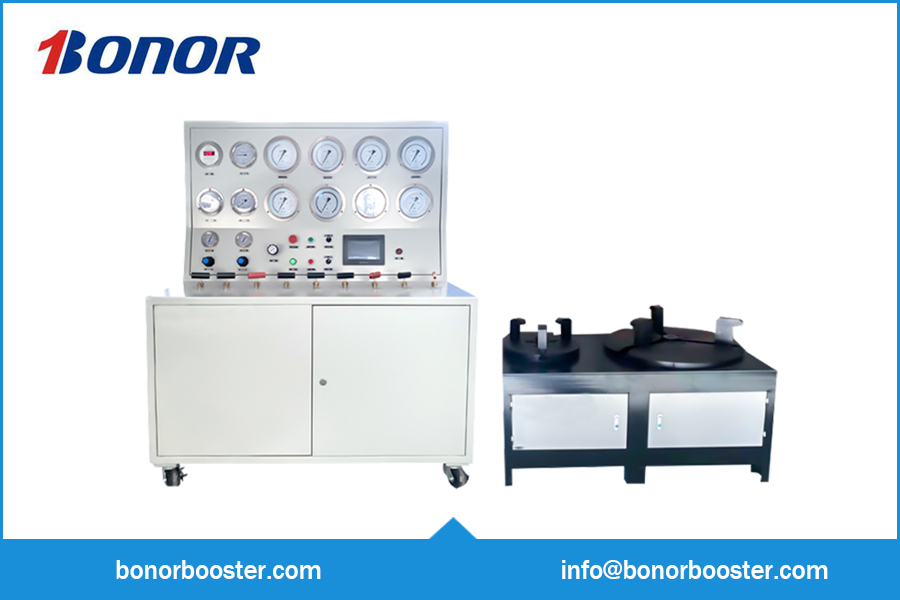
Selecting the right burst pressure test bench is critical to ensure the safety and reliability of the components you’re testing. Different industries and applications will require different features. Whether you’re testing small parts for automotive applications or large pressure vessels for the oil and gas industry, understanding the key factors will help you choose the ideal equipment for your needs.
Before choosing a burst pressure test bench, consider the following important aspects:
一、Maximum Pressure Rating: How Much Pressure Can the Bench Handle?
The maximum pressure rating is one of the most crucial features. Depending on your industry and application, the pressure range can vary significantly.
Low-pressure testing: For testing small components like valves and hoses, you may only need a bench capable of reaching pressures up to 1,000 PSI.
High-pressure testing: If you’re working with components used in oil and gas or aerospace, you may need a bench that can handle pressures as high as 10,000 PSI or more.
Choosing the right pressure range ensures that the test bench is suitable for the types of components and applications you’re working with, preventing unnecessary wear or failure in your testing equipment.
二、Test Specimen Size: Can the Bench Accommodate Your Components?
The size of your test specimens plays a major role in selecting the right burst pressure test bench. Whether you’re testing small pipes, fuel lines, or large pressure vessels, your bench must be designed to handle these varying sizes.
Small-scale tests: Ideal for components like brake lines or valves.
Large-scale tests: Essential for testing large pipes or pressure vessels found in chemical processing, oil refineries, and natural gas plants.
Make sure that the test bench can accommodate your components securely, ensuring that they are properly aligned and able to withstand the applied pressure.
三、Testing Speed & Cycle Time: How Efficient is the Testing Process?
The speed at which a burst pressure test bench operates is important, especially for high-volume testing environments. In industries like automotive or manufacturing, testing hundreds or thousands of components requires efficient machines that can deliver accurate results quickly.
Faster testing: Some test benches come with automated systems that can increase cycle time and handle multiple specimens in a shorter period.
Standard testing speeds: Others may be manual or semi-automated, offering slower but highly accurate testing processes.
Choosing the correct balance between speed and accuracy ensures that you meet both production demands and safety standards.
四、Automation vs. Manual Testing: Which is Right for Your Operations?
Test benches can either be automated or manual, depending on your testing needs. The level of automation you choose will affect both the cost and efficiency of your testing process.
Automated test benches: These machines can test specimens quickly and with minimal human intervention. Automation is especially beneficial in environments that require high throughput.
Manual test benches: Ideal for smaller-scale testing or environments where customization of each test is needed. While slower, they offer greater control over the testing process.
Choosing between manual or automated testing will depend on factors like the volume of testing, your budget, and how much human supervision is required.
Industrial Requirements: Light-duty vs. Heavy-duty Burst Pressure Test Benches
The requirements of your specific industry will largely determine whether you need a light-duty or heavy-duty test bench.
Light-duty test benches: These are typically used in industries like automotive or medical devices, where components are smaller and the pressure demands are lower (usually up to 5,000 PSI). They’re also ideal for small-scale operations or when testing smaller components like hoses and fuel lines.
Heavy-duty test benches: In industries like oil and gas, aerospace, or chemical manufacturing, high-pressure testing is the norm. A heavy-duty test bench can withstand much higher pressures (up to 10,000 PSI and beyond) and is designed for larger components, such as pipes or pressure vessels.
When comparing options, ensure you evaluate both light-duty and heavy-duty test benches based on your test specimen and the maximum pressure your industry requires.
Choosing the right burst pressure test bench involves understanding the pressure range, specimen size, testing speed, and the level of automation you need. Whether you’re in the oil and gas, automotive, or aerospace industries, selecting the correct test bench ensures reliable, safe, and accurate testing of critical components. Be sure to compare light-duty and heavy-duty options based on the demands of your application, ensuring you meet both production and safety standards.