
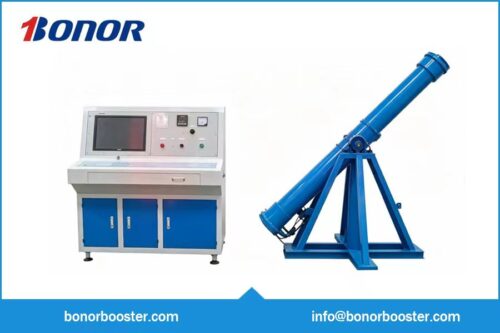
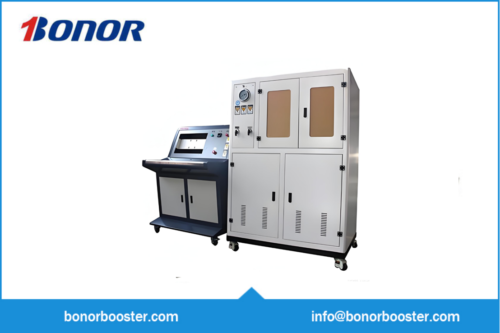
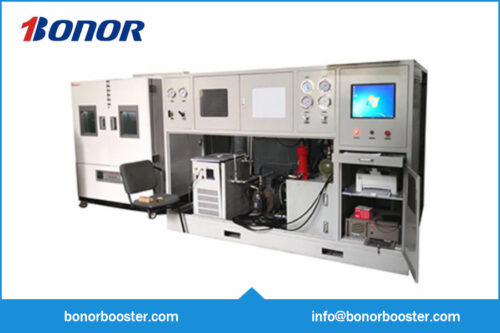
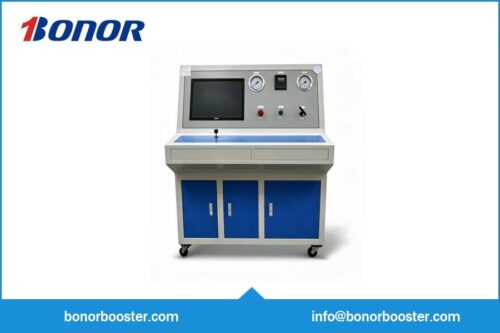
BONOR manufactures hydrostatic pressure testing equipment for checking the pressure resistance and sealing performance of cylinders, pipes, valves, and other pressure-bearing components. Our equipment is used by manufacturers, testing laboratories, and industrial inspection facilities for a range of pressure testing applications.
Different systems are available to suit specific test pressures, workpiece dimensions, and operating requirements. Contact BONOR to discuss your application and find suitable hydrostatic pressure testing equipment for your testing needs.


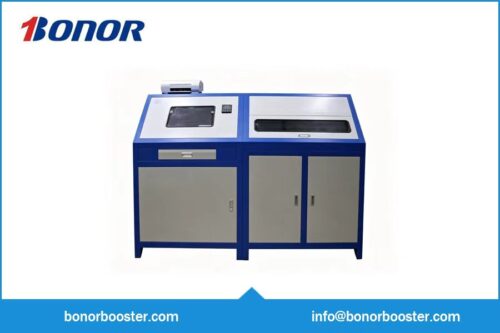
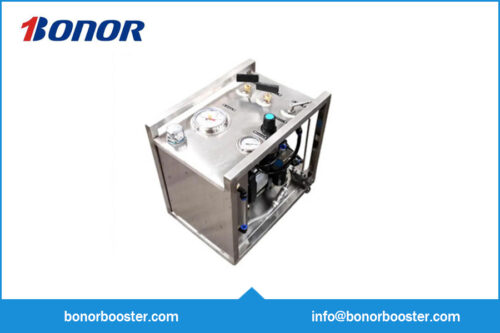
Hydrostatic Pressure Testing Equipment: How to Specify the Right System
A hydrostatic test proves that a pressure-bearing part will hold its design pressure without leaking, weeping or taking a permanent set. Water is the usual medium because it stores very little energy when compressed, so if a part fails during the test the stored energy is released as a small volume of liquid rather than as fragments. Oil or a water-glycol mix is used where the part must not corrode or where the cavity is difficult to dry afterwards.
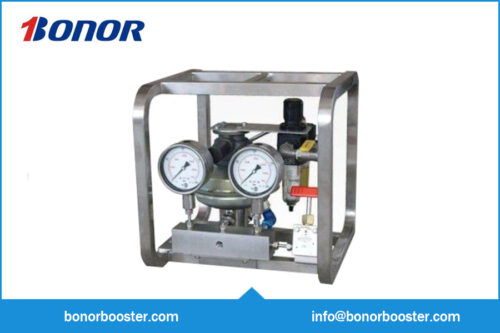
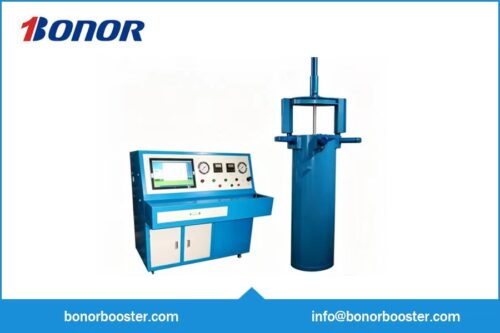
Two families cover almost every requirement. Water-jacket systems measure permanent and total volumetric expansion, which is the method written into the cylinder standards (ISO 9809, ISO 7866, EN 1964, DOT). Direct-pressure systems pressurise the part, hold it and watch for pressure decay, seepage and permanent deformation, which suits pipes, valves, small vessels, heat exchangers and laboratory work. Both families can be built as a bench, a skid or a portable unit, and both can be manual, semi-automatic or PLC-controlled.
What to specify before you compare quotations
- Maximum test pressure, with margin Size the machine above the highest test pressure you will ever run. Pipes and vessels are normally tested at 1.5x design pressure, and gas cylinders at a value fixed by the requalification standard — commonly 1.5x working pressure for steel. A machine with no headroom becomes a bottleneck the first time a larger product arrives.
- Test medium and circuit design Decide water, oil or glycol, and how the medium is filtered, inhibited and recovered. For high-volume cylinder testing the water circuit, tank volume and temperature stability matter as much as the pump.
- Measurement method Water jacket measures expansion in millilitres and is the only way to demonstrate compliance with cylinder requalification clauses. Pressure-hold only proves the part did not burst or leak. Some buyers need both on one machine.
- Workpiece handling and sealing Thread, flange or end-cap sealing, clamping force, loading height and cycle time decide real throughput. Send drawings of the largest and smallest parts you intend to test — this is where most quotation errors happen.
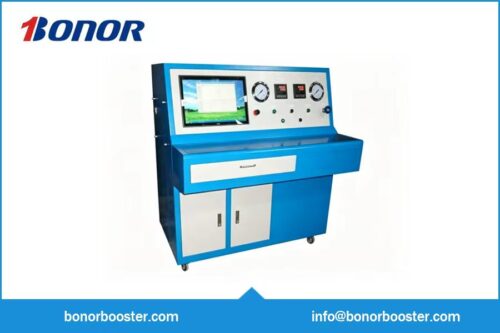
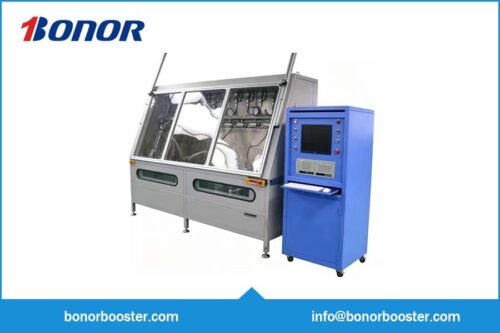
- Control, recording and traceability Manual units suit occasional testing and R&D. PLC units give an automatic pressure ramp, a logged pressure-time curve and an exportable record per serial number, which is what inspection bodies and customer audits ask for.
- Services and footprint Confirm power supply, water supply and drain, compressed air and floor space. A water-jacket line for large cylinders needs considerably more room than a bench for small fittings.
Choosing between the three common configurations
| Configuration | What it measures | Best suited for | Watch out for |
|---|---|---|---|
| Water jacket (volumetric expansion) | Total and permanent expansion, plus pressure retention | Gas cylinder requalification, type approval, standards-driven work | Needs burette and temperature calibration; longer cycle time |
| Direct pressure hold | Pressure retention, visible leakage, permanent set | Pipes, valves, small vessels, heat exchangers, R&D | Cannot quantify expansion, so it will not satisfy cylinder clauses |
| Portable / compact bench | Same as direct pressure hold | Site testing, small batches, service workshops | Limited clamping range and reservoir volume |
Standards these systems are usually built around
Cylinder work commonly references ISO 9809-1/-2, ISO 7866, ISO 11119, EN 1964, DOT 3AA/3AL and GB/T 5099 or GB/T 9251. Vessels follow ASME BPVC Section VIII or EN 13445, and plastic pipe follows ISO 1167 or ASTM D1598. We do not claim certification on your behalf: tell us the exact clause you have to satisfy and the machine is configured, instrumented and documented around it, so that the paperwork matches what the auditor will read.
Frequently asked questions
What is the difference between a hydrostatic test and a burst test?
Should I use water or oil as the test medium?
How is the test pressure calculated?
Can the machine produce records that an inspection body will accept?
Related equipment and buying guides
- LPG cylinder hydrostatic testing machine
- Gas cylinder hydrostatic test machine (water jacket method)
- Portable hydrostatic testing machine
- Plastic pipe hydrostatic pressure testing machine
- Selection guide: from specification to sign-off
- Water vs oil media: the cost trap
- Burst pressure test bench (destructive testing)
Need help specifying? Send us your test pressure, specimen range and the standard you work to — talk to our engineers or use the inquiry form on any product page.