
BONOR is a China manufacturer of booster systems for industrial gas and liquid pressurization. Our product range includes gas booster systems, air booster systems, and gas-liquid booster systems for different pressure requirements.
These systems can be configured according to the working medium, inlet pressure, required outlet pressure, and flow rate. They are suitable for applications such as pressure testing, gas transfer, and industrial fluid control, depending on the system configuration.
Contact BONOR with your operating conditions and technical requirements to discuss a suitable booster system for your application.

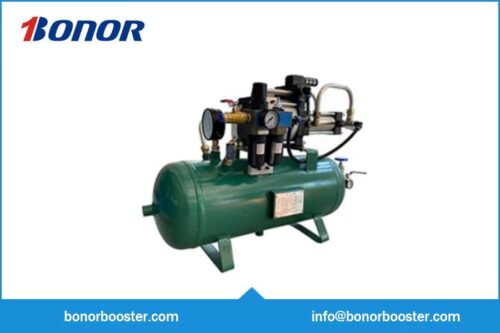

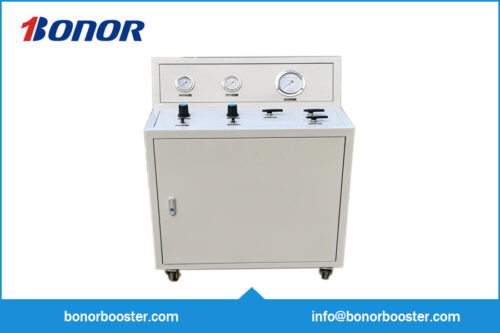
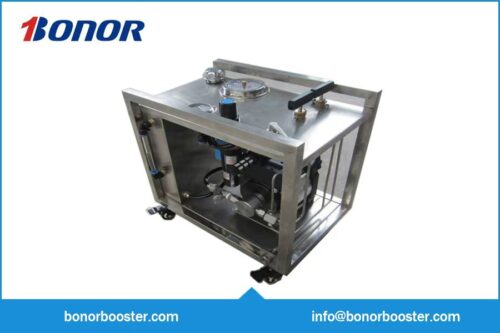
Booster Systems: When a Pump Alone Is Not Enough
A booster pump raises pressure; a booster system keeps it raised. The difference is the buffer volume, the controls and the safety devices around the pump — the parts that turn a component into a utility. Plants that buy a pump and expect stable pressure usually end up adding those parts one at a time, at higher cost and with less documentation than a purpose-built skid.
A system is the right answer when several points of use share the pressure, when the demand is intermittent and a pump on its own would short-cycle, when the outlet pressure has to be held within a band, or when the installation has to be handed over with drawings, testing and a control interface.
What a system specification should contain
- Outlet pressure, flow and acceptable band State the pressure you need and how much variation the process tolerates. The band, not the set point, decides the receiver size and the control strategy.
- Buffer volume The receiver absorbs the pulsing of a reciprocating pump and covers peaks in demand. Undersizing it is the most common reason a system feels weak even though the pump is adequate.
- Control philosophy Automatic start and stop on pressure, a PLC with alarms, or a signal to the plant SCADA. Decide how the system reports faults before you decide how it looks.
- Safety devices Relief valve, over-pressure trip, low-level or low-inlet protection, and a vent path. On gas systems this set is not optional and should be listed in the quotation.
- Footprint, noise and services Skids are compact but need access for maintenance, ventilation and a drain. Noise from exhaust and from the pump itself should be stated as a figure, not as 'quiet'.
- Handover documentation Drawings, test records, material certificates and a spare parts list. For an exported or audited plant these are as important as the hardware.
System types in this catalogue
| System | Raises | Typical application |
|---|---|---|
| Air booster system | Compressed air pressure | Point-of-use pressure elevation, pneumatic clamping, testing fixtures |
| Gas booster system | Nitrogen, oxygen, hydrogen, helium, argon | Cylinder filling, accumulator charging, test rigs |
| Gas-liquid booster system | Liquid pressure using gas drive | Hydrostatic testing, pressing, holding pressure |
Why a skid usually costs less than the sum of its parts
Buying the pump, receiver, panel and safety devices separately means four suppliers, four sets of drawings and a commissioning phase where nobody owns the interface. A skid arrives pressure-tested, wired, documented and with a single point of responsibility. For anything that will be audited, exported or handed to a maintenance team, that consolidation is usually worth more than the price difference on the components.
Frequently asked questions
Can a booster system connect to our existing plant air?
How much maintenance does a skid need?
How is pressure stability guaranteed?
Can the system report to our SCADA?
Booster systems and pumps
Need help specifying? Send us your test pressure, specimen range and the standard you work to — talk to our engineers or use the inquiry form on any product page.