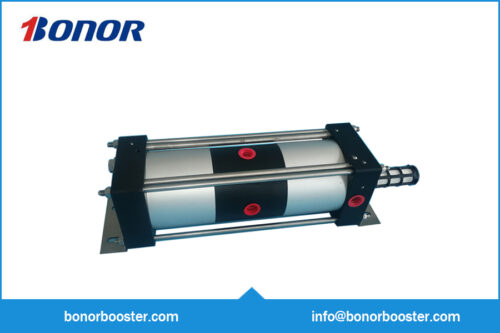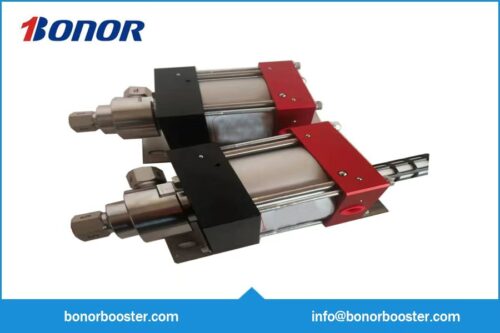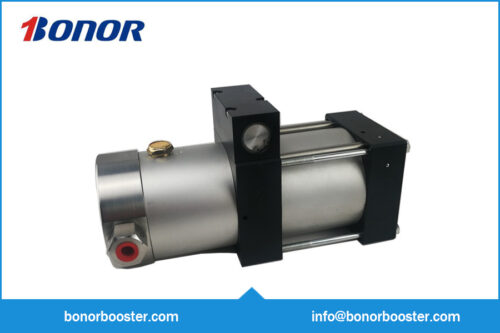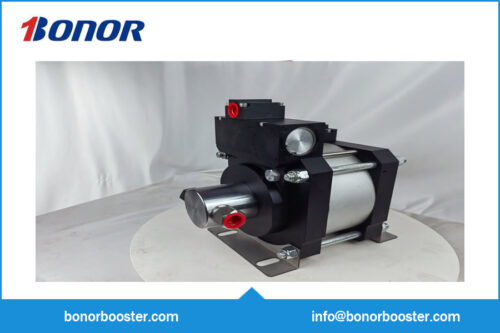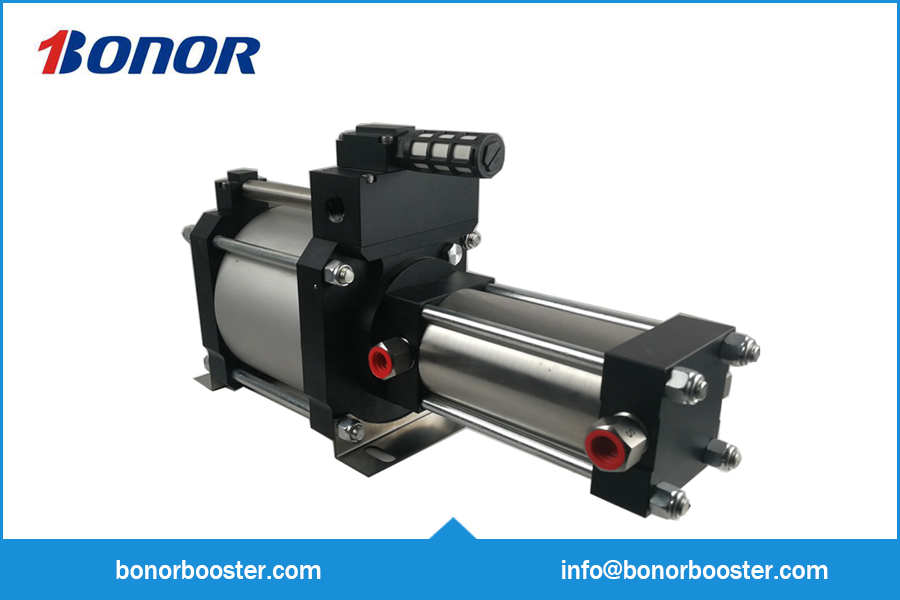
The A32K-05 Air Booster Pump is built for compressed-air pressure multiplication. Configured here as pressure Boost Ratio: 4:1; maximum Flow Rate: 240 L/min. The outlet pressure follows the drive pressure at the pump, so the ratio is set on measured air pressure.
Description
The drive piston diameter of the A32K-05 is 160mm, and the high-pressure piston diameter is 80mm. Therefore, the calculated pressure boost ratio is 1:4.
However, its structure is a single-end double-acting structure, so the outlet pressure calculation formula is: pB=4pL+pA.
Therefore, when the pump is used for compressed air boosting, the drive air and the gas source are from the same pipeline with the same pressure, so the outlet pressure calculation is simplified to 5pL.
Another Model: A32K-05AThe high-pressure piston diameter is 70mm, the area pressure boost ratio is 1:5, and the outlet pressure is calculated as pB=5pL+pA.
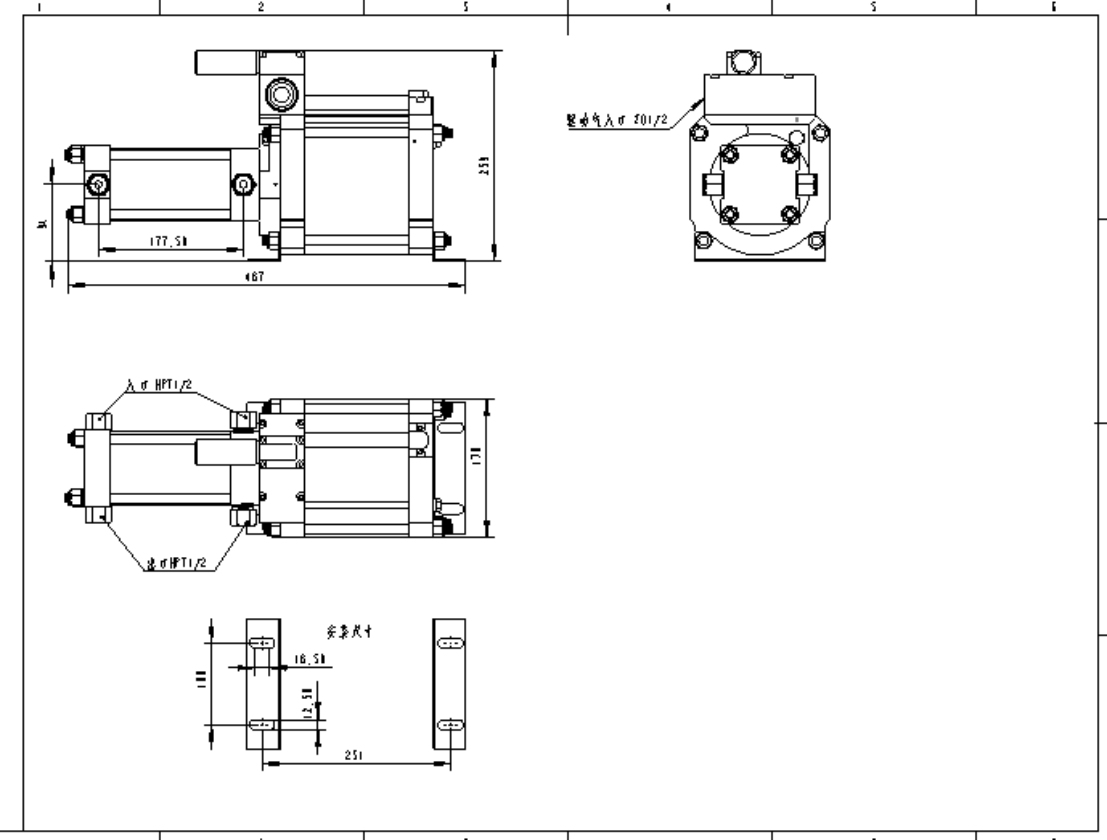
Due to its double-acting structure, the A32K-05 has two inlets and two outlets at one end of the pump.
Upon delivery, the two inlets can be connected in parallel and the two outlets can be connected in parallel with pipelines for more convenient on-site use. The model is A32K-05D.
If there are special requirements, there can also be one inlet and one outlet on each side. Connect the outlet and inlet on one side with a pipeline to form a two-stage boosting mode. The model is: A32K-05T.
Technical Parameters
- Drive Source: Clean compressed air
- Pneumatic Control System
- Drive Compressed Air Pressure: 1-8 bar (recommended drive pressure < 8 bar)
- Pressure Boost Ratio: 4:1
- Maximum Flow Rate: 240 L/min
- Maximum Air Outlet Pressure: 16 bar
- Suitable Medium: Clean air
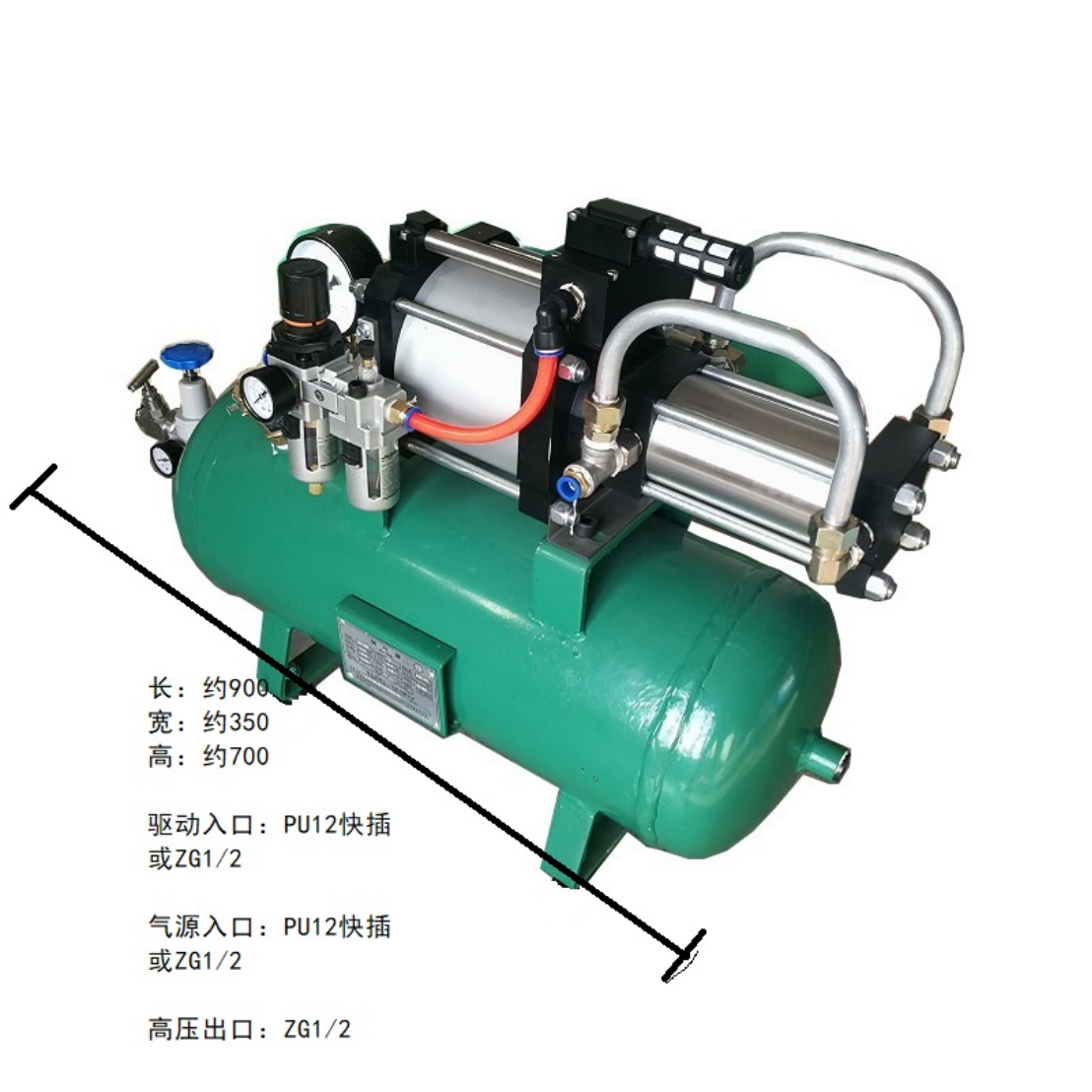
Usually, the A32K-05 is delivered as an air boosting unit for more convenient on-site use.
Applications of the air booster pump
The A32K-05 Air Booster Pump is the simplest way to get high pressure out of a low-pressure air line: connect the drive air, connect the outlet, set the regulator. It is used wherever a compressor upgrade would be excessive for one station.
- Leak testing — providing a stable high-pressure supply to a leak-test bench.
- Clamping and fixtures — holding hydraulic clamps and press-fit fixtures without a hydraulic power unit.
- Air spring and shock absorber filling — boosting to the charging pressure required by the assembly.
What to specify before we build yours
- Drive air pressure at the pump — the outlet is the drive pressure multiplied by the ratio, minus losses; 6 bar is a typical figure.
- Required outlet pressure and flow — the pair decides the ratio and the piston area.
- Whether the outlet drives air or liquid — the same pump body can be configured for either, with different seals.
- Duty — holding a static pressure, or supplying continuous flow; the second needs a larger unit or a receiver.
Currently configured as: Pressure Boost Ratio: 4:1; Maximum Flow Rate: 240 L/min. Other ranges and fixtures are built to order.
How to choose a air booster pump
Air boosters are usually chosen on the outlet pressure alone, which is why some of them never reach it:
- Use the pressure you really have. A compressor rated at 8 bar rarely delivers 8 bar at the point of use during peak demand. Size the ratio on the measured pressure at the pump inlet, not on the compressor nameplate.
- Add a receiver if the demand is intermittent. A small buffer vessel lets a compact booster serve a demand spike that would otherwise need a much larger pump.
- Check the air consumption. The booster is driven by compressed air at a ratio, so high outlet pressure costs drive air. On a large ratio the compressor may become the limiting factor, not the booster.
Frequently asked questions
What outlet pressure can it reach with 6 bar drive air?
With a 1:10 ratio, roughly 50 to 60 bar at stall, depending on seal friction and the actual inlet pressure; higher ratios reach more. The catalogue figure is a maximum, and the achievable value should be confirmed against your measured inlet pressure.
Does it need electrical power?
No. The pump is driven entirely by compressed air, which makes it suitable for hazardous areas, outdoor installations and locations without a power supply. Only the pressure switch or solenoid, if fitted, needs electricity.
Can it be mounted directly on the air line?
Yes, it can be installed inline with a filter-regulator, a gauge and a relief valve. A small receiver downstream is recommended so the pump cycles less and the outlet pressure stays stable.
Related equipment and further reading
- A16K-02 Air Booster Pump
- A32K-02 Air Booster Pump
- All Air Booster Pump models and specifications
- How does an air booster pump work
- Air booster pump maintenance and troubleshooting
Need a pressure range, fixture or test standard that is not listed here? Send the specimen list and the standard you test to and we will come back with a configuration and a price within one working day.