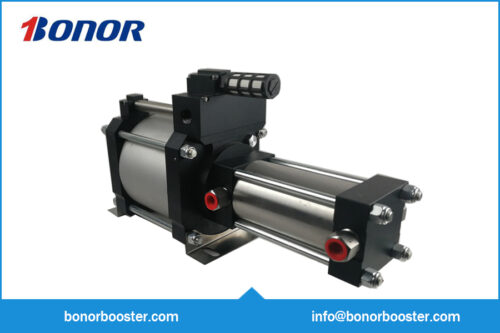
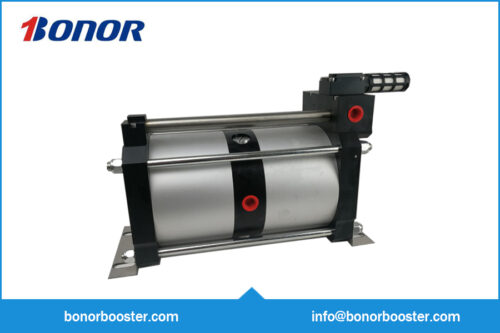
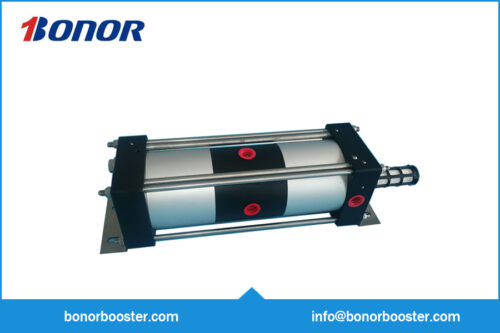
Ⅰ. Core Working Principle
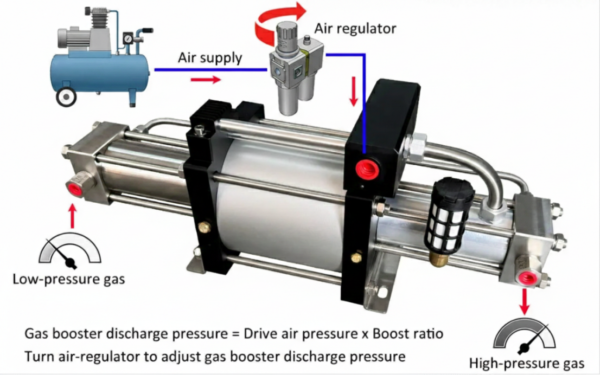
The air booster pump can amplify the pressure of compressed air from factories, workshops and air compressors based on the self-pressurization principle. It utilizes the low air pressure acting on the large piston to generate high air pressure on the small piston, thereby achieving pressure boosting.
Specifically, the air booster is composed of two parts: a drive cylinder with a built-in large piston and a high-pressure cylinder with a built-in small piston. The two pistons are connected by a shaft. When compressed air enters the booster pump, part of it flows into the drive cylinder to push the large piston to perform reciprocating motion, while the remaining air enters the high-pressure cylinder, waiting to be compressed. As the large piston moves back and forth, the small piston reciprocates synchronously. Therefore, the air inside the high-pressure cylinder is continuously compressed, and the air pressure keeps rising until the high-pressure air is discharged.
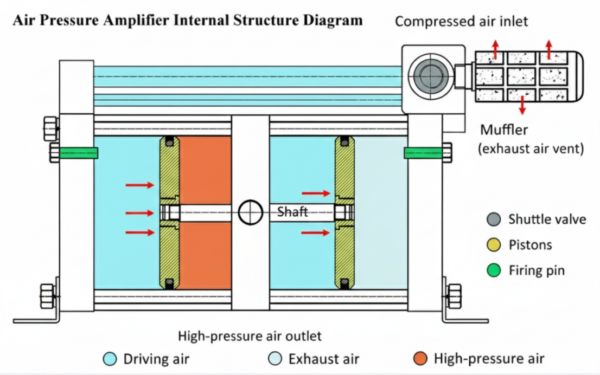
Air Pressure Amplifier Internal Structure Diagram
Ⅱ. Core Product Features and Application Scenarios
1. Core Features
- High Versatility: Generally suitable for compressed air boosting, and also applicable to media such as nitrogen; custom modification is available for special gases.
- Cost-Effectiveness: Featuring a simple structure and mass production, it offers an affordable price. It serves as a highly efficient solution for local pressure boosting/stabilization in gas circuits.
- Automatic Start & Stop: When used with an air storage tank, the pump will automatically stop operation once the pressure inside the tank reaches the maximum value, and restart automatically to compensate pressure when the pressure drops.
2. Advantages of Air Booster Pumps
- Long service life of seals and easy maintenance;
- No risk of heat generation, open flames or sparks;
- Multiple models, control methods and options available;
- No need to lubricate air pipes, thus eliminating oil emissions;
- Stepless adjustment of outlet pressure and flow rate;
- Rich standard and customized systems provided;
- Maximum pressure can be controlled by an economical pneumatic pressure regulator.
Ⅲ. Applications of Air Booster Pumps
Air boosters are widely used in various industrial fields, including the following:
PET Bottle Manufacturing
Automated polyethylene terephthalate (PET) manufacturing requires a continuous supply of high-pressure gas, which standard compression systems cannot provide. Booster air compressors help deliver high-pressure air to blow molding machines for PET bottle production. Blow molding uses compressed air to force molten thermoplastics into molds.
Industrial Stress Testing
It involves pressure testing of pipes, pipe fittings, containers, piping systems, etc., helping to determine their integrity, reliability and tightness before and after on-site commissioning. It is usually conducted during maintenance operations to ensure that key equipment functions properly and is in good condition.
Leakage Testing Procedures for Compressed Air or Nitrogen (Also Known as Pneumatic Testing)
It includes injecting compressed air into the container to reach the required pressure range, then releasing the gas through a pressure relief valve installed on the tested system. Pneumatic booster pumps or pneumatic intensifiers are suitable for this purpose.
Ⅳ. Operation Method (Construction of a Simple Boosting System)
- Start the air compressor to generate initial compressed air with a pressure of 1–8 MPa.
- The compressed air is automatically split into two paths:
One path enters the air pressure regulator and is converted into drive air; the other path directly enters the air amplifier as air to be boosted.
- Adjust the pressure regulator to control the pressure of the drive air. The air amplifier will automatically compress the air to be boosted, and finally discharge high-pressure air with a maximum pressure of 80 MPa.
air booster pump