I. Core Working Principle
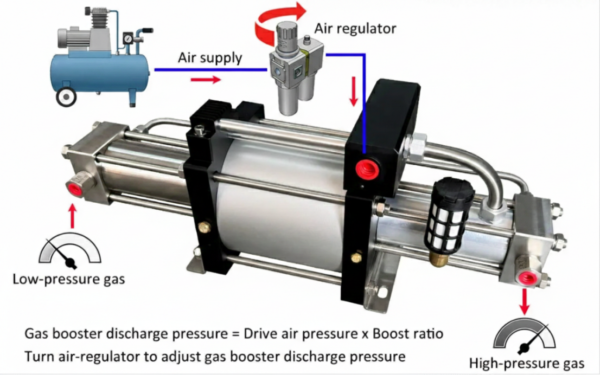
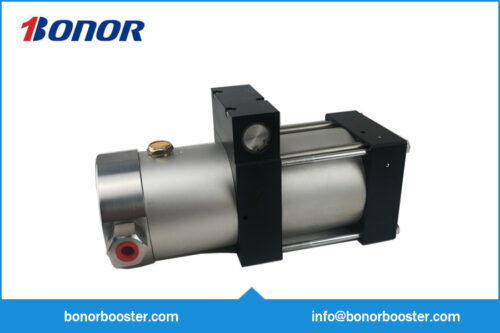
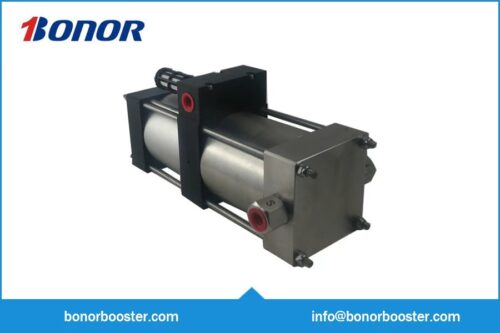
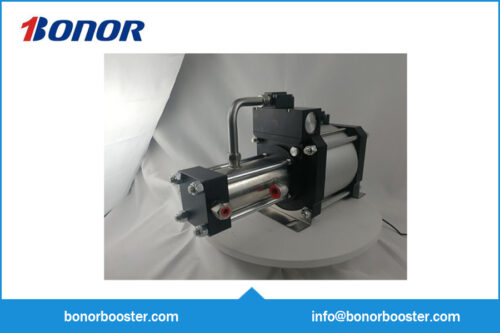
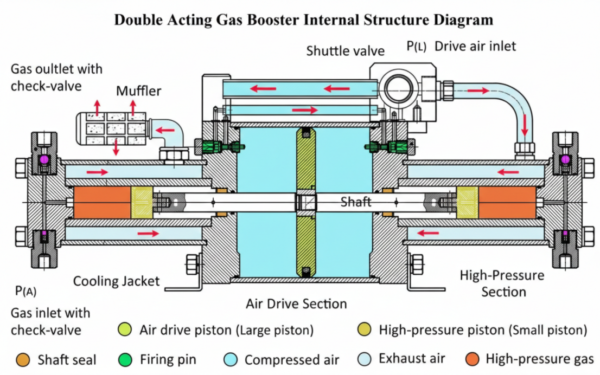
The gas booster pump is a pressure intensifying device powered by compressed air. Its core pressure boosting is achieved through the linked compression of large and small pistons, with the detailed principle as follows:
- Structure Composition: It consists of two parts: a drive cylinder (with a built-in large piston) and a high-pressure cylinder (with a built-in small piston). The two pistons are connected by the same shaft.
- Working Process: Compressed air drives the large piston to perform reciprocating motion, which synchronously drives the small piston to move back and forth, thus completing the cycle of drawing in low-pressure gas → compressing gas → discharging high-pressure gas.
- Pressure Core: Discharge Pressure = Drive Air Pressure × Boost Ratio (The boost ratio is a fixed value, i.e., the area ratio of the large piston to the small piston). Therefore, the discharge pressure is proportional to the drive air pressure, and the outlet pressure can be preset by adjusting the drive air pressure.
II. Core Product Features & Application Scenarios
Core Features
- Powered by compressed air — no electricity required (can be connected to a regular air compressor)
- To extend the service life of the pump, the drive air pressure should not exceed 8 MPa
- No air lubricator needed
- Hydrocarbon-free — separation between air and gas sections
- Max pressure up to 80 MPa (11,600 PSI)
- Available in a variety of boost ratios
- Most models are equipped with built-in cooling function
- Easy to install, operate and maintain
- High cost performance
- No heat generation, open flame or spark risk, explosion-proof
- Automatic pressure maintenance function: Regardless of the cause of pressure drop, the BONOR pump will start automatically to keep the loop pressure constant
- Applicable Gases: Air/Argon/Helium/Hydrogen/Oxygen/Nitrogen/Carbon Dioxide/Nitrogen Dioxide/Methane/Ethane/LNG/LPG/CNG/FM200/Sulfur Hexafluoride/Hydrogen Sulfide, etc.
Applications
The BONOR pneumatic booster can provide pressure up to 80 MPa. It is not only suitable for the oil-free compression of air or nitrogen, but also applicable to flammable and explosive gases such as hydrogen, oxygen and natural gas. These boosters are ideal choices for increasing gas pressure, conveying high-pressure gas, cylinder filling and waste gas recovery.
The pneumatic booster is an effective alternative to electric boosters and can be used in explosion-proof areas.
With a wide range of models, the optimal booster can be selected for each application. Single-stage, double-acting or two-stage boosters, or combinations of these models, can be used to achieve different working pressures and flow rates.
The BONOR pneumatic gas booster is ideal for hydrostatic testing and burst testing of valves, pipelines, pipes and pressure vessels. It is also widely used in safety valve calibration, automobile regulator testing and telecommunication cable inflation devices.
Specific Applications:
- Pressure testing with gas/air
- Gas transmission and filling (Air/Argon/Helium/Hydrogen/Oxygen/Nitrogen/Carbon Dioxide/Nitrogen Dioxide/Methane/LNG/LPG/CNG/FM200, etc.)
- Cylinder and battery inflation with nitrogen
- Nitrogen spring inflation
- Supply of isolated gas systems
- Gas-assisted injection molding
- Oxygen cylinder transfer
- Breathing cylinder filling
- Leak testing
- Hydrostatic testing of valves, storage tanks, pressure vessels, pressure switches, hoses, pipes and pipe fittings, pressure gauges, cylinders, sensors, well casings, blowout preventers, cylinders and aircraft components
- Safety valve adjustment
III. Operation Method (Construction of Simple Booster System)
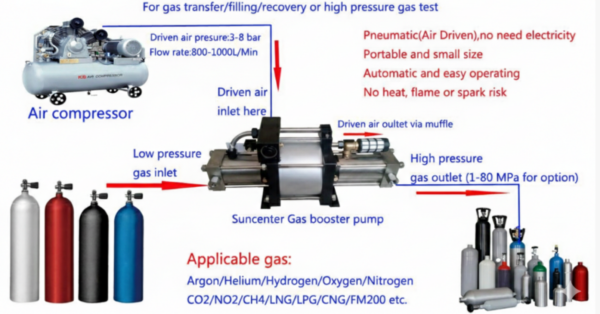
Since the discharge pressure is proportional to the drive air pressure, the outlet pressure can be easily preset by adjusting the drive air pressure. The specific operations are as follows:
- Install a pressure regulator and a pressure gauge on the gas booster pump.
- Adjust the drive air pressure (regular range: 1-8 bar, maximum not allowed to exceed 10 bar) to build a basic gas boosting/conveying system.