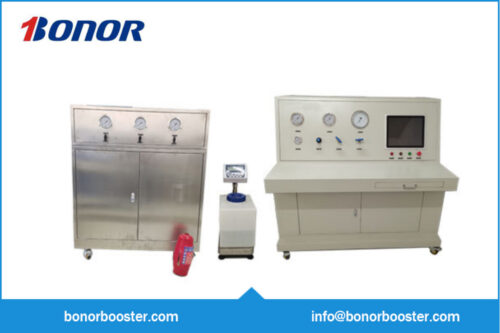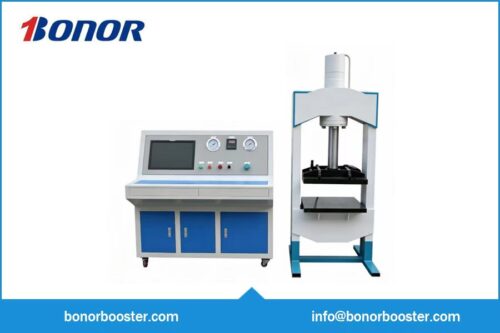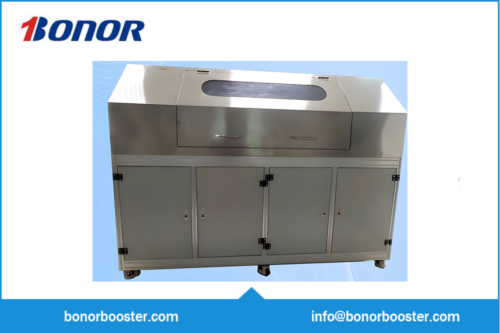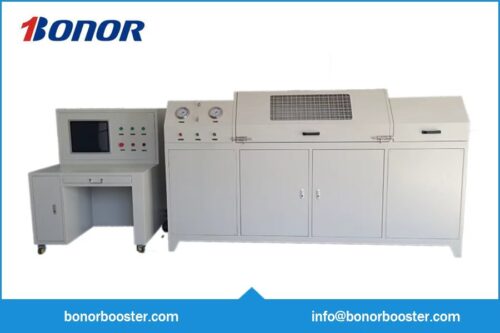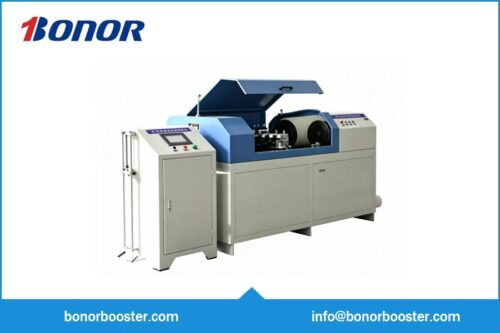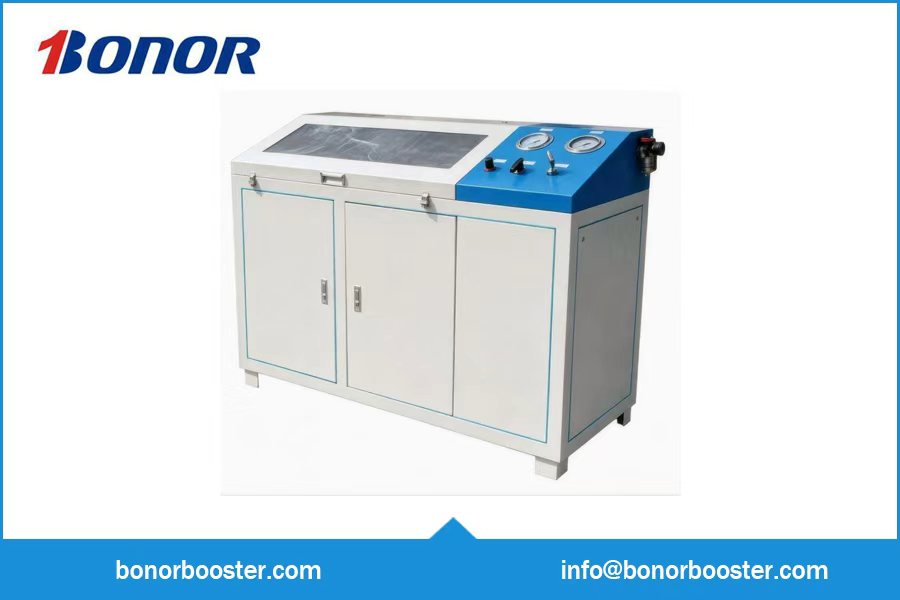
The Water Pressure Sealing and Strength Testing Machine for Sprinkler Heads is built for pressure and burst testing of firefighting equipment. Configured here as test pressure for hydrostatic strength & sealing test: 12MPa. The test sequence is stored as a recipe, so one bench can serve several cylinder sizes and markets.
Description
一、 Application Scope
This tester is specially developed for hydrostatic strength test and sealing performance test of fire sprinkler heads, fully complying with the hydrostatic sealing and strength test requirements specified in standard GB 5135.1. Both automatic control and manual control modes are available for conducting hydrostatic tests on test samples.
二、 Control System
The control system adopts a two-tier hierarchical design:
- Upper control unit: Realizes pressure display and pressure regulation. It supports pressure adjustment, pressure relief, curve plotting and test data storage.
- Lower execution unit: Provides hydraulic boosting power, connects test specimens, and completes water circulation and water storage for testing.
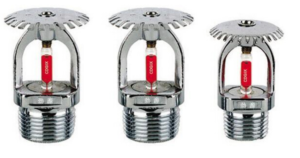
Fire sprinkler heads
三、 Machine Features
- Equipped with Bonor pressure booster pump. The output water pressure can be controlled and adjusted precisely by regulating the driving air pressure.
- Multi-channel simultaneous testing is available to test multiple samples in one run. A built-in water tank is fitted, and test water can flow back to the tank after testing for reuse.
- The pipeline adopts non-welded detachable connection design for easy disassembly and convenient equipment maintenance.
四、Technical Parameters
- Test pressure for hydrostatic strength & sealing test: 12MPa
- Number of test channels: 10 channels (customizable upon request)
- Test medium for hydrostatic test: clean water
- Pressure control mode: manual / automatic optional, stepless adjustable pressure; no energy consumption during pressure holding stage
- Bonor data acquisition software is available as optional accessory according to customer requirements
Applications of the firefighting equipment test bench
The fire protection market is inspected closely, so the test bench has to do two jobs at once: prove the hardware, and produce a certificate that survives an audit. The Water Pressure Sealing and Strength Testing Machine for Sprinkler Heads is specified around both.
- Valve and coupling production — body strength and seat tightness on extinguisher valves and hose couplings.
- Municipal and industrial fire brigades — in-house periodic testing of the equipment they carry.
- Extinguisher refilling and service stations — periodic requalification of cylinders before recharge, with the test date recorded on the unit.
What to specify before we build yours
- Standard and test sequence — EN 3, GB 4351, GB/T 9251 or the local code, including the hold times and the deformation limit.
- Cylinder sizes and volumes — from 1 kg portable bodies to wheeled and fixed units; the jacket and the clamp follow the size range.
- Medium and drying — water is standard, but the bodies must be dried afterwards, so a drying stage is often part of the same cell.
- Certificate format — the fields your inspector expects: serial number, test pressure, hold time, deformation, operator and date.
Currently configured as: Test pressure for hydrostatic strength & sealing test: 12MPa. Other ranges and fixtures are built to order.
How to choose a firefighting equipment test bench
Firefighting testing is a volume business, so cycle time and record quality matter as much as pressure accuracy:
- Count the steps around the test. Filling, venting, drying and marking often take longer than the pressure hold itself. A bench that integrates them changes the throughput of the whole line, not just the test station.
- Confirm the deformation measurement method. Water-jacket and weighing methods are both accepted by different codes; the one your certificate has to show determines the fixture.
- Plan for different cylinder sizes. Interchangeable clamps and jacket inserts are much cheaper than a second bench, but only if they are designed in from the start.
Frequently asked questions
Which standards can the test sequence follow?
The common ones are EN 3 for portable extinguishers, GB 4351 for Chinese-made bodies and GB/T 9251 for hydrostatic test methods, and the bench program is written to whichever of these your market requires. If you export to several markets, the sequence is stored as a recipe and selected per batch.
Does the machine test burst strength as well as proof pressure?
Yes — proof pressure and burst are the same pressure circuit with different set points and different acceptance criteria. A burst test is destructive, so it is normally run on samples rather than on every unit.
How long does one complete test cycle take?
A single-body proof test including fill, hold, drain and record typically takes a few minutes; the exact figure depends on body volume, fill rate and the hold time your standard requires. We quote cycle time for your specific body size rather than an average.
Related equipment and further reading
- Fire Extinguisher Cylinder Hydrostatic Pressure Testing Machine
- Fire Hose Hydraulic Pressure and Wear Resistance Tester
- Fire Hose Testing Machine
- All Firefighting Testing Equipment models and specifications
- Hydrostatic pressure test machine import guide for eu buyers 2026
- Which hydrostatic pressure test machine certificates clear eu customs
Need a pressure range, fixture or test standard that is not listed here? Send the specimen list and the standard you test to and we will come back with a configuration and a price within one working day.