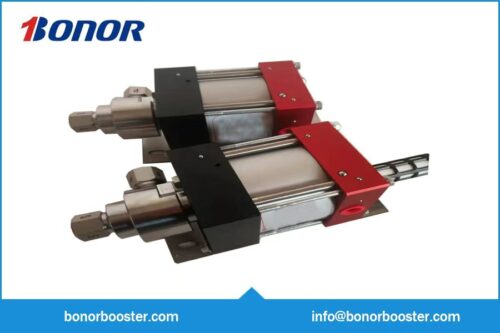
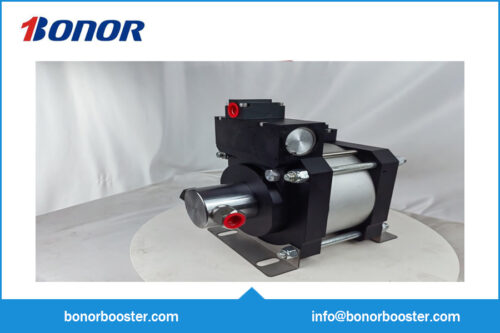
Ⅰ. Core Working Principle
Liquid gases are prone to vaporization during storage and transportation due to temperature or pressure changes. The LPG booster pump maintains the medium in a liquid state through pressurization, preventing unnecessary gas-liquid phase transition, thus enabling the transfer and filling of liquid gases.
Powered by compressed air, it is suitable for the transfer, filling and recovery of carbon dioxide, nitrous oxide, liquefied petroleum gas (LPG), butane, propane, dimethyl ether (DME), freon, refrigerants, and clean gases including FM-200, HFC-227e and NOVEC 1230.
The pump’s discharge pressure is proportional to the driving air pressure. You can preset and adjust the discharge pressure by controlling the driving air pressure. A basic liquid gas transfer and filling loop can be set up simply by installing an air regulator and an outlet pressure gauge on the pump.
II.LPG Booster Pump – Core Features & Application Scenarios
I. Core Features
1.Compressed air driven; no electricity required, compatible with regular air compressors
2.Driving air pressure ≤ 8MPa to extend service life
3.No aviation lubricator needed; easy to install and maintain
4.Multiple boost ratios available for different pressure requirements
5.Built-in cooling function for most models ensures stable operation
6.Cost-effective & explosion-proof (no heat, open flame or spark risk)
7.Automatic pressure maintenance; starts up automatically to compensate pressure drop
8.Suitable for various gases including N₂O, CO₂, NOVEC and refrigerants
9.Applicable for transfer, filling & recovery of liquefied gas cylinders, CO₂ fire extinguisher filling and supercritical CO₂ extraction
II. Application Scenarios
Pressure supplementation to prevent vaporization of liquefied gases during transportation
Liquefied gas filling for media like LPG, butane, propane, DME and liquid CO₂
Refilling of FM-200 and NOVEC 1230 clean fire extinguishing agents for fire protection systems
Filling liquid CO₂ into fire extinguishers
Recovery of residual liquid and vapor from large storage tanks
III. Operating Instructions
1.Check Conections:Ensure the pipeline connections between the air compressor, air regulator and liquefied gas pump are secure and free of leaks.
2.Start the Compressor:Turn on the air compressor to generate drive air and deliver it to the air regulator.
3.Adjust Drive Air Pressure:Rotate the adjustment knob of the air regulator, and set the corresponding drive air pressure according to the formula: Discharge pressure = Drive air pressure × Boost ratio.
4.Confirm Pressure:Monitor the pressure gauge equipped with the liquefied gas pump. Once the displayed value stabilizes at the target discharge pressure, the equipment can operate normally.