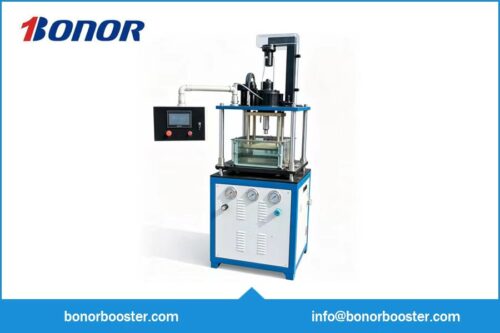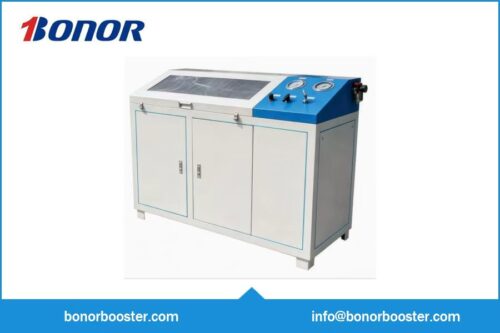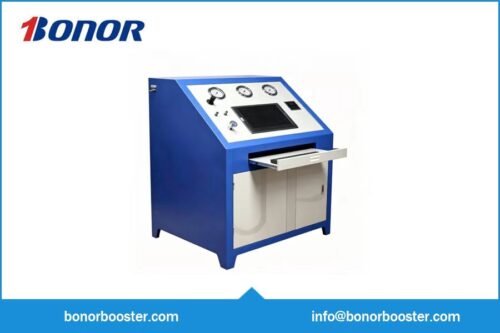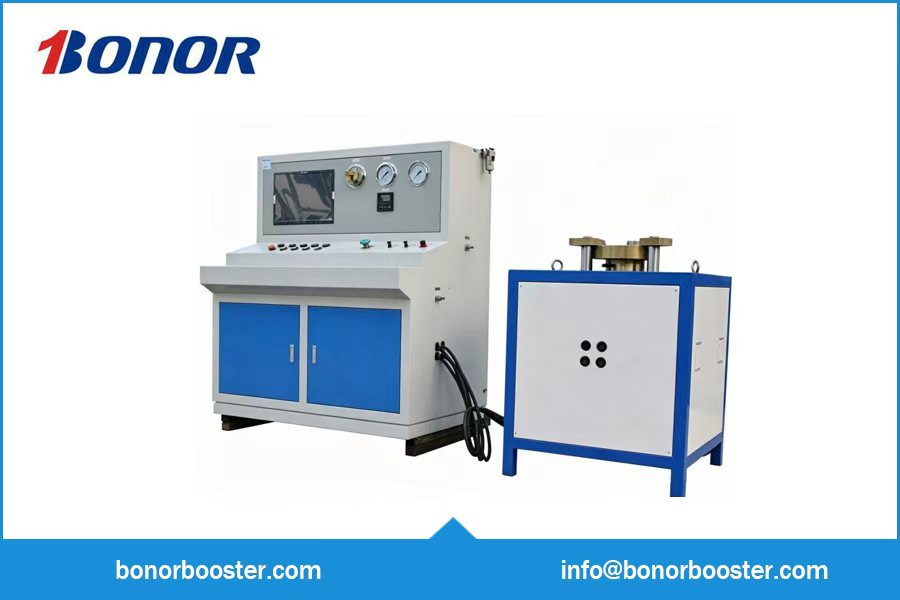
The Breathing Valve Airtightness Test Bench is built for pressure-decay and flow leak detection. The sensor is sized against the leak rate you need to resolve, not against the pressure rating.
Description
一、Application Scope
Bonor breather valve air tightness test bench is designed for sealing test of various breather valves. Equipped with an automatic control system, it displays real-time pressure & time curves and supports test report printing. It is widely adopted for factory inspection of breather valves and routine maintenance tests by end users. The pressure is stepless adjustable, and technical parameters including holding pressure and dwell time can be customized. During testing, compressed gas with set pressure is filled into the valve cavity. The air tightness is evaluated by monitoring pressure variation. Rapid pressure drop will be identified as unqualified leakage.
Typical Applications
- Sealing test for screwed type breather valves
- Sealing test for packed type breather valves
- Factory inspection & sealing test for self-sealing breather valves
- Sealing test for lamp type breather valves
Introduction of Breather Valve
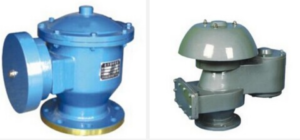
Composed of pressure valve and vacuum valve, breather valves are mounted on vent pipes of cargo oil tanks. They open and close automatically responding to positive and negative pressure inside tanks, keeping the differential pressure between tank interior and atmosphere within permissible limits.
二、Product Features
- Optional automatic clamping structure for automatic sealing compression.
- Adopt Bonor liquid booster pump as stable pressure source.
- Weld-free pipeline layout for easy disassembly, high safety and convenient maintenance.
- Stepless pressure output to meet test requirements of breather valves with different pressure ratings.
- Supported by Bonor data acquisition software; test data is auto-saved and printable.
三、 Control Modes
Two control modes are available: automatic control mode and manual control mode for flexible operation.
四、Technical Parameters of Breather Valve Air Tightness Test Bench
- Test medium: Air, Nitrogen
- Ambient test temperature: -20℃ ~ 60℃
- Test accuracy: 0.1 kPa
- Test temperature for specimens: Ambient temperature; high-temperature testing is available upon customized requirement
- Test pressure range Relief pressure (outlet): 0 ~ 10 kPa Inhalation pressure (vacuum): -10 kPa ~ 0 kPa
- Applicable valve size: Breather valves from DN50 to DN350
- Test channel: 1 test channel for sample testing
- Power supply: 380V, 50Hz
- Test curve: Real-time curve display via control software, with zoom in & zoom out functions
- Test report: Automatic report printing function for burst pressure tests
Applications of the air tightness test bench
A leak test is only useful if it can resolve the leak rate that actually matters — and that rate is often tiny. The Breathing Valve Airtightness Test Bench measures pressure decay, flow or tracer gas with enough resolution to separate a good part from a marginal one, and does it in cycle times that fit a production line.
- Automotive components — fuel systems, EV battery housings, lamps and connectors tested for ingress protection.
- Vehicle assembly — whole-vehicle air tightness verification for NVH, water ingress and HVAC performance.
- Cylinder and vessel production — leak verification after valve fitting, before filling or dispatch.
What to specify before we build yours
- Leak rate to be detected — expressed in ml/min, Pa/s or ppm; this single number decides the method, the sensor and the chamber.
- Test pressure and part volume — decay time scales with volume, so a large part at low pressure needs a different approach from a small part at high pressure.
- Method — pressure decay, differential pressure, mass flow or helium; each has a different sensitivity and cost.
- Automation level — manual clamp-and-press, semi-automatic with a fixture, or a station integrated into a conveyor line.
How to choose a air tightness test bench
Most leak-test problems come from the specification, not the instrument. These three questions decide the machine:
- Start from the allowable leak rate. Convert it into a pressure-decay value for your part volume, then check that the sensor can resolve one tenth of it. If it cannot, no amount of averaging will fix the measurement.
- Control the temperature and the fixture. Air expands when it warms, so a part that is still hot from brazing will show a pressure rise that looks like a leak. A stabilisation time and a temperature-compensated sensor are worth more than a faster valve.
- Decide pass/fail limits before delivery. Run known-good and known-bad samples during commissioning and store the limits in the recipe, otherwise the operator will adjust them by feel on the first difficult batch.
Frequently asked questions
What leak rate can the machine detect?
It depends on part volume and method. Pressure-decay instruments typically resolve a pressure change equivalent to a few tenths of a millilitre per minute on a small part; helium systems reach far lower rates but need tracer gas and a vacuum chamber. We size the sensor against the rate you need to detect.
Pressure decay or helium — which do I need?
Pressure decay is cheaper, needs only compressed air and is enough for most industrial parts. Helium is chosen when the allowable leak is very small, the part is flexible, or the test must be done at low differential pressure.
Can it run inside an automated line?
Yes. The bench can be supplied with pneumatic clamping, a PLC interface and digital I/O so a robot or conveyor can load and unload it. The test recipe and the result are passed over the same interface.
Related equipment and further reading
- Battery Air tightness Tester
- High Pressure Air Tightness Test Bench
- Tubing and Casing Thread Helium Seal Test Bench
- All Air Tightness Testing Machine models and specifications
- Hydrostatic pressure test machine selection guide from spec to sign off
- The complete hydrostatic pressure test machine spare parts guide 2026
Need a pressure range, fixture or test standard that is not listed here? Send the specimen list and the standard you test to and we will come back with a configuration and a price within one working day.