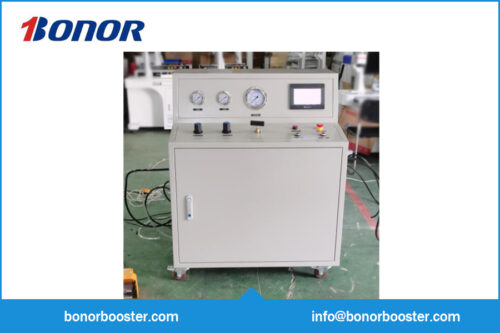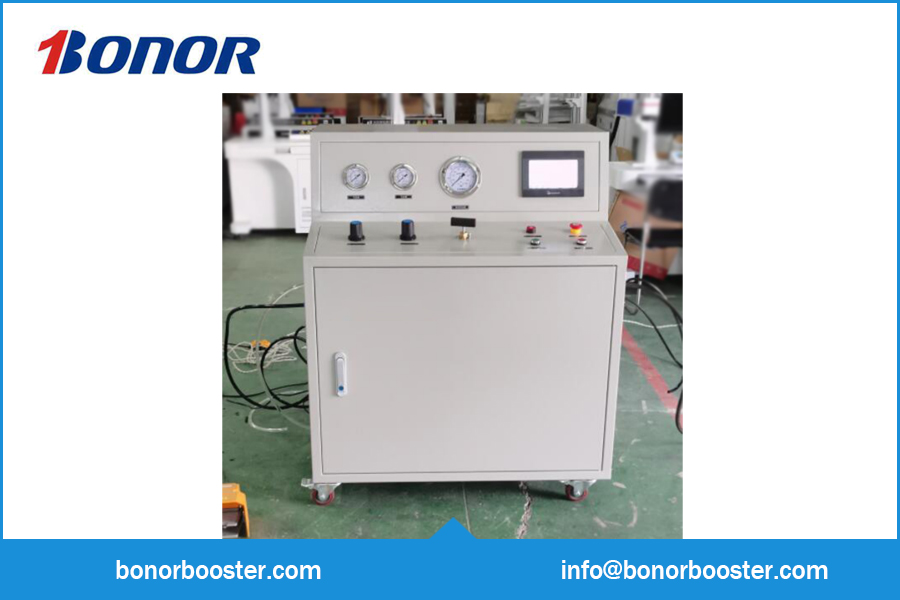
The Hydraulic Tube Expander For Heat Exchanger is built for controlled hydraulic tube expansion. Expansion is controlled to a set torque, pressure or dimension, so every joint in the bundle matches.
Description
The hydraulic tube expansion system is a specialized equipment for the manufacture and maintenance of boilers, heat exchangers, etc. It can reliably expand heat exchange tubes of various specifications and materials, and is especially suitable for thick tube sheets and large-diameter tube heat exchangers.
Heat exchangers produced by this rapid expansion technology have the advantages of uniform expansion, safety and reliability, long service life and low failure rate. Moreover, it features simple operation and fast expansion speed, which can greatly shorten the manufacturing and maintenance cycles, reduce the shutdown loss of chemical plants, and achieve significant economic benefits.
Heat Exchanger Hydraulic Tube Expansion Machine Technical Parameters
Rated Expansion Pressure: 3000 bar
Maximum Expansion Pressure: 3500 bar
Expansion Speed: 5-10 times/min
Working Medium: Pure water
High-pressure pipe burst pressure: 280/700 MPa
Minimum Expansion Hole Diameter: >10 mm
Driving Air Source: 280/700 MPa
Hydraulic Tube Expander Operating Principle
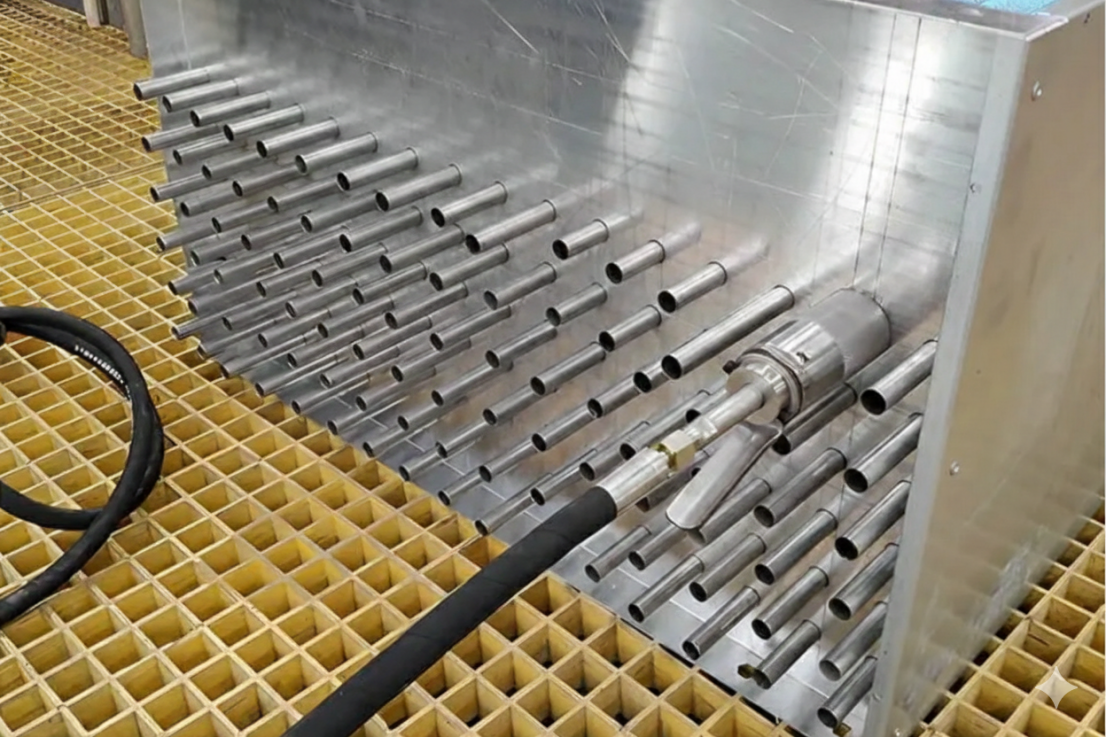
The High-Pressure Hydraulic Tube Expander, is an innovative machine that differs from traditional mechanical tube expanders. It uses water or hydraulic oil as the working medium and hydraulic power for tube expansion. The machine applies uniform hydraulic pressure to the inner surface of the tube, causing plastic deformation to achieve secure connections between the tube and fins, as well as the tube and tube sheet. This expansion process is also referred to as flexible tube expansion.
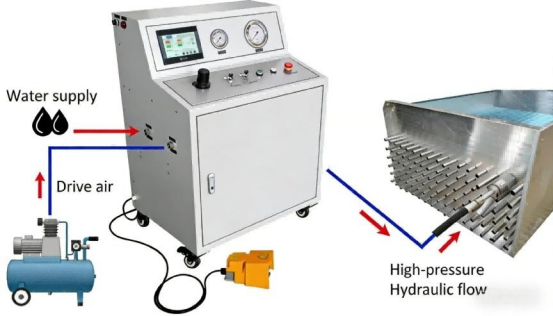
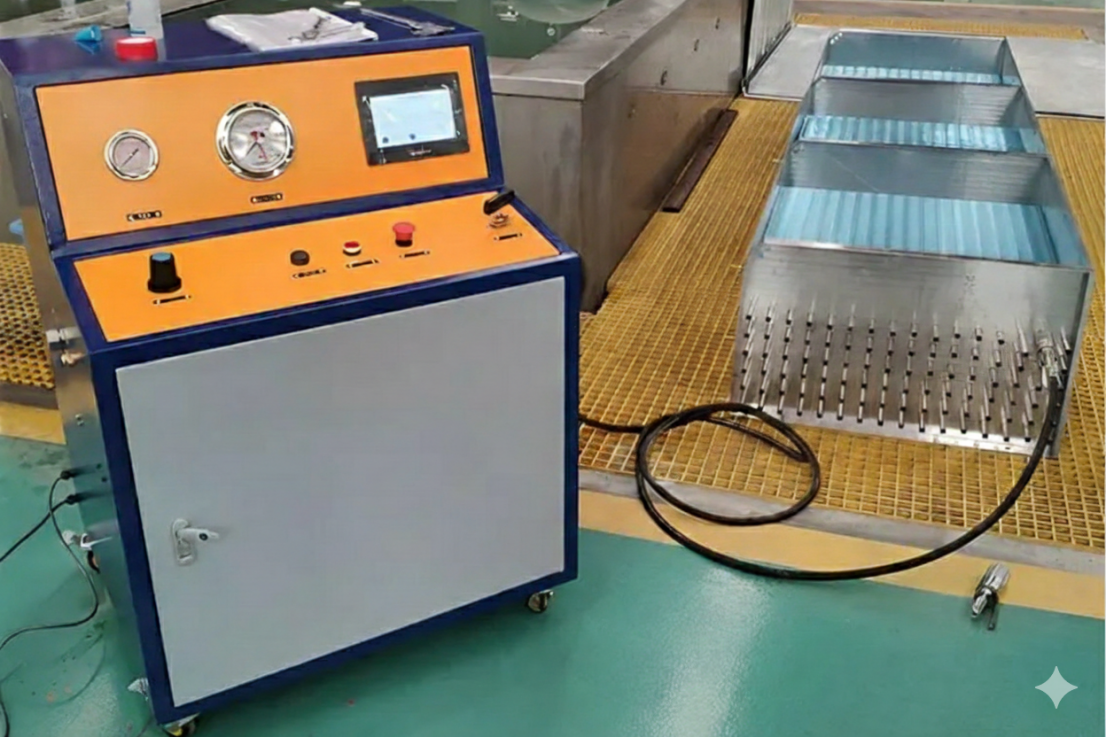
The High-Pressure Tube Expanding Machine uses compressed air as its power source and consists of two main components: a hydraulic power console and collet tooling. First, two collets are used to securely block and seal both ends of the tube to be expanded. The machine then generates high-pressure hydraulic flow, which is injected into the tube, completing the tube-to-fins expansion joint. Simply set parameters such as expansion pressure and duration on the touchscreen, and the entire expansion process will be automatically carried out by the PLC module.
 |
 |
Product Features of Hydraulic Tube Expander
- Adjustable Pressure-Holding Time: Set the duration as needed to ensure expansion quality; fast pressure boosting and releasing double the expansion efficiency.
- Full-Thickness One-Time Expansion: 25-150mm thick tube sheets can be uniformly expanded in one operation without multiple steps.
- Multi-Scenario Adaptability: Suitable for full-thickness expansion of intermediate tube sheets with any depth and multi-tube-sheet heat exchangers, boasting wide applicability.
- Low Residual Stress: Effectively reduces the risk of crevice corrosion and improves equipment operation stability.
- No Axial Elongation: Only slight contraction occurs, helping reduce equipment operation noise.
- Clean and Pollution-Free: Supports weld-before-expansion process, and the expansion effect is not affected by welding.
- Easy Operation: The edge of heat exchangers with channel boxes can be directly expanded, eliminating additional procedures.
- High Efficiency and Labor-Saving: Single-person continuous operation, expanding 5-7 tube heads per minute, with remarkable economic benefits
.
Applicable Scenarios of Hydraulic Tube Expander
Power plant feedwater heaters, natural gas plant tubular reactors, petrochemical plant heat exchangers, etc.
Applications of the hydraulic tube expander
An under-expanded joint leaks in service; an over-expanded one cracks the tube or damages the ligament. The Hydraulic Tube Expander For Heat Exchanger keeps the expansion inside that window, repeatably, across a whole tube sheet.
- Pressure vessel fabrication — expanding tubes in fire-tube boilers and waste-heat units.
- Boiler and condenser re-tubing — replacing tubes on site or in the workshop with a controlled expansion.
- Chiller and evaporator assembly — tube-to-tubesheet joints in copper and stainless bundles.
What to specify before we build yours
- Tube material, diameter and wall thickness — copper, stainless, titanium and duplex each expand differently.
- Tube sheet thickness and hole tolerance — determines the expansion length and the torque or pressure required.
- Expansion control method — torque control, pressure control or dimensional control by gauge.
- Access and drive — hand-held, pneumatic or hydraulic drive, depending on tube length and site access.
How to choose a hydraulic tube expander
The expansion method matters more than the machine size, because it decides whether the joint is measurable:
- Decide how expansion is controlled. Torque control is simple and fast but indirect; pressure control is more repeatable; dimensional control measures the actual expansion. For critical bundles the third method is the only one that proves the result.
- Check the tube material before the tool. Stainless and titanium work-harden and need a different roller or a different expansion strategy from copper. A tool set up for copper will crack a titanium tube.
- Plan the trial. Every new tube sheet should start with a trial expansion and a pull-out or hardness check, and the machine settings recorded. That record is what makes the production joints defensible.
Frequently asked questions
What tube sizes can the machine expand?
Typical ranges run from about 6 mm to 60 mm outside diameter, with larger sizes available with a different tool head. The limit is the tool and the access space rather than the hydraulic unit.
Does it control expansion automatically?
Yes — the hydraulic unit controls either torque or pressure to a set point, and stops when it is reached, so each joint receives the same expansion regardless of the operator. Dimensional control is available as an option.
Can it work with both copper and steel tubes?
Yes, but with different tools and settings. Copper expands easily and work-hardens less; steel and stainless need higher force and a different roller geometry. The material is specified at the order stage.
Related equipment and further reading
- Hydraulic Tube Expander For Radiators
- All Hydraulic Tube Expansion Machine models and specifications
- Hydrostatic pressure test machine selection guide from spec to sign off
- The complete hydrostatic pressure test machine spare parts guide 2026
Need a pressure range, fixture or test standard that is not listed here? Send the specimen list and the standard you test to and we will come back with a configuration and a price within one working day.