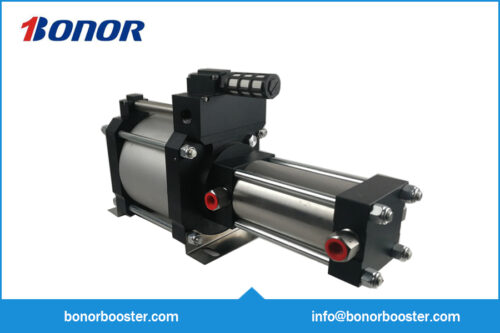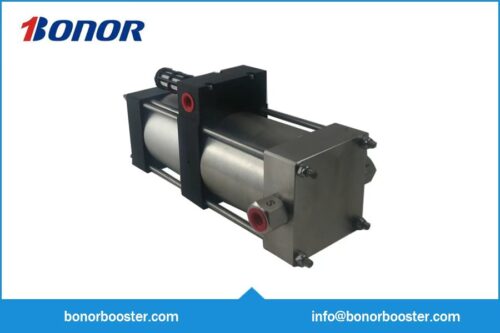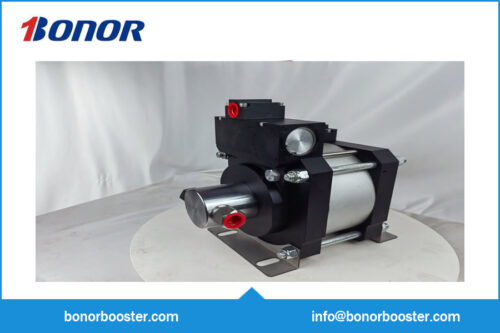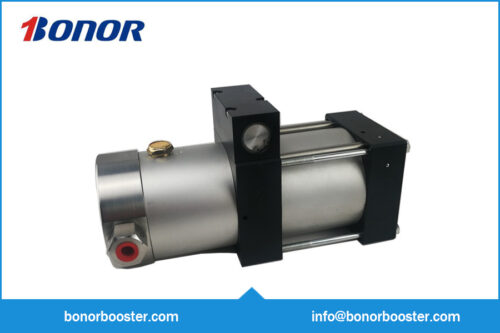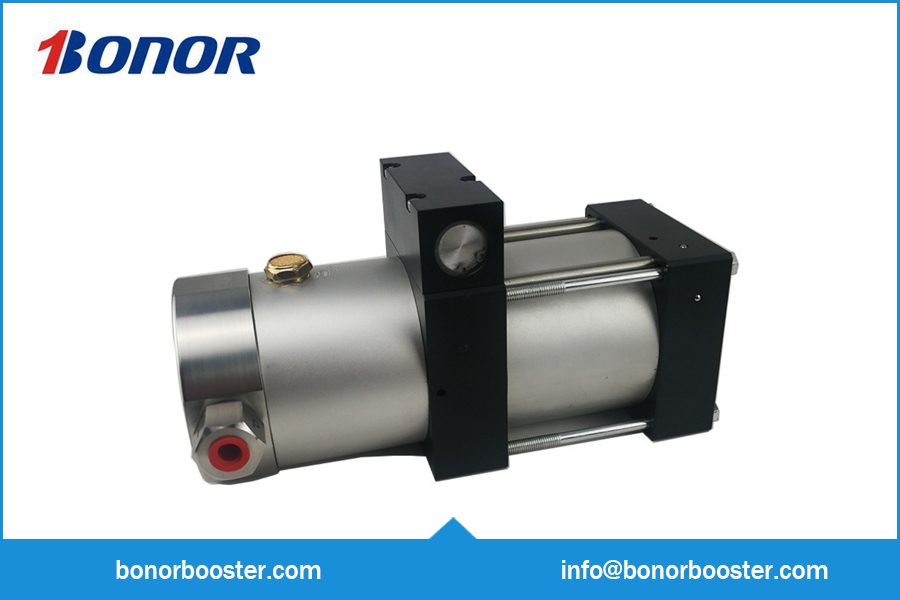
The Oxygen Booster Pump A16MS-25 / -32 is built for oil-free high-pressure gas boosting. Configured here as drive air pressure range: 1-10 bar. Seals and cleaning are specified for the gas, including oxygen-clean and oil-free builds.
Description
General Parameters
- Drive air pressure range: 1-10 bar
- Air consumption displacement: 452 cm³ (Volume of drive gas consumed per stroke)
- Weight: 6 kg (Meets the design positioning of “lightweight and portable”)
- Outlet pressure calculation: PB=PL×Boost Ratio (Outlet Pressure = Drive Air Pressure × Boost Ratio)
Specific Model Parameters
| Model | Boost Ratio | Boost Displacement (Volume of medium boosted per stroke) |
| A16MS-25 | 1:25 | 9 cm³ |
| A16MS-32 | 1:32 | 6.9 cm³ |
V. Customization Service for Special Gases
The high-pressure gas booster pump can safely boost most industrial gases. However, special gases require modification or remanufacturing according to medium characteristics. Common modification measures include:
- Replacing seals and contact part materials that match the gas medium
- Adopting oil-free compression process
- Degreasing all components
Common Non-Standard Customization Types: Oxygen booster pump, carbon dioxide booster pump, hydrogen booster pump, natural gas booster pump, ozone booster pump, etc.
We provide a variety of standard gas booster pump models to meet different pressure and flow requirements. For special gas medium needs, please contact us for non-standard customization.
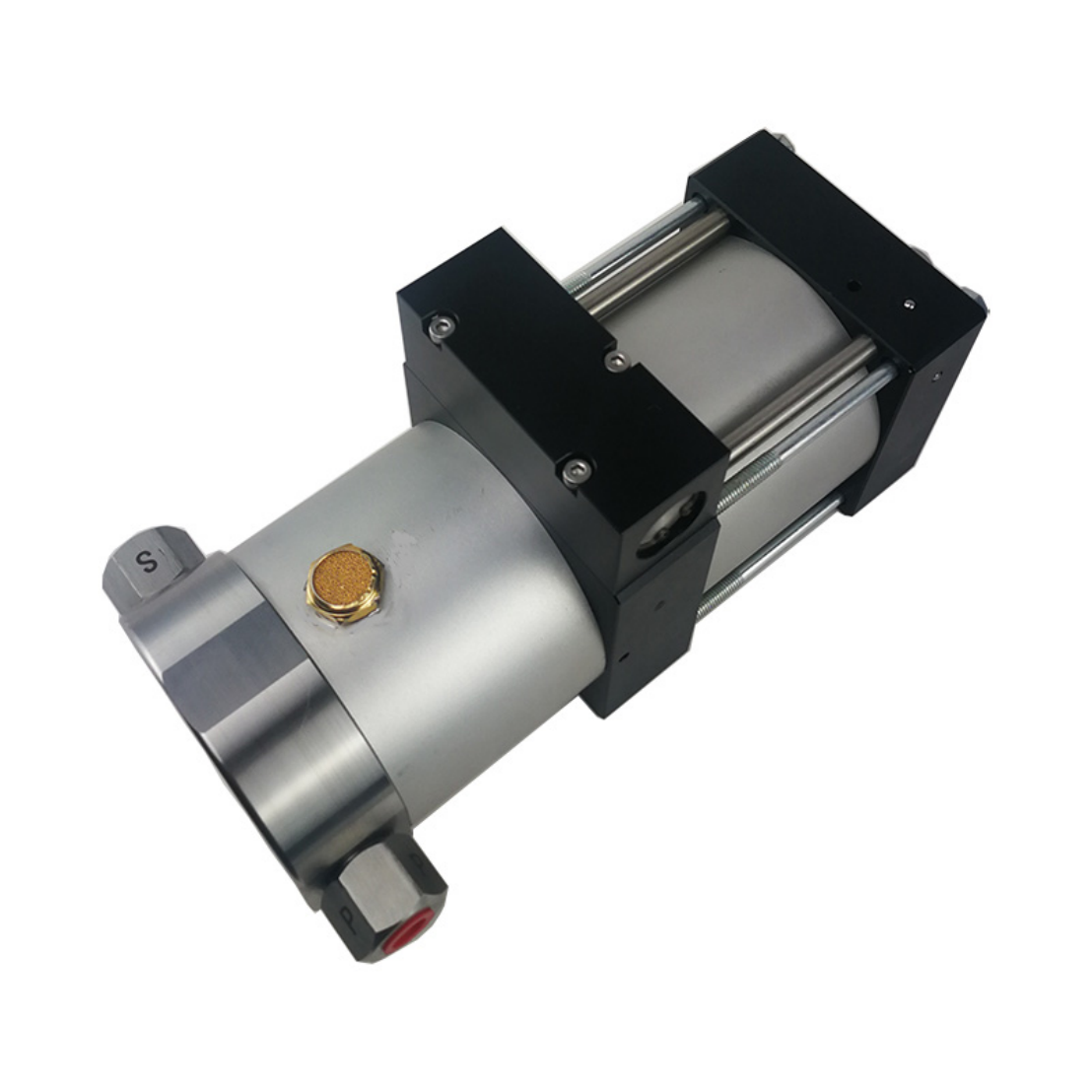
Applications of the gas booster pump
When a process needs nitrogen at 200 bar, oxygen at 150 bar or hydrogen at 100 bar, a gas booster pump is what gets it there from a standard cylinder supply. The Oxygen Booster Pump A16MS-25 / -32 is an air-driven reciprocating unit: no electricity at the pump, no contamination from a motor, and a stall-and-hold behaviour that suits pressure-holding duty.
- Pharmaceutical and chemical — helium or nitrogen pressurisation of reactors and transfer lines.
- Cylinder filling and transfer — topping up receivers from a lower-pressure supply, or moving gas between bundles.
- Laser cutting and welding — boosting nitrogen or oxygen to the pressure the nozzle needs.
What to specify before we build yours
- Gas and its purity requirement — oxygen-clean, oil-free or standard; the seals and the cleaning procedure change with the gas.
- Inlet and outlet pressure — the ratio is selected from these two, not from the outlet alone.
- Flow at outlet pressure — determines the displacement per stroke and the number of heads.
- Safety configuration — relief valve, burst disc, vent routing and, for hydrogen, material and permeation review.
Currently configured as: Drive air pressure range: 1-10 bar. Other ranges and fixtures are built to order.
How to choose a gas booster pump
Gas boosters are selected on three numbers and one safety question:
- Fix the gas first. Oxygen excludes any oil-wetted part; hydrogen changes the material and venting requirements; corrosive gases change the seals. Quoting a pump before the gas is known is how projects end up with a unit that cannot be certified.
- Size for flow at pressure. A booster that reaches 300 bar with no flow is not useful for filling. Ask for the displacement per stroke and the cycle rate at the outlet pressure you need.
- Decide the number of stages. Single-stage is simpler; two-stage reaches higher pressure with a lower ratio per stage and less heat. The choice is driven by the inlet pressure you actually have.
Frequently asked questions
Which gases is the pump compatible with?
Inert gases such as nitrogen, argon and helium are standard. Oxygen needs an oxygen-clean, oil-free build. Hydrogen is possible with a design review of materials and venting. Corrosive or toxic gases need a specific seal and containment review before quotation.
What boost ratios are available?
Ratios from about 1:2 up to 1:60 are common, with multi-stage arrangements reaching higher pressures. The ratio is chosen from the inlet and outlet pressures you specify, and the actual outlet is always lower than the theoretical product because of friction and seal drag.
Can it be supplied as an explosion-proof unit?
The pump itself is air-driven, so there is no electrical component at the pump. The controls, sensors and solenoid valves can be supplied in an explosion-proof enclosure when the installation area requires it.
Related equipment and further reading
- Single-Drive Single-Acting Gas Booster Pump A32Q
- A16 Series gas Booster Pump
- A16MS-01 Negative Pressure Sampling Pump
- All Gas Booster Pump models and specifications
- Key features of gas booster pumps
- Applications of gas booster pumps
Need a pressure range, fixture or test standard that is not listed here? Send the specimen list and the standard you test to and we will come back with a configuration and a price within one working day.