Description
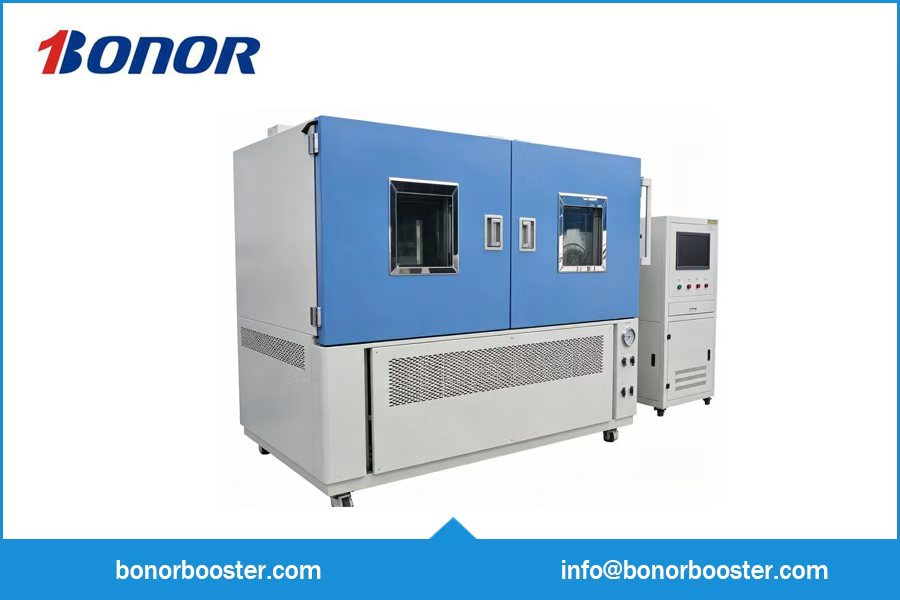
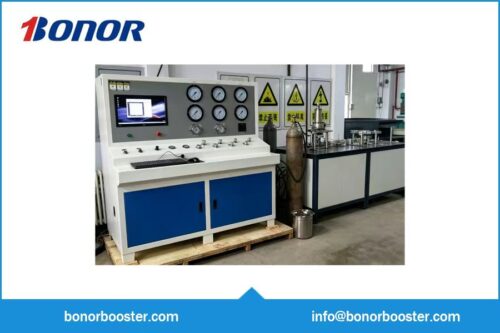
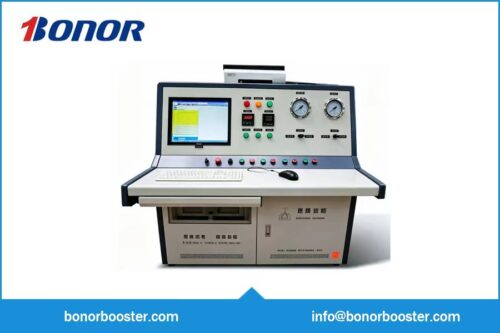
A Valve Life Testing Machine is a computer-controlled test system used to simulate repeated opening and closing cycles on valves under operating pressure and temperature, verifying seal integrity and mechanical endurance before a valve enters service. Bonor’s systems cover liquid pressures from 0 to 800 MPa and gas pressures from 0 to 210 MPa, with control accuracy of ±0.05 MPa and sensor accuracy of 0.5% FS. These machines generate automated pressure curves and test reports, certified under ISO 9001:2015.
Valve Seat Leakage and Certification Failure Risks
- Leakage past the seat:A valve that passes a hydrostatic shell test can still fail a seat leakage test after 500 cycles. The result is a rejected batch and a missed delivery window.
- Unverified cycle life:API 6D and ISO 5208 require evidence of cycle endurance. Without a documented cycle history, your valve cannot be certified for pipeline service.
- Data disputes:When a customer rejects a valve based on field leakage, you need recorded torque, pressure, and temperature data from every cycle to prove compliance. Without it, the dispute is yours to absorb.
If any of these sound familiar, a Valve Life Testing Machine was engineered to solve exactly these problems.
Core Differentiation and Industry Comparison
| Dimension |
This product |
Industry conventional |
Differential value |
| Max liquid pressure |
800 MPa |
100–150 MPa typical |
5x higher test envelope — covers deep-sea and hydrogen-rated valves |
| Max gas pressure |
210 MPa |
35–70 MPa typical |
3x higher — enables hydrogen and CNG valve certification |
| Control accuracy |
±0.05 MPa |
±0.5 MPa typical |
10x tighter — detects seat wear that standard systems miss |
| Data acquisition |
0.5% FS, automated curve + report |
Manual logging or basic HMI |
Eliminates data disputes — every cycle traceable |
| Software |
Self-developed C#/LabVIEW |
Third-party licensed package |
Custom report formats, no per-seat license fees |
| 5-year TCO |
Lower — no software licensing, lower rework |
Higher — license renewals + rejected batch losses |
~30% lower total lifecycle cost |
Manufacturing Process
- Raw material inspection and frame assembly — spectrometer-verified components per GB/T 12241, then CNC machining of manifold blocks on our in-house lathes and milling machines.
- Pressure system integration — air-driven liquid booster pumps (own brand) connected to high-pressure tubing with ultra-high-pressure hard-seal taper connections rated to 800 MPa.
- Control system assembly — self-developed data acquisition hardware and PID control loops; calibration against a deadweight tester traceable to national standards.
- Software configuration — C#/LabVIEW test sequences programmed to your valve’s cycle profile, torque, and pressure setpoints.
- Factory acceptance test — 48-hour continuous cycle run with a reference valve, full report generated, then third-party inspection available (SGS/TÜV/BV).
Core Components
- Pressure transducer: accuracy 0.5% FS ,selected for long-term drift stability
- High-pressure valve: FITOK (USA) ,rated for 800 MPa, zero-leak hard seal
- Booster pump: Bonor self-developed air-driven pump ,up to 800 MPa liquid ,no electric motor — intrinsically safe
- Data acquisition card: 16-bit, 1 kHz sampling ,synchronized with pressure and cycle counter
Quality Inspection
- Incoming inspection of pressure transducers and valves → calibration per ISO 3766 → acceptance criteria: ±0.5% FS deviation
- In-process inspection of manifold welds → dye penetrant testing per ISO 3452 → acceptance criteria: zero indications
- Assembly pressure test → hydrostatic test at 1.5x rated pressure for 30 minutes → acceptance criteria: zero leakage
- 100% function test → 500 cycle run on reference valve → acceptance criteria: zero seat leakage after test
Technical Specifications
| Category |
Parameter |
Value |
Standard |
| Pressure Range |
Liquid pressure |
0–800 MPa |
Custom |
| Gas pressure |
0–210 MPa |
Custom |
| Accuracy |
Control accuracy |
±0.05 MPa |
GB/T 9251 |
| Sensor accuracy |
0.5% FS |
ISO 3766 |
| Data |
Sampling rate |
1 kHz |
Custom |
| Report output |
Automated curve + PDF |
Custom |
| Capacity |
Test stations |
1–4 stations |
Custom |
| Environment |
Power supply |
220V/50Hz |
Custom |
| Air supply |
0.6–0.8 MPa |
Custom |
Customization Capability
- Pressure range: 0–70 MPa to 0–800 MPa liquid, 0–210 MPa gas
- Test medium: water, oil, nitrogen, hydrogen, natural gas, methane
- Station count: single station to multi-station carousel for batch testing
- Report format: custom templates matched to your certification body’s requirements
- Connection type: quick-connect, flange, or threaded per your valve size
Customization Process
- Requirement confirmation — your valve spec, cycle profile, and certification target are documented in a technical questionnaire.
- Solution design — our C#/LabVIEW engineers configure the test sequence and report template.
- Prototype — a single-station unit is built and cycle-tested with your reference valve.
- Mass production — multi-station system assembly and calibration.
- QC & delivery — 48-hour FAT run, full report, then crated for export.
Applications and Industry Fit
| Industry |
Typical Application |
Recommended Spec |
Operating Environment |
| Oil & gas |
Valve seat leakage test per API 6D |
0–180 MPa liquid |
Offshore platform, 50°C, salt spray |
| Hydrogen energy |
Hydrogen valve cycle endurance |
0–210 MPa gas |
Dry, high-purity hydrogen |
| Aerospace |
Hydraulic valve verification |
0–800 MPa liquid |
Cleanroom, mineral oil medium |
| Fire protection |
CO₂ and IG-541 valve certification |
0–45 MPa |
Dry gas, 20°C |
Customer Cases and Quantified Results
- Chinese Academy of Sciences, Institute of Acoustics China · 0–80 MPa custom deep-sea chamber test system · 6 months in service · passed deep-sea housing seal certification on the first attempt, eliminating a 2-month retest cycle.
- Sinopec Shengli Oilfield China · 0–180 MPa offshore platform water pressure console · 3 years in service · valves pass seat leakage tests at 180 MPa with zero recorded leakage; test reports accepted by platform certifiers without re-inspection.
- Guangzhou Boiler and Pressure Vessel Institute China · 0–35 MPa pressure vessel console · 2 years in service · ±0.05 MPa control accuracy enabled hydrostatic burst tests that previously failed due to pressure overshoot; throughput up 40%.
- Bayannur Special Gas Cylinder Station China · 0–45 MPa dual-station external-measurement water jacket tester · 1 year in service · single-cylinder test time cut from 15 minutes to 4 minutes including a 2-minute hold, with automated volume deformation and residual deformation calculation.
Common Questions
Q1: How does the Valve Life Testing Machine prevent pressure overshoot during cycle testing?
A: The control loop samples pressure at 1 kHz, and the PID controller adjusts the booster pump inlet air pressure in real time. The control accuracy is ±0.05 MPa, verified with a deadweight tester traceable to national standards per GB/T 9251. This means the pressure at each cycle point is held within 0.05 MPa of the setpoint — no overshoot, no false failures.
Q2: Can this system test gas valves with hydrogen or natural gas?
A: Yes. The gas pressure range extends to 210 MPa, and the booster pumps handle nitrogen, hydrogen, natural gas, methane, air, and argon. All gas-contacting components are selected for the specific medium — for hydrogen, seals and materials are chosen per ISO 11114 to prevent embrittlement. A ventilation and leak detection interlock is standard on gas configurations.
Q3: What certification standards does this product support?
A: The control system and software are designed to generate reports that comply with GB/T 9251-2022 (gas cylinder hydrostatic test), GB 24161-2009 (breathing apparatus cylinder periodic inspection), TSG ZF001 (safety valve calibration), and API 527 (seat leakage). The machine itself is manufactured under ISO 9001:2015, and third-party inspection by SGS, TÜV, or BV is available on request.
Q4: How long does a typical custom Valve Life Testing Machine take to deliver?
A: Standard configurations ship in 30 days. Custom systems with a unique pressure range or multi-station setups typically take 45–60 days, depending on the complexity of the test sequence and report format. If your project has a hard deadline for certification or line acceptance, we prioritize the build and confirm a delivery date in writing before production starts.
Q5: What is the warranty and after-sales support?
A: The system carries a 12-month warranty from the shipment date. Technical support responds within 24 hours by email or WhatsApp, and on-site service is available within 48 hours in China. The self-developed software is updated at no charge, and the calibration service is offered annually to maintain the ±0.05 MPa accuracy claim.
Key Takeaways
- Liquid pressure coverage to 800 MPa — 5x the conventional range
- Gas pressure coverage to 210 MPa — hydrogen and CNG valve testing enabled
- Control accuracy ±0.05 MPa, sensor accuracy 0.5% FS (per ISO 3766)
- Self-developed C#/LabVIEW software — automated reports, no license fees
- 500+ projects delivered since 2008, ISO 9001:2015 certified
After-Sales Service
- Warranty: 12 months from shipment date
- Technical response: within 24 hours
- On-site service: within 48 hours (domestic)
- Support channels: WhatsApp / Email / Online chat / Phone
Logistics & Delivery
- Annual capacity: 3,000 m² facility with in-house CNC machining — capable of running concurrent custom builds
- Standard lead time: 30 days; expedited lead time: 21 days
- Packaging: export-grade wooden crate, pressure lines capped and sealed
- Sample policy: reference valve testing available at our facility, 7–10 days scheduling