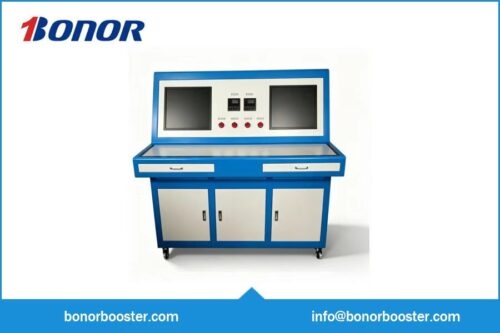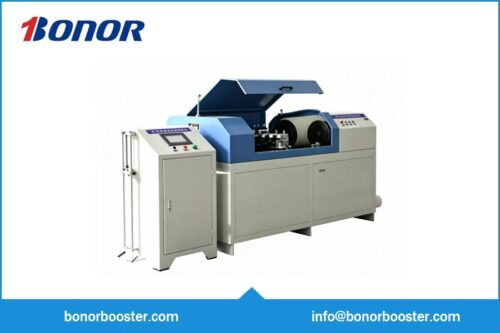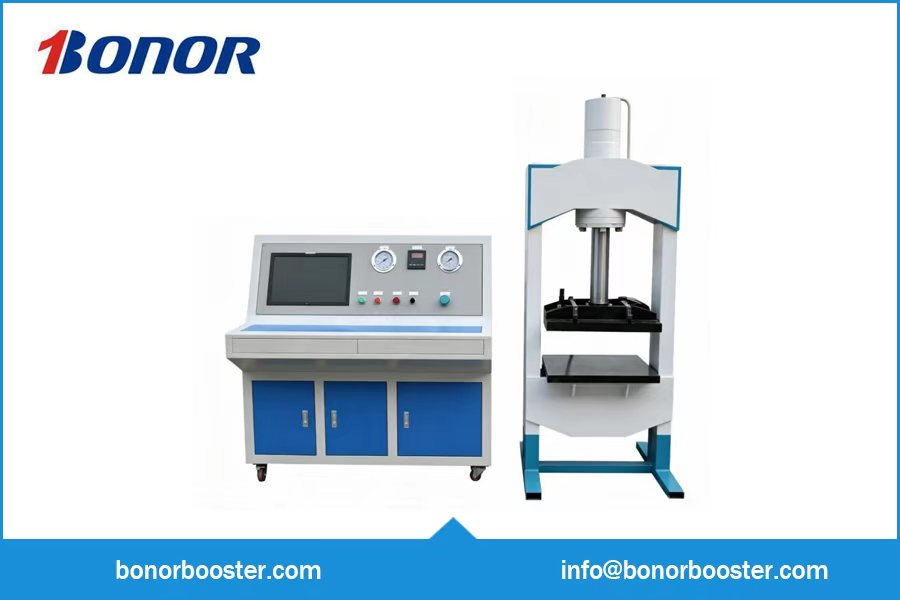
The Fire Extinguisher Cylinder Flattening Test Machine is built for pressure and burst testing of firefighting equipment. The test sequence is stored as a recipe, so one bench can serve several cylinder sizes and markets.
Description
Fire Extinguisher Cylinder Flattening Test Machine
The flattening test machine is specially designed for flattening tests on fire extinguisher cylinders, and can also perform flattening inspections for steel cylinders and gas cylinders. It complies with standards including GB4351.1-2005 Portable Fire Extinguishers, which guarantees high accuracy and reliability of test results.
Fire Hydrant Cabinet Stiffness Test Bench
This bench measures the indentation deformation of fire hydrant cabinets under specified torque loads to evaluate their structural stiffness performance. It plays a critical role in verifying the quality and operational safety of hydrant cabinets, and is widely used in fire product quality inspection and safety assessment industries.
Product Introduction
- This test bench is designed and manufactured in accordance with national standard GB14561-2003 Fire Hydrant Cabinets, capable of stiffness testing under torque of 150 N·m and 40 N·m.
- Suitable for stiffness test of fire hose reel cabinet at torque of 150 N·m.
- Suitable for stiffness test of bracket-mounted hydrant cabinet at torque of 40 N·m.
- Suitable for stiffness test of wall-mounted hydrant cabinet at torque of 40 N·m.
- Applicable cabinet dimensions (Length × Width × Thickness, unit: mm): 800×650×200, 800×650×240, 800×650×320, 1000×700×200, 1000×700×240, 1000×700×320, 1200×750×200, 1200×750×240, 1200×750×320.
- Dial indicator deformation resolution: 0.01 mm
- Dial indicator measuring range: 0–10 mm
- Max measurable cabinet dimension: 750×320×1200 mm
Applications of the firefighting equipment test bench
Firefighting equipment is only as good as its last pressure test. Extinguisher bodies, hoses, valves and couplings all have to be proof-tested on a fixed interval, and the Fire Extinguisher Cylinder Flattening Test Machine is built to run that test at production speed without compromising the record.
- Extinguisher manufacturers — body hydrostatic proof, burst and deformation testing on the production line.
- Fire hose workshops — pressure and burst testing of hose assemblies after repair or on the annual inspection cycle.
- Inspection and certification bodies — independent verification against EN 3, GB 4351 or the local code.
What to specify before we build yours
- Standard and test sequence — EN 3, GB 4351, GB/T 9251 or the local code, including the hold times and the deformation limit.
- Cylinder sizes and volumes — from 1 kg portable bodies to wheeled and fixed units; the jacket and the clamp follow the size range.
- Medium and drying — water is standard, but the bodies must be dried afterwards, so a drying stage is often part of the same cell.
- Certificate format — the fields your inspector expects: serial number, test pressure, hold time, deformation, operator and date.
How to choose a firefighting equipment test bench
Firefighting testing is a volume business, so cycle time and record quality matter as much as pressure accuracy:
- Count the steps around the test. Filling, venting, drying and marking often take longer than the pressure hold itself. A bench that integrates them changes the throughput of the whole line, not just the test station.
- Confirm the deformation measurement method. Water-jacket and weighing methods are both accepted by different codes; the one your certificate has to show determines the fixture.
- Plan for different cylinder sizes. Interchangeable clamps and jacket inserts are much cheaper than a second bench, but only if they are designed in from the start.
Frequently asked questions
Which standards can the test sequence follow?
The common ones are EN 3 for portable extinguishers, GB 4351 for Chinese-made bodies and GB/T 9251 for hydrostatic test methods, and the bench program is written to whichever of these your market requires. If you export to several markets, the sequence is stored as a recipe and selected per batch.
Does the machine test burst strength as well as proof pressure?
Yes — proof pressure and burst are the same pressure circuit with different set points and different acceptance criteria. A burst test is destructive, so it is normally run on samples rather than on every unit.
How long does one complete test cycle take?
A single-body proof test including fill, hold, drain and record typically takes a few minutes; the exact figure depends on body volume, fill rate and the hold time your standard requires. We quote cycle time for your specific body size rather than an average.
Related equipment and further reading
- Fire Extinguisher Cylinder Hydrostatic Pressure Testing Machine
- Fire Hose Hydraulic Pressure and Wear Resistance Tester
- Fire Hose Testing Machine
- All Firefighting Testing Equipment models and specifications
- Hydrostatic pressure test machine import guide for eu buyers 2026
- Which hydrostatic pressure test machine certificates clear eu customs
Need a pressure range, fixture or test standard that is not listed here? Send the specimen list and the standard you test to and we will come back with a configuration and a price within one working day.