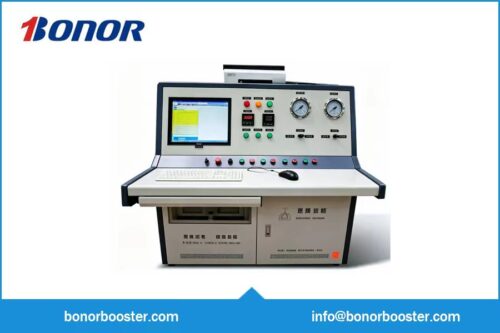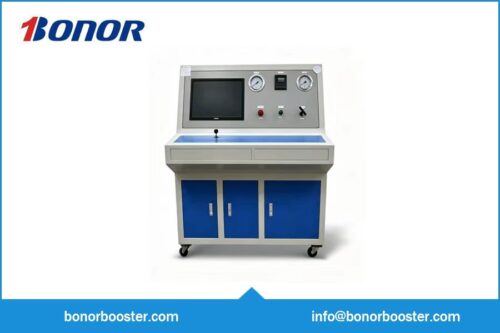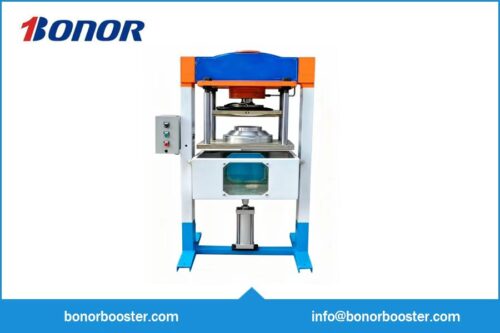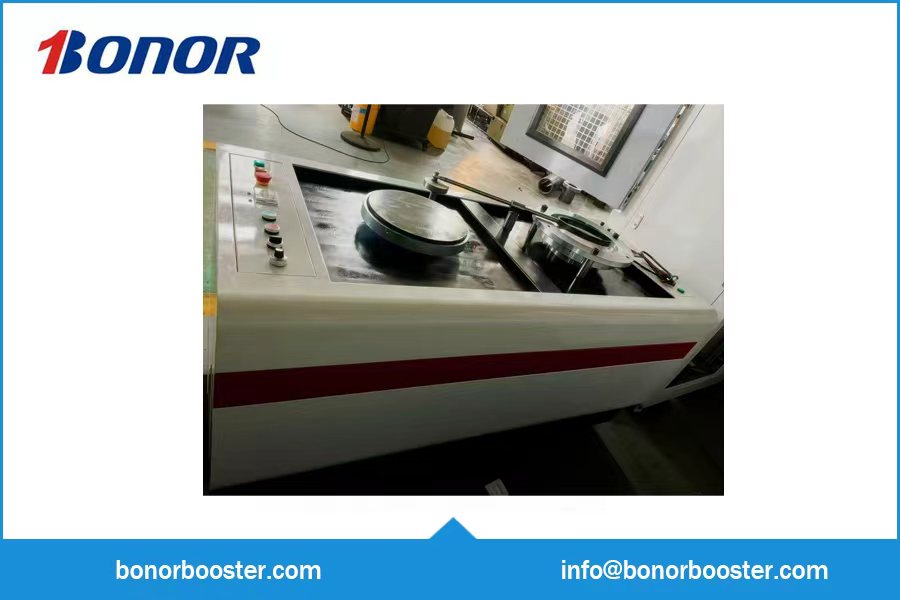
This machine realizes automatic lapping of valve discs and valve seats with an automatic control unit. It improves lapping precision for safety valve sealing surfaces, avoids shortcomings of manual lapping, reduces labor intensity and boosts working efficiency. It can be matched with safety valve test benches.
Description
一. Application Scope
- Lapping of valve seats and discs for all flat hard-seated safety valves
- Applicable lapping size: DN25 ~ DN150mm
二. Technical Parameters
- Rough lapping plate diameter: Φ300mm
- Fine lapping plate diameter: Φ300mm
- Lapping nominal diameter: DN25 ~ DN150mm
- Lapping station: Double stations; independent operation for valve seat and valve disc
- Applicable lapping compound: 280#, 400#, 600#, 800#, 2000#
- Power supply: AC220V, 50HZ
- Single lapping pressing depth: 1mm
- Workpiece flatness: 0.03mm
- Workpiece roughness after lapping: Ra0.8
- Workpiece thickness tolerance: ±0.05mm
- Adjustable motor speed for valve seat lapping: 1250 RPM
- Adjustable motor speed for valve disc lapping: 1450 RPM
- Lapping time setting: 1 ~ 1799 minutes
- Adjustable lapping pressure for valve seat: 0~0.6MPa
- Rotation direction for valve seat & disc lapping: Forward / Reverse rotation optional
- Mechanical arm for valve seat lapping: Stroke ≤345mm, adjustable angle <30°
- Lapping head lifting stroke: <35mm; cross universal joint guiding adopted
- Overall dimension: 1800×600×1600mm
三. Performance Features
- Double-station structure. Valve disc and valve seat can be lapped independently, supporting both rough lapping and fine lapping.
- Multiple valve discs can be processed simultaneously on the disc station to improve efficiency. Rough and fine lapping plates can be quickly exchanged on the same station.
- Supports simultaneous lapping of 3 pcs Φ110 valve discs.
- Valve seat lapping and valve disc lapping can operate independently.
What a safety valve test bench does in production
Between a valve that opens at the stamped pressure and one that opens ten percent late sits an entire safety case. Regular verification on a Automatic Safety Valve Sealing Surface Lapping Machine is how plant operators keep that margin measured rather than assumed. The primary workload here is sealing surface lapping, so fixtures and ramp logic are prepared for it from the factory; other valve families slot in with additional fixtures.
- Power plant auxiliary systems — feedwater, cooling and fuel-skid relief valves on scheduled testing.
- Marine Classification surveys — shipboard relief devices verified with class surveyor witness points.
- PSV manufacturers and repair shops — set, reseat and seat-tightness verification with a certificate per valve.
- Sealing-surface rework — lapping machines that restore flatness before the valve returns to the test bench.
In daily use the Automatic Safety Valve Sealing Surface Lapping Machine sees mostly sealing surface lapping. That decides the fixture style, the approach rate and what the operator actually does between tests.
What to specify before we build yours
- Test medium — air, nitrogen, steam or water; steam testing requires a steam generator and different safety measures. The setting here follows the valve you run most.
- Record and traceability — valve tag, set pressure, reseating pressure, leakage rate and operator, stored per test. It is set up here for the valve.
Configuration on the current build: The specification calls for power supply of ac220v, 50hz.
What to look for in a safety valve test bench
A test bench for relief devices must reproduce service conditions closely enough that the set point means the same thing on the bench as in the pipe. These checks keep that true:
- Consider the media for tightness testing. Air for most work, nitrogen where cleanliness matters, steam correction factors for valves that will run on steam — the acceptance criteria differ and the bench should support the one your standard uses.
- Plan the small-valve workflow. If half your volume is DN15 to DN80, benches designed around large flanges waste most of their table. A dedicated small-valve fixture set usually pays for itself in months.
- Handling for the valve. Loading height, clamping force and the drain path are arranged for the valve you run most, which is where the daily minutes are won or lost.
Frequently asked questions
Can the bench test both pop-action and modulating valves?
Yes, within the pressure and size range. Pop-action valves need a sharp approach near the set point; modulating and pilot-operated valves need a slower ramp and a look at the pilot response. The difference is in the programme and the instrumentation, not in the hardware. With sealing surface lapping as the main duty, we verify this point on your parts before the machine ships.
Is a bench suitable for air-only testing of liquid-service valves?
Air testing is the normal shop method with accepted corrections for service on liquid. Where a code demands liquid, the same bench can be arranged for water with a suitable medium circuit. The choice is made per valve family when the bench is specified. This is standard on the Automatic Safety Valve Sealing Surface Lapping Machine, not an optional extra.
Related equipment and further reading
- Aviation Valve Test Bench
- Pressure Relief Valve Test Bench
- Nuclear Valve Hydrostatic Test Bench
- All Safety Valve Test Machine models and specifications
- Accuracy checks without a lab
- Inside a safety valve bench
Questions about set-point verification for a specific code? Write the code and the valve size — we answer with the test sequence we would use, within one working day.