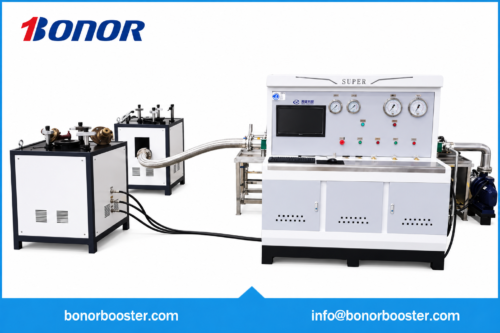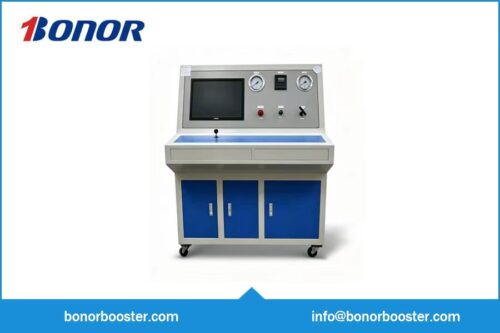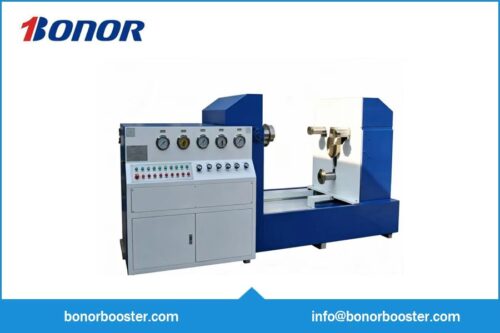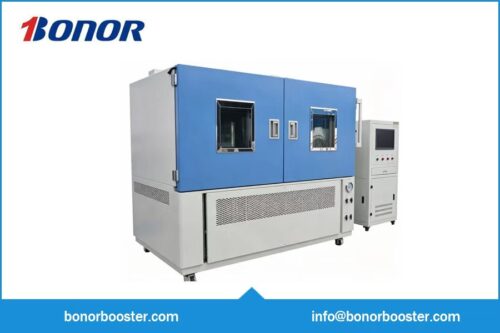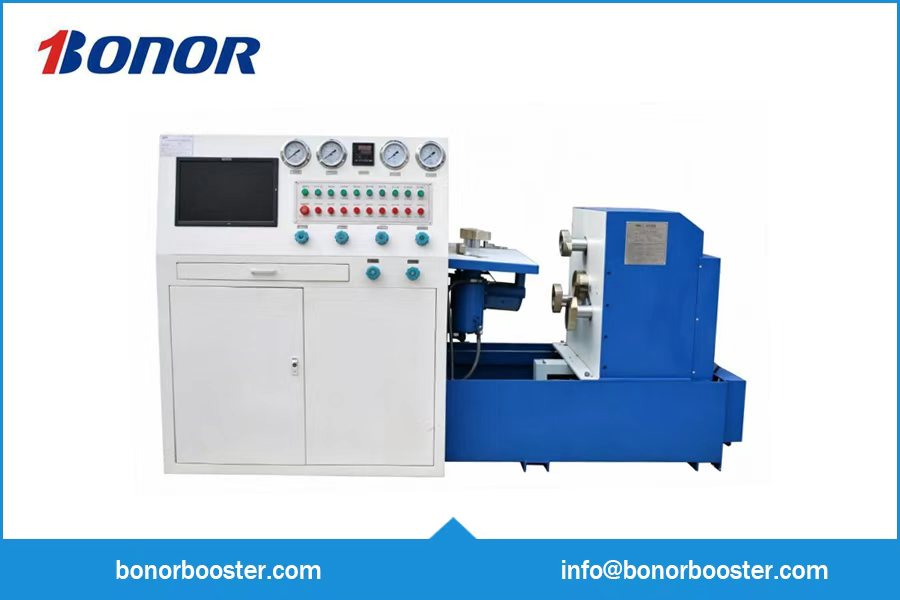
The clamping type valve test bench developed by Jinan Bonor Technology Co., Ltd. is used for pressure performance tests including tightness test and valve body strength test of straight-through flange-connected valves. It complies with standards such as GB/T 13927-2008 Pressure Test for General Valves, JB/T 9092-99 Valve Inspection and Test and American Standard API 598, to conduct strength test, seat tightness test and backseat tightness test for flange-type valves.
Clamping-type valve test bench
Description
一. Technical Parameters
| Item | Specification |
| Applicable valve nominal diameter (mm) | DN80 ~ DN300 |
| Max. test pressure for full bore | 16.0 MPa |
| Opening range of movable frame (mm) | 200 ~ 1080 |
| Cylinder clamping force | 211 Ton |
| Hydraulic system Flow rate | 25 L/min |
| Hydraulic system High pressure boosting range | 3.0 ~ 31.5 MPa |
| Motor power (kw) | 3.0 |
| Power supply | 380V/50HZ |
二. Features
- Clamping by jaw gripping flange, fully meets requirements of GB/T13927-2008, JB/T9092-99 and API598.
- The left clamping unit is a movable frame that can slide horizontally, adapting to valves with different lengths.
- The right rotary turntable supports 90° rotation, convenient for valve air tightness inspection.
- Audio & visual alarm function. After pressure holding phase, the equipment triggers buzzer and indicator light to remind test status.
- Water pipeline adopts 304 stainless steel. The bench is equipped with high & low pressure stainless steel water pumps.
- Low-pressure gas tightness test for valves: A bubble counter is equipped within the PLC data management system. A bubble detection unit is installed at the valve outlet. When leakage occurs on sealing surfaces, gas flows from valve inlet to outlet and enters the bubble detector to generate bubbles in water. The infrared sensor counts bubbles and transmits data to PLC. The leakage rate is calculated according to bubble quantity per minute. The bubble counter satisfies low-pressure gas tightness test requirements specified in ANSI/FCI 70-2006, ANSI B16.104 and GB/T4213-2008.