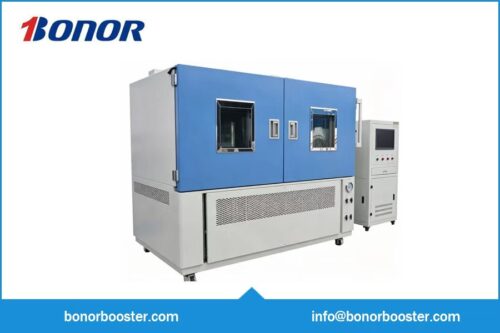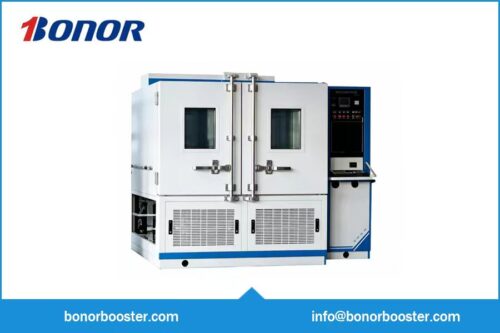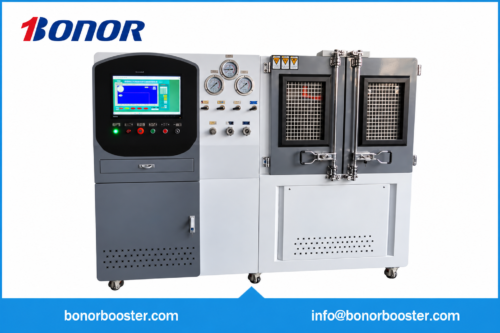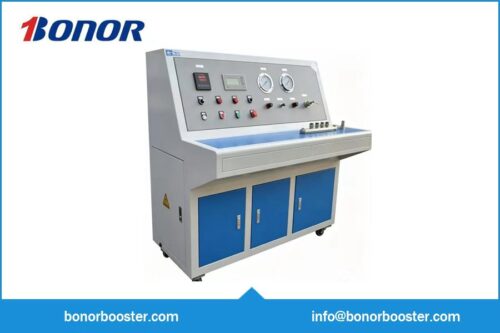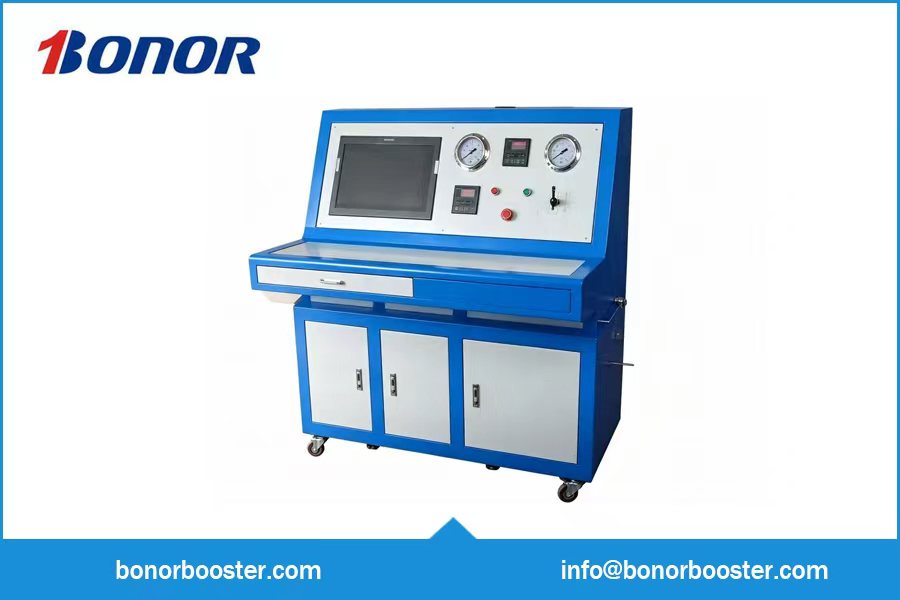
The Solar Energy Pulse Pressure Test Bench is built for pressure pulse and fatigue cycling. Cycle rate, waveform and shutdown logic are set for the protocol your product has to pass.
Description
一. Application Scope
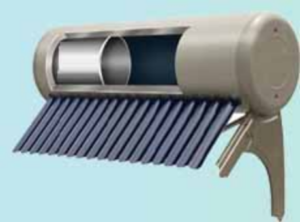
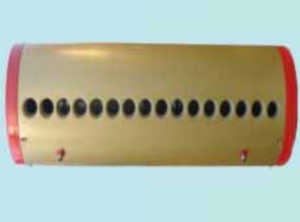
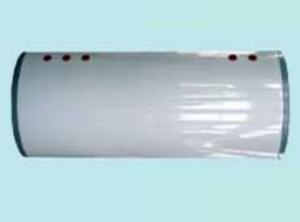
Developed by Jinan Bonor, this pulse tester is applied to pulse pressure tests for solar water heaters, solar heating systems, solar water storage tanks, solar heat collecting tubes and collectors. Compliant Standard: GB/T 19141-2011 Technical Specifications for Domestic Solar Hot Water Systems
- Supports continuous hydraulic pulse tests up to 80,000 times; the computer displays real-time pressure curves, prints test reports and stores experimental data.
- Capable of solar thermal system negative pressure test with vacuum degree down to -33 kPa.
- Widely applicable to pulse pressure tests for solar thermal products as well as other relevant industries, effectively guaranteeing product quality, performance, reliability and safety.
 |
 |
 |
二. Basic Parameters
- Test medium: Water
- Pulse pressure: 0~1 MPa (adjustable)
- Pressure control accuracy: ±0.5%FS
- Pulse frequency: 25~60 times per minute (adjustable)
- Pulse waveform: Basic square wave / trapezoidal wave; pulse width customizable per client requirements
- Medium temperature: Ambient temperature (customizable)
- Test station quantity: 1 station
- Negative test pressure: -33 kPa
- Working Principle:The high-pressure pump generates pressurized fluid, which is delivered to test samples via high-pressure pipelines after regulation by the pressure control system to conduct cyclic pulse tests.
- Control Mode:Computer automatic control
- Specimen Connection:Threaded connection
- Structural Composition:Power system, circulation system, pressure control system, workpiece mounting fixture, computer control system
- Solar heat storage water tank, solar collector, heat collecting tube
三. Equipment Composition of Pulse Test Bench
The whole device consists of three major assemblies:
- Hydraulic System: Circulation pump, pulse generator
- Test Cabinet: For workpiece installation, pressure regulation and system pressure indication
- Electric Control Cabinet & Computer Test System: Control buttons and meters are centrally mounted on the console for unified control & monitoring. The system collects pressure waveform, test cycles, pulse frequency and other data, supports report printing and fault alarm notification.
Applications of the pulse fatigue test bench
A hose or pipe that survives one burst test can still fail after ten thousand pressure cycles, because fatigue damage accumulates at the reinforcement, the fitting or the weld. The Solar Energy Pulse Pressure Test Bench reproduces those cycles at accelerated rate so the service life can be estimated before the product reaches a customer.
- Hydraulic and pneumatic hose assemblies — SAE J343, ISO 6803 and similar pulse protocols on brake, power steering and high-pressure lines.
- Pipe and tube assemblies — pressure cycling of welded and brazed joints in automotive and refrigeration circuits.
- Filters, accumulators and pressure vessels — diaphragm and shell fatigue verification.
What to specify before we build yours
- Pressure range and cycle waveform — square, saw-tooth or sine, with rise and hold times defined by the standard.
- Cycle rate — cycles per minute determines how long a 100,000-cycle test will take, and whether you need one station or several.
- Media and temperature — oil, water, glycol or gas, at ambient or elevated temperature; hot oil changes the pump and seal selection.
- Failure detection and shutdown — pressure-loss detection, burst detection and an automatic stop with the cycle count preserved.
How to choose a pulse fatigue test bench
Fatigue benches are judged by how many cycles they complete without attention, not by their peak pressure:
- Calculate the calendar time first. A 200,000-cycle test at 30 cycles per minute runs for five days. If your qualification plan has ten variants, one station will not finish this quarter — plan the number of stations before the pressure rating.
- Ask how the failure is caught. A hose that bursts at cycle 40,000 must stop the test and log the count, otherwise the run continues against a dead specimen and the data is wasted.
- Check the oil temperature control. Continuous cycling heats the medium; without a cooler the test drifts away from the specified temperature and the result is not comparable to the standard.
Frequently asked questions
How many cycles per minute can the bench reach?
Typical industrial benches run between 10 and 60 cycles per minute depending on pressure range, specimen volume and waveform. Higher rates need a larger pump and an accumulator; we size the rate against the total cycle count in your test plan.
Can the test run with hot oil or at low temperature?
Yes, with a temperature-conditioning loop. Hot oil is the common requirement for automotive hose protocols; low-temperature testing needs a cooled enclosure and a medium that stays fluid at the set point.
What happens when the specimen leaks or bursts?
The controller detects the pressure loss, stops the pump, closes the isolation valve and records the cycle count at failure. A burst shield or enclosure protects the operator, and the record is exported with the test ID.
Related equipment and further reading
- High-Pressure Water Pulse Testing Machine
- Cyclic Fatigue Testing Machine
- Fully Automatic Hydraulic Pulse Testing Machine
- All Pulse Fatigue Testing Machine models and specifications
- How long should a hydrostatic pressure test machine last
- The complete hydrostatic pressure test machine spare parts guide 2026
Need a pressure range, fixture or test standard that is not listed here? Send the specimen list and the standard you test to and we will come back with a configuration and a price within one working day.