Description
What is automated hydrostatic burst testing bench?
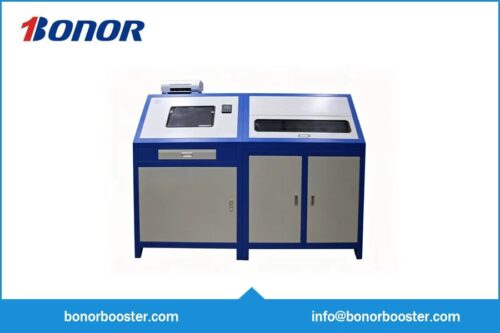
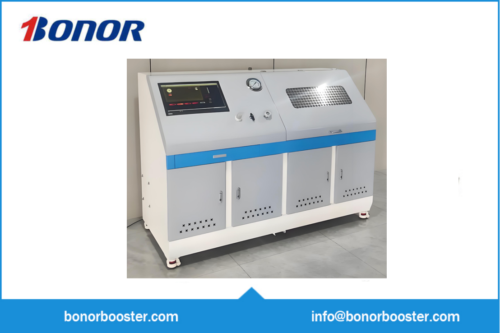
The automated hydrostatic burst pressure testing bench is a multi-functional high-pressure testing machine intelligently controlled by a PLC or computer, integrating four core functions: automatic pressure maintenance, timing, pressure release, and venting.
The equipment uses water or hydraulic oil as the medium to inject into the sealed test piece, simulating a high-pressure environment. It can perform four tests: hydrostatic pressure, pressure resistance, burst pressure, and leakage. It is widely applicable to the testing of various sealed components such as pipes, hydraulic hoses, fire hoses, instruments, liquid cooling plates, valves, connectors, cylinders, gas containers, and fire extinguishing cylinders.The machine is equipped with two operating modes: PLC control and computer control, both with built-in dedicated testing software, ensuring convenient and efficient operation.
Automatic Hydrostatic Pressure Burst Testing Bench – Core Advantages:
- Specifically designed for hydrostatic pressure and burst testing, suitable for testing various sealed pressure-bearing components.
- Maximum pressure up to 408 MPa, with flexible pressure adjustment.
- Dual control mode (PLC/computer), automated operation, and high testing accuracy.
- Integrated automatic pressure maintenance, pressure release, and venting functions; the entire process requires no manual intervention.
- Supports precise parameter presetting to meet personalized testing needs.
- Built-in testing program, easy to operate and user-friendly.
Working Principle of the Automatic Hydrostatic Pressure Burst Testing Bench
Power and Medium Preparation
Compressed air provided by an air compressor/nitrogen cylinder is used as the driving power, and water or hydraulic oil pre-injected into the storage tank is used as the test medium.
Core Pressurization Mechanism
Compressed air drives the piston of the pneumatic booster pump to reciprocate, drawing in and pressurizing the medium in the storage tank, capable of outputting high-pressure liquid up to 408 MPa.
Automatic Testing Process
Controlled automatically by a computer/PLC: exhaust → pressurization → pressure holding → depressurization. The entire process requires no manual intervention, ensuring accurate and reliable testing.
Simplified operating steps for the automatic hydrostatic pressure burst test bench:
Preparation Phase:
Fill the liquid reservoir with water or hydraulic oil and check the liquid level.
Connect the air compressor/nitrogen cylinder and confirm that the driving air pressure is normal.
Connect the test specimen to the hydraulic outlet of the test chamber, close and lock the protective chamber door.
Start the computer and the test bench power supply, and access the testing software.
Testing Phase:
Select the test type (hydrostatic/burst/leakage), and preset parameters such as pressure and holding time.
Start the venting procedure to purge air from the pipelines and the test specimen.
Start the test; the equipment will automatically increase pressure, maintain pressure, and monitor the status.
After the pressure holding period, the pressure will be automatically and slowly released.
The software automatically generates and exports/prints the test report.
After complete depressurization, remove the tested component and clean the test chamber.
Turn off the software, power supply, and driving air source in sequence.

Automotive hose pressure test burst test bench
Applications of pressure burst testing equipment: Automotive steering hoses, brake hoses, air conditioning hoses, oil hoses, water cooling hoses, radiators, heater hoses, hydraulic equipment, condensers, evaporators, air conditioning filter hoses, turbocharger system hoses, automotive brake pumps, cylinder blocks, engineering hydraulic hoses, air hoses and manifolds, rigid pipes, connectors, valves, pressure gauges, pressure vessels, pressure transmitters, etc.

Where a burst pressure test bench is used
Design engineers iterate on wall thickness, material and crimp dimensions; every one of those iterations ends the same way — something has to be pressurised until it fails. The Automated Hydrostatic Burst Testing Bench is built for that daily cycle of sample, clamp, ramp, record. The typical workload here is hydrostatic testing, so the clamping and detection settings are tuned for that from the factory; commissioning includes running your own samples to prove it.
- Fire equipment and extinguisher bodies — cylinder shells proof- and burst-checked as part of periodic requalification programmes.
- Rubber and polymer product development — diaphragms, bladders and reinforced membranes where the fabric layout decides the failure mode.
Every Automated Hydrostatic Burst Testing Bench is laid out around its duty cycle, and here that means hydrostatic testing. The controls, the guards and the record format follow from that.
What to specify before we build yours
- Specimen envelope and clamping — hose bore and length, pipe diameter, cylinder height and the fixture that holds the part without crushing it. It is set up here for the part.
- Maximum test pressure and pressure-holding time — the bench is sized around your highest specimen rating plus a safety margin, not around the average. The setting here follows the part you run most.
Choosing the right burst pressure test bench
The bench you need is decided less by the pressure number and more by what happens around it — media, fixturing and records. Work through this list before ordering:
- Check what the software exports. If your customer wants a curve with time stamps and the raw transducer file, confirm the format before the order, not during acceptance. A PDF screenshot is not a record.
- Count the specimens per day before sizing the pump. A laboratory doing five careful tests and a production line doing two hundred need different pressurisation, different fixtures and different levels of automation. Buying headroom you never use wastes money; buying too little stops the line.
- Fixture fit for the part. The clamping set is drawn around your part drawings first, so the part sits square without shimming — and the same fixture family extends to other sizes later.
Frequently asked questions
Do burst results change with temperature?
They can, sometimes by a lot — polymers lose strength quickly as temperature rises, and metals shift more slowly. If your parts serve hot, test hot or at least document the temperature of every test. The bench can log specimen temperature alongside pressure so the two curves stay together in the record. For the part work this bench is quoted for, that answer is written into the acceptance protocol.
Can the bench also run hold and leak tests, or only bursts?
The same pressure source, fixture and recording chain runs all three. A hold test is a ramp to a target followed by a timed stand; a leak test adds a fine-resolution drop measurement; a burst simply continues the ramp to failure. You switch by loading a different programme, not by changing hardware. On the Automated Hydrostatic Burst Testing Bench, that is part of the standard delivery, not an option.
Related equipment and further reading
Bench or fixture questions we have not answered here? Write us the specimen and the standard — a configuration with pricing follows within one working day.