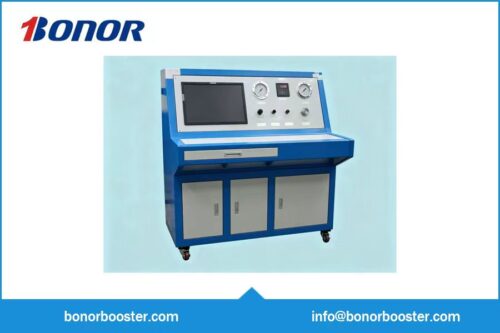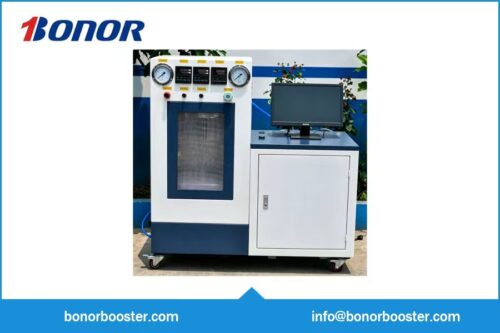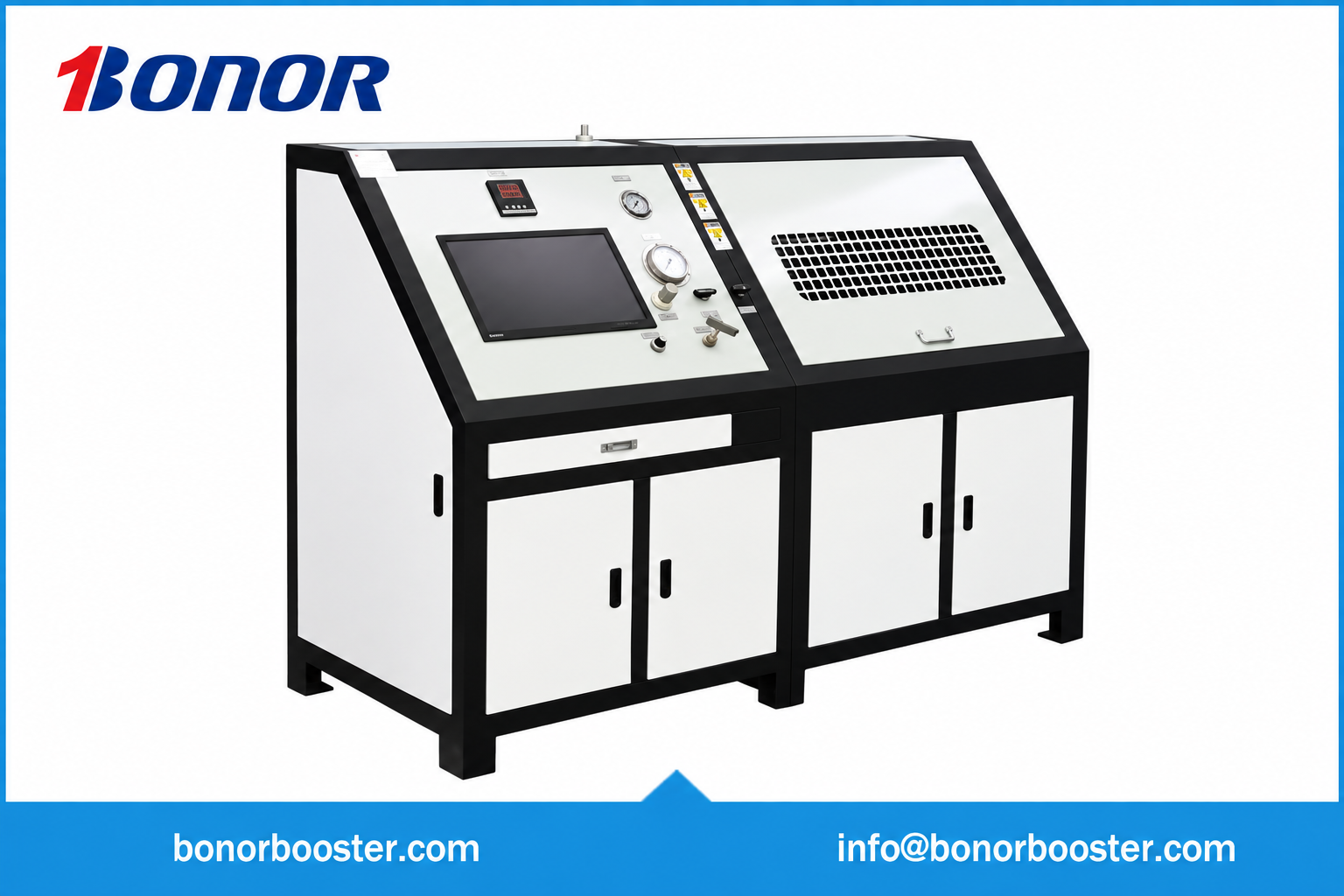
The High-pressure hose burst testing machine is built for burst and proof-pressure testing. Configured here as air consumption: 1 Nm³/min. Clamping fixtures are quoted around the specimen, and the pressure curve is stored with the test ID.
Description
Ⅰ. Application Scope
This equipment is applied to test the pressure resistance and burst performance of automotive hoses, rubber tubes, air-conditioning pipes, automotive assemblies and other products. It measures the burst pressure and pressure holding duration of various pipes, widely used in quality inspection institutions, auto parts manufacturers, product testing stations, scientific research institutes as well as the production, R&D and research fields of all types of hoses.
The pressure test system consists of a pressurization system and a control & display system. The pressurization system is mainly composed of Siminte liquid booster pump, which realizes pressurization and pressure holding for long-time tests stably. The control & display system undertakes gas pressure regulation, pressure relief control, real-time pressure display and pressurization management. Adopting PLC control mode with touch screen operation & display, the bench supports automatic pressurization, automatic peak value retention, automatic shutdown upon specimen burst, automatic safety protection and other functions.
Ⅱ. Test Standards
This hose burst test bench is manufactured in accordance with EN ISO1402-1996 / NF T47202-1996 Rubber and plastic hose assemblies — Hydrostatic test, GB/T5563 Hydraulic Hose Assembly Test Standard. The hose installation and test methods comply with EN ISO1402-1996 / NF T47202-1996, while equipment performance indexes and test methods conform to GB7939 and GB/T5563. It meets burst test, leakage test and pressure resistance test requirements for GB383 steel wire braided hoses and all specifications of pipes specified in GB/T10544 & GB/T16897-2010.
Standard Test Procedures for Hose Burst Test
- Constant speed pressurization until burst
- Constant speed pressurization → pressure holding → constant speed pressurization until burst
- Constant speed pressurization → pressure holding → pressure relief
- Constant speed pressurization → pressure holding → constant speed pressurization → pressure holding → constant speed pressurization until burst
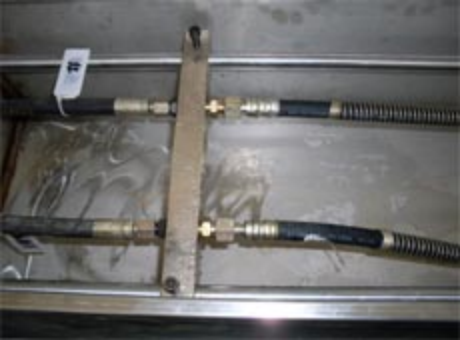
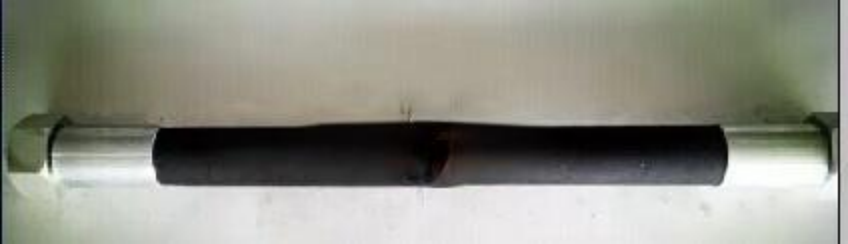
Ⅲ. Equipment Features
- Equipped with gas-driven automatic booster pump to achieve stepless adjustable and controllable output pressure.
- Adopts advanced technology and optimized structural layout with small footprint, light weight and elegant appearance.
- All pressure-bearing components are world-famous brand standard parts without welded joints, featuring easy disassembly, high safety factor, long service life and convenient maintenance.
Ⅳ. Technical Parameters
- Driving air pressure range: 0.1–0.69 MPa; output pressure is proportional to driving air pressure
- Air consumption: 1 Nm³/min
- Pressure test range: 0–300 MPa (customizable pressure range according to customer demands)
- Working medium: water, hydraulic oil, emulsion
- Portable automatic recorder is optional upon customer request
Typical uses of a burst pressure test bench
A burst number on a datasheet is only worth what the test behind it is worth, and the test is only as good as the bench that ran it. The High-pressure hose burst testing machine gives your laboratory or production line one fixed reference: same clamp, same rate, same report, every sample. On this configuration the emphasis is hose testing: the fixture, the ramp profile and the recording settings are arranged around that job first, and other specimen families can be added later.
- Medical and laboratory device shells — sterile fluid pathways proof-tested well above sterilisation and operating pressures.
- Kitchen and sanitaryware production — porcelain and composite parts checked for lamination faults that only show at pressure.
- Hydraulic and industrial hose plants — crimped assemblies burst-verified against the rated working pressure before each batch ships.
Day-to-day, the High-pressure hose burst testing machine works around one thing: the hose assembly. Loading, clamping and the report format are arranged so that a hose assembly goes from bench entry to signed result without re-work.
What to specify before we build yours
- Specimen envelope and clamping — hose bore and length, pipe diameter, cylinder height and the fixture that holds the part without crushing it. It is set up here for the hose assembly.
- Recording requirement — whether you need a printed curve per sample, a database record, or only a pass/fail lamp. It is set up here for the hose assembly.
- Air consumption — 1 Nm³/min (confirmed for this unit).
This unit is configured as follows: This unit works with air consumption at 1 nm³/min.
Currently configured as: Air consumption: 1 Nm³/min. Different ranges or fixtures — built to order.
How to choose a burst pressure test bench
Two quotations can quote the same maximum pressure and still be built for different jobs. Before you compare prices, pin down the points below:
- Think about who operates it. A laboratory bench used by engineers can be manual and flexible; a production fixture used by rotating operators should be one-button with automatic pass/fail and interlocks. Specify for the actual operator, not the ideal one.
- Check what the software exports. If your customer wants a curve with time stamps and the raw transducer file, confirm the format before the order, not during acceptance. A PDF screenshot is not a record.
- Records for the hose assembly. The report is laid out with the fields your hose assembly standard asks for, so a result leaves the shop as a certificate rather than a rewrite job.
Frequently asked questions
How is the test pressure rate standardised?
Most codes specify a rate in bar or MPa per second, or a time-to-failure window. The controller holds the commanded ramp within a tolerance band and records the actual rate, so a reviewer can see that the rate stayed inside the specification for the whole test. In practice, the hose assembly dictates the answer here — and that is what the quotation is built around.
Do burst results change with temperature?
They can, sometimes by a lot — polymers lose strength quickly as temperature rises, and metals shift more slowly. If your parts serve hot, test hot or at least document the temperature of every test. The bench can log specimen temperature alongside pressure so the two curves stay together in the record. On the High-pressure hose burst testing machine, that is part of the standard delivery, not an option.
Related equipment and further reading
- Manual Control Burst Pressure Test Machine
- Bursting Disc Burst Test Machine
- PET Bottle Bursting Tester
- The complete Burst Pressure Test Bench line-up
- Where burst benches are used
- Inside a burst test bench
Tell us what you burst, at what pressure, and how many per day — send the specimen list and we will reply with a layout, a cycle time and a price within one working day.