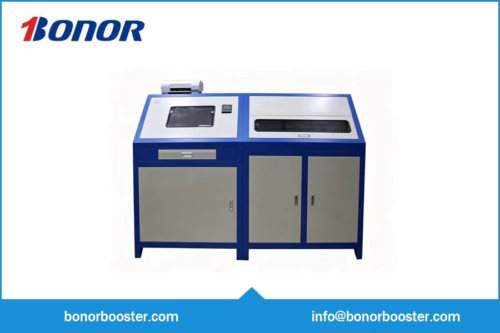
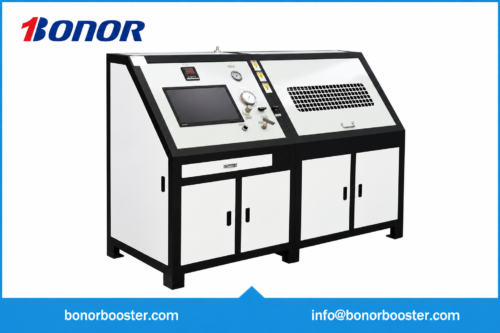
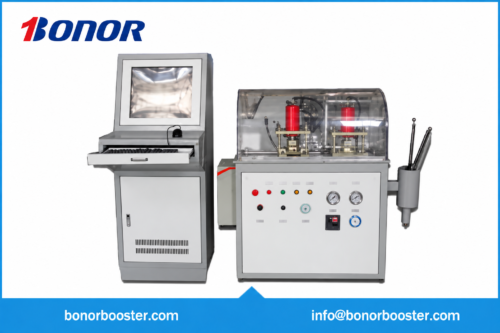
The Pneumatic Emulsifying Pump is built for burst and proof-pressure testing. Clamping fixtures are quoted around the specimen, and the pressure curve is stored with the test ID.
Description
I. Product Definition
The HGD40-B pneumatic emulsion pump is an explosion-proof hydraulic power unit exclusively designed for underground coal mine applications, serving as the core component of single prop injection pump stations. Powered solely by underground compressed air and requiring no electrical drive, it pressurizes emulsion and delivers a stable high-pressure fluid flow to provide hydraulic power for underground support equipment. It is a key supporting device for ensuring the safety of coal mine roadways and working faces.
II. Core Parameters
(The following are industrial standard parameters for this model, suitable for foreign trade communication and technical collaboration)
| Parameter Category | Specific Indicator | Notes |
| Power Source | Compressed Air | Operating pressure: 0.4~0.8MPa, Air flow rate ≥0.6m³/min |
| Rated Output Pressure | 32MPa | High-pressure grade meeting coal mine support standards, adjustable as needed |
| Rated Flow | 40L/min | Efficiently meets the rapid injection needs of single hydraulic props |
| Working Medium | Emulsion (Water:Emulsion oil = 95:5) | Coal mine-specific medium with anti-wear and anti-rust properties |
| Material | Full 304 Stainless Steel | Resistant to underground moisture and emulsion corrosion; Explosion-proof rating: Ex d Ⅰ Mb |
| Dimensions (L×W×H) | 850×600×750mm | Compact design suitable for narrow underground spaces |
| Overall Weight | Approximately 180kg | Equipped with portable handles for easy underground movement |
| Noise Level | ≤85dB | Complies with underground operation noise standards |
III. Core Features
- Intrinsically Safe Explosion-Proof Design: Pure pneumatic drive with no electrical components, eliminating the risk of electric sparks at the source. Fully compatible with high-gas, flammable, and explosive underground coal mine environments, and certified by national mine equipment explosion-proof standards.
- Full Stainless Steel Protection: The entire unit is constructed from 304 stainless steel, resistant to underground water seepage and emulsion corrosion, extending service life and reducing underground maintenance frequency.
- Precision Pressure Monitoring: Dual pressure gauges provide real-time displays of air source pressure and output hydraulic pressure, allowing operators to easily monitor equipment status and prevent overpressure operation.
- Portable and Easy to Operate: Compact size and light weight, with integrated portable handles and mobile feet, enabling single-person relocation underground. The control panel is simple—start/stop is achieved by controlling the air source valve, requiring no specialized training.
- Stable and Reliable Pressure: Utilizes a pneumatic diaphragm pump core structure, ensuring minimal fluctuation in output hydraulic pressure for stable prop lifting and support, avoiding support failure due to pressure surges.
- Low Maintenance Costs: Fewer wearing parts and a modular design allow disassembly and maintenance without special tools, enabling routine servicing underground.
IV. Working Principle
The device operates based on the pneumatic-hydraulic conversion principle, using the pressure energy of compressed air to drive the pump and convert low-pressure emulsion into high-pressure fluid flow:
- Power Input: Underground compressed air enters the pneumatic chamber of the pump through the air inlet, driving the pneumatic piston to reciprocate linearly.
- Hydraulic Conversion: The pneumatic piston is linked to the hydraulic plunger. As the pneumatic piston advances, the hydraulic chamber volume decreases, pressurizing the emulsion; as the piston retracts, the hydraulic chamber volume increases, drawing low-pressure emulsion from the reservoir.
- Pressure Control: The output pressure is set via a pressure regulating valve. When hydraulic pressure reaches the rated value, a pressure relay triggers automatically, stopping air intake to the pneumatic chamber and putting the device into pressure-holding mode. When pressure drops, it resumes operation automatically to maintain stable pressure.
- Medium Output: Pressurized emulsion is delivered through the high-pressure outlet via hydraulic pipelines to equipment such as single hydraulic props, completing power supply.
V. Working Process
1. Preparation Phase
- Inspect Equipment Appearance: Ensure the stainless steel casing is undamaged, pressure gauges are zeroed, and all pipeline connections are leak-free.
- Fill Medium: Add properly proportioned emulsion to the reservoir, ensuring the liquid level reaches the scale mark (not less than 80%).
- Connect Pipelines: Connect the air inlet to the underground compressed air pipeline and the high-pressure outlet to the single hydraulic prop hydraulic pipeline, ensuring secure and sealed connections.
2. Startup Phase
- Slowly Open the Air Source Valve: Observe the air source pressure gauge to confirm pressure is within the 0.4~0.8MPa range.
- Adjust Pressure Regulating Valve: Set to the target output pressure (typically 32MPa), open the output valve, and the device will start automatically, delivering high-pressure emulsion.
3. Operation Phase
- Monitor Dual Pressure Gauges in Real Time: Ensure stable air source pressure and that output hydraulic pressure does not exceed the rated value.
- Observe Prop Support Status: When the prop reaches the predetermined height and pressure stabilizes, close the prop’s injection valve.
- For Multiple Prop Injection: Switch pipeline connections sequentially; the device maintains pressure-holding output continuously.
4. Shutdown Phase
- Close the Air Source Valve: After residual compressed air in the device is exhausted and hydraulic pressure drops to zero, close the output valve.
- Disconnect Pipelines: Clean emulsion and dust from the equipment surface.
- For Long-Term Shutdown: Drain remaining medium from the reservoir and implement moisture-proof protection for the device.
5. Maintenance Phase
- Daily: Check pressure gauge accuracy and pipeline sealing.
- Weekly: Clean the reservoir filter and inspect pneumatic piston seals.
- Monthly: Replace emulsion and calibrate pressure regulating valve pressure.
VI. Wide-Ranging Applications
This product is the core power unit of underground coal mine support systems and can also be extended to explosion-proof hydraulic scenarios in non-coal mines and underground engineering:
- Core Underground Coal Mine Support: Provides high-pressure emulsion for single hydraulic props and hydraulic supports, enabling roof and side support in mining faces and excavation roadways to ensure underground operational safety.
- Coal Seam Water Injection: By adjusting output pressure, it powers coal seam water injection equipment to reduce dust and prevent gas outbursts, improving the underground working environment.
- Temporary Support Projects: Powers lightweight hydraulic support equipment in roadway repairs and temporary construction areas to quickly establish safe temporary support.
- Underground Hydraulic Equipment Drive: Serves as a universal power source for small underground hydraulic tools (e.g., hydraulic shears, hydraulic jacks), adapting to various underground hydraulic operations.
- Explosion-Proof Scenarios in Non-Coal Mines: Used in underground metal and non-metal mining for hydraulic support and power supply in high-gas, flammable, and explosive environments.
Applications of the burst pressure test bench
Between a part that passed a hold test and a part that actually burst, there is a margin somebody is betting a shipment on. The Pneumatic Emulsifying Pump turns that bet into a measurement: pressure rises under control until the specimen gives, and the exact value is logged. On this configuration the emphasis is emulsifying pump: the fixture, the ramp profile and the recording settings are arranged around that job first, and other specimen families can be added later.
- Packaging and containers — PET bottles, tin cans and aerosol bodies tested for bottom burst and seam strength as part of packaging qualification.
- Pressure vessel and cylinder validation — shells, receivers and extinguisher bodies checked for burst strength and permanent deformation before type approval.
In daily use the Pneumatic Emulsifying Pump sees mostly emulsifying pump. That decides the fixture style, the approach rate and what the operator actually does between tests.
What to specify before we build yours
- Maximum test pressure and pressure-holding time — the bench is sized around your highest specimen rating plus a safety margin, not around the average. The setting here follows the part you run most.
- Specimen envelope and clamping — hose bore and length, pipe diameter, cylinder height and the fixture that holds the part without crushing it. It is set up here for the part.
The way this particular bench is set up: As configured, power source is compressed air. This unit works with dimensions (l×w×h) at 850×600×750mm.
Selecting a burst pressure test bench for your line
Two quotations can quote the same maximum pressure and still be built for different jobs. Before you compare prices, pin down the points below:
- Ask for the ramp profile in writing. A burst value depends on how fast pressure rises — a fast ramp can hide a weak seam and a slow one can fatigue it. A bench that stores and re-plays the ramp is the only way two tests can be compared fairly.
- Look at how the fixture treats the specimen ends. Crushed hose, slipped plugs and scratched faces produce failures that say more about the clamp than the part. A good fixture spreads the grip and keeps the ends free to move the way they will in service.
- Handling for the part. Loading height, clamping force and the drain path are arranged for the part you run most, which is where the daily minutes are won or lost.
Frequently asked questions
How many samples does a burst test normally need per batch?
That is set by your standard or by the agreement with your customer, not by the bench. What the bench contributes is repeatability: when the clamp and the ramp are identical, three samples tell you more than ten scattered ones. Most of our customers run one to five samples per production batch plus a full programme per design change. For the part work this bench is quoted for, that answer is written into the acceptance protocol.
How is the burst point detected automatically?
The controller samples pressure at a fixed rate and stops the test when pressure falls by more than a set percentage inside a short window, which is the signature of a fracture. A pressure-relief valve and a burst shield sit behind that logic so the test cell stays safe if the detection is late. Our quotation for the Pneumatic Emulsifying Pump states this explicitly, so there is nothing to discover at acceptance.
Related equipment and further reading
- Air Spring Hydrostatic Burst Test Machine
- Tire Hydrostatic Burst Testing Machine
- Automated Hydrostatic Burst Testing Bench
- The complete Burst Pressure Test Bench line-up
- How a burst test bench works
- Where burst benches are used
Every bench is quoted around a real specimen list. Send yours with the working pressure and you will have a costed proposal, not a brochure, within one working day.