Description
1. Application Scope
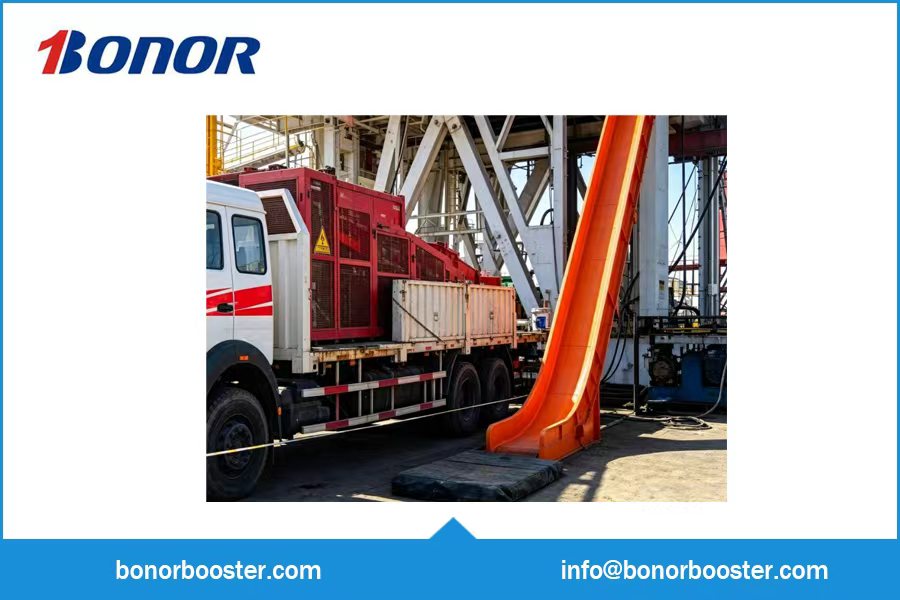
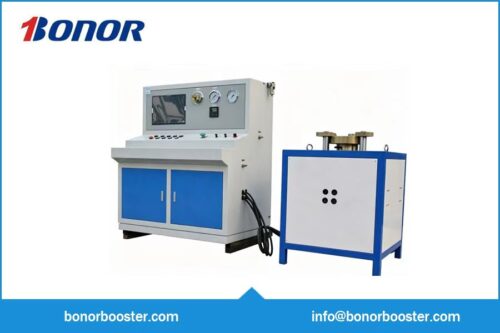
Bonor helium seal test bench is designed for high-pressure helium tightness test on tubing and casing thread connections. The maximum test pressure reaches 140 MPa in accordance with standard SY/T 6872-2012. Test data can be collected and printed by computer automatically. The system is equipped with automatic pressure compensation function and optional monitoring cameras to realize unattended pressure test. Widely adopted in petroleum, chemical and natural gas industries, it verifies the sealing performance of pipe threads to guarantee safe and stable operation under high-pressure, high-temperature and harsh downhole working conditions.
2. Equipment Composition
- Power Station: Large-flow booster pump driven by diesel engine
- Helium Mass Spectrometer: High-precision detector for helium leakage inspection
- Helium Bottle Assembly Unit: Integrated device for pipeline connection and control of helium cylinder groups
- Hydraulic Winch: Hydraulic driving device for lifting and lowering packers
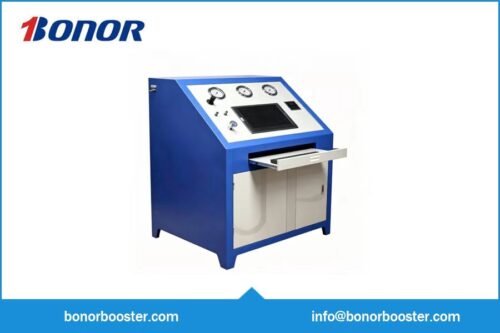
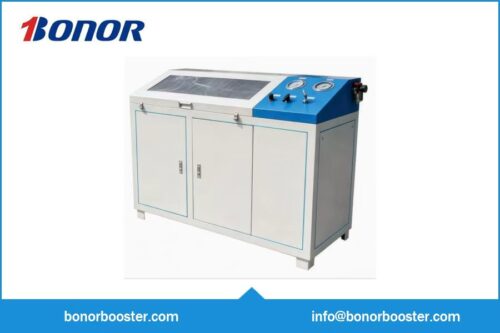
- Control Console: Centralized control of pressure build-up, pressure relief, hydraulic winch and diesel power station
- High-pressure Accumulator: Stabilizes pipeline pressure and compensates system pressure loss
3. Product Features
- Diesel-powered design, no external power supply required for field oilfield operation
- Remote control available for all equipment with reliable and safe operation performance
- Equipped with high-precision helium analyzer to accurately measure helium leakage rate
- Test reports can be printed automatically after test completion for file management
4. Technical Specifications
- Test Pressure: 140 MPa
- Working Medium: Nitrogen, Helium
- Accumulator Volume: 30 L
- Boost Flow Rate: 30 L/min
- Optional Configuration: Portable automatic data recorder according to customer requirements
Applications of the air tightness test bench
Leak testing catches the defects that a pressure test cannot: a pinhole that holds 6 bar for a minute but leaks 20 ml/min in service. The Tubing and Casing Thread Helium Seal Test Bench is built around that measurement rather than around the pressure rating alone.
- Valve and fitting assembly — seat and body leak checks at the end of the assembly line.
- Medical and household appliances — sealed housings where a leak compromises function rather than safety.
- Radiators, condensers and heat exchangers — leak detection on tanks, headers and tube joints after brazing.
What to specify before we build yours
- Leak rate to be detected — expressed in ml/min, Pa/s or ppm; this single number decides the method, the sensor and the chamber.
- Test pressure and part volume — decay time scales with volume, so a large part at low pressure needs a different approach from a small part at high pressure.
- Method — pressure decay, differential pressure, mass flow or helium; each has a different sensitivity and cost.
- Automation level — manual clamp-and-press, semi-automatic with a fixture, or a station integrated into a conveyor line.
Currently configured as: Test Pressure: 140 MPa. Other ranges and fixtures are built to order.
How to choose a air tightness test bench
Most leak-test problems come from the specification, not the instrument. These three questions decide the machine:
- Start from the allowable leak rate. Convert it into a pressure-decay value for your part volume, then check that the sensor can resolve one tenth of it. If it cannot, no amount of averaging will fix the measurement.
- Control the temperature and the fixture. Air expands when it warms, so a part that is still hot from brazing will show a pressure rise that looks like a leak. A stabilisation time and a temperature-compensated sensor are worth more than a faster valve.
- Decide pass/fail limits before delivery. Run known-good and known-bad samples during commissioning and store the limits in the recipe, otherwise the operator will adjust them by feel on the first difficult batch.
Frequently asked questions
What leak rate can the machine detect?
It depends on part volume and method. Pressure-decay instruments typically resolve a pressure change equivalent to a few tenths of a millilitre per minute on a small part; helium systems reach far lower rates but need tracer gas and a vacuum chamber. We size the sensor against the rate you need to detect.
Pressure decay or helium — which do I need?
Pressure decay is cheaper, needs only compressed air and is enough for most industrial parts. Helium is chosen when the allowable leak is very small, the part is flexible, or the test must be done at low differential pressure.
Can it run inside an automated line?
Yes. The bench can be supplied with pneumatic clamping, a PLC interface and digital I/O so a robot or conveyor can load and unload it. The test recipe and the result are passed over the same interface.
Related equipment and further reading
Need a pressure range, fixture or test standard that is not listed here? Send the specimen list and the standard you test to and we will come back with a configuration and a price within one working day.