Description
1. Application Scope
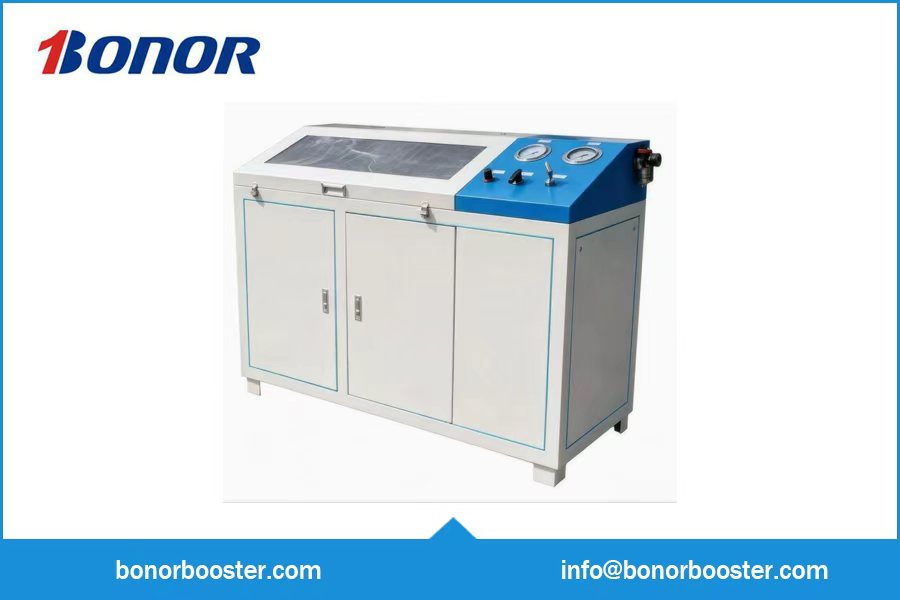
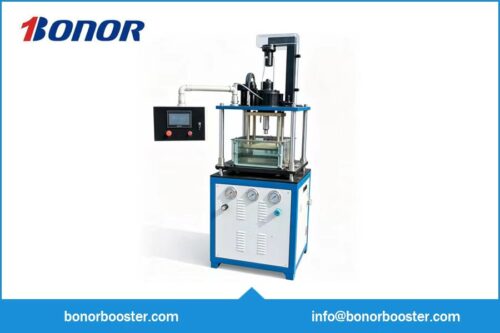
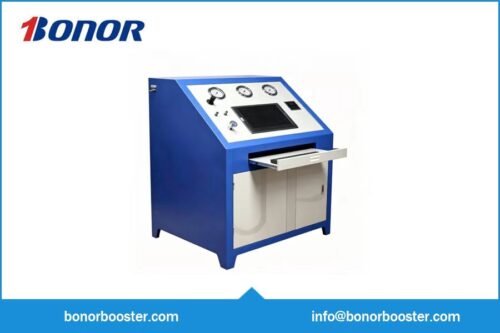
Manufactured by Jinan Bonor, the fire extinguisher air tightness test chamber is used for pressure resistance inspection of fire extinguisher cylinders. This multi-functional cylinder hydrostatic tester is developed in full compliance with national standards: GB4351.1-2005 Portable fire extinguishers, GB/T4351-2005 Part 3: Inspection rules, GB8109-2005 Wheeled fire extinguishers.
2. Equipment Features
- Equipped with Bonor booster pump to realize pressure boosting.
- Hydrostatic test pressure is adjustable and controllable accurately.
- Built-in water collecting tank to contain leaked water from tested samples.
3. Technical Parameters
- Test medium: Tap water
- Temperature control range: 5℃ ~ 55℃
- Temperature control accuracy: ±1℃
- Heating power: 3KW
- Loading capacity for each test batch: 10 pcs of 2kg fire extinguishers, 6 pcs of 8kg fire extinguishers, 1 pc of 35kg wheeled fire extinguisher
Applications of the air tightness test bench
A leak test is only useful if it can resolve the leak rate that actually matters — and that rate is often tiny. The Fire Extinguisher Air Tightness Test bench measures pressure decay, flow or tracer gas with enough resolution to separate a good part from a marginal one, and does it in cycle times that fit a production line.
- Cylinder and vessel production — leak verification after valve fitting, before filling or dispatch.
- Automotive components — fuel systems, EV battery housings, lamps and connectors tested for ingress protection.
- Vehicle assembly — whole-vehicle air tightness verification for NVH, water ingress and HVAC performance.
What to specify before we build yours
- Leak rate to be detected — expressed in ml/min, Pa/s or ppm; this single number decides the method, the sensor and the chamber.
- Test pressure and part volume — decay time scales with volume, so a large part at low pressure needs a different approach from a small part at high pressure.
- Method — pressure decay, differential pressure, mass flow or helium; each has a different sensitivity and cost.
- Automation level — manual clamp-and-press, semi-automatic with a fixture, or a station integrated into a conveyor line.
How to choose a air tightness test bench
Most leak-test problems come from the specification, not the instrument. These three questions decide the machine:
- Start from the allowable leak rate. Convert it into a pressure-decay value for your part volume, then check that the sensor can resolve one tenth of it. If it cannot, no amount of averaging will fix the measurement.
- Control the temperature and the fixture. Air expands when it warms, so a part that is still hot from brazing will show a pressure rise that looks like a leak. A stabilisation time and a temperature-compensated sensor are worth more than a faster valve.
- Decide pass/fail limits before delivery. Run known-good and known-bad samples during commissioning and store the limits in the recipe, otherwise the operator will adjust them by feel on the first difficult batch.
Frequently asked questions
What leak rate can the machine detect?
It depends on part volume and method. Pressure-decay instruments typically resolve a pressure change equivalent to a few tenths of a millilitre per minute on a small part; helium systems reach far lower rates but need tracer gas and a vacuum chamber. We size the sensor against the rate you need to detect.
Pressure decay or helium — which do I need?
Pressure decay is cheaper, needs only compressed air and is enough for most industrial parts. Helium is chosen when the allowable leak is very small, the part is flexible, or the test must be done at low differential pressure.
Can it run inside an automated line?
Yes. The bench can be supplied with pneumatic clamping, a PLC interface and digital I/O so a robot or conveyor can load and unload it. The test recipe and the result are passed over the same interface.
Related equipment and further reading
Need a pressure range, fixture or test standard that is not listed here? Send the specimen list and the standard you test to and we will come back with a configuration and a price within one working day.