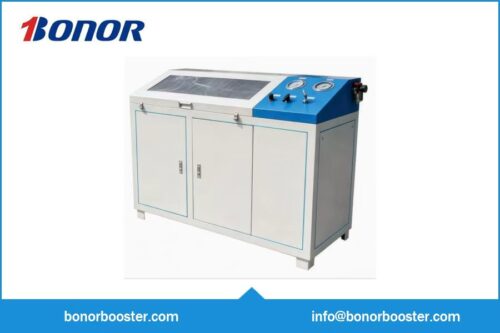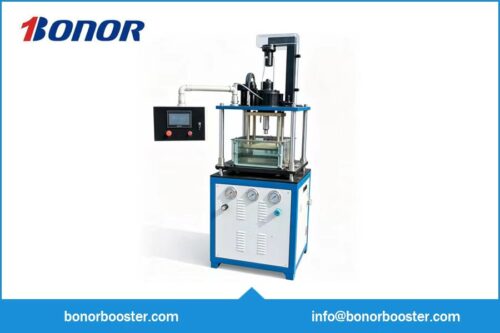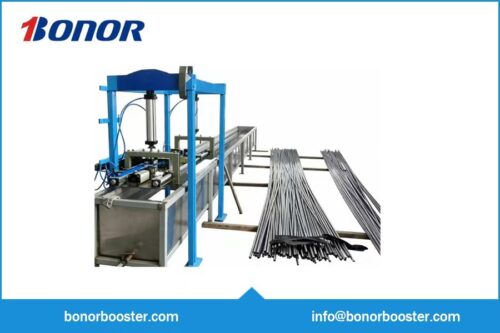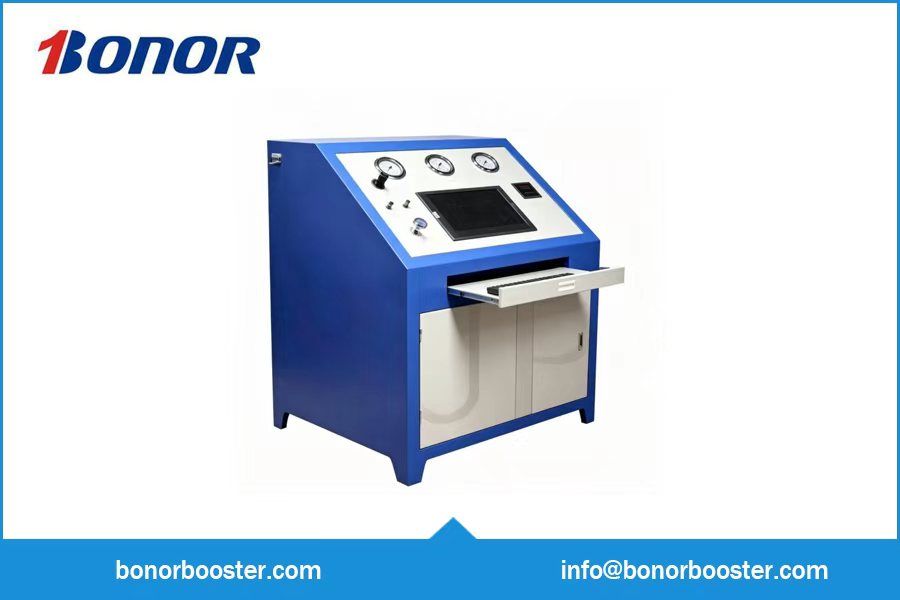
The Gas Cylinder Air tightness Test Bench is built for pressure-decay and flow leak detection. The sensor is sized against the leak rate you need to resolve, not against the pressure rating.
Description
Product Introduction
The gas cylinder air tightness test bench consists of guide rails, water tank, isolation device and control panel. The control panel is equipped with pipelines, valves, valve switches, pressure gauges, test cylinder connectors, vent pipes and high-pressure gas source connectors. It is widely used in manufacturers, quality inspection institutes, scientific research institutions for factory inspection and R&D tests of various gas cylinders.
Test Conditions
- The ambient temperature for air tightness test shall not be lower than 5℃.
- Tested cylinders shall pass hydrostatic test in advance (except dissolved acetylene cylinders and cylinders prohibited from water ingress during testing). The inner wall of cylinders shall be free of oil stains and other contaminants.
- Charge the tested cylinder to the specified test pressure at the regulated filling rate according to relevant standards. The filling rate of dissolved acetylene cylinders shall be controlled below 0.3MPa/min.
Product Features
- Automatic pressure holding: The system will automatically supplement pressure once outlet pressure drops to keep pressure stable constantly.
- Stepless pressure regulation: The output pressure can be adjusted flexibly by changing driving pressure.
- Fast pressure build-up: The system can quickly reach target pressure after accessing driving gas.
- Gas-driven structure: No power supply or wiring needed, safe in operation with intrinsic explosion-proof performance.
- Optional control modes: Manual control mode and computer automatic control mode are both available.
Applications of the air tightness test bench
A leak test is only useful if it can resolve the leak rate that actually matters — and that rate is often tiny. The Gas Cylinder Air tightness Test Bench measures pressure decay, flow or tracer gas with enough resolution to separate a good part from a marginal one, and does it in cycle times that fit a production line.
- Automotive components — fuel systems, EV battery housings, lamps and connectors tested for ingress protection.
- Vehicle assembly — whole-vehicle air tightness verification for NVH, water ingress and HVAC performance.
- Cylinder and vessel production — leak verification after valve fitting, before filling or dispatch.
What to specify before we build yours
- Leak rate to be detected — expressed in ml/min, Pa/s or ppm; this single number decides the method, the sensor and the chamber.
- Test pressure and part volume — decay time scales with volume, so a large part at low pressure needs a different approach from a small part at high pressure.
- Method — pressure decay, differential pressure, mass flow or helium; each has a different sensitivity and cost.
- Automation level — manual clamp-and-press, semi-automatic with a fixture, or a station integrated into a conveyor line.
How to choose a air tightness test bench
Most leak-test problems come from the specification, not the instrument. These three questions decide the machine:
- Start from the allowable leak rate. Convert it into a pressure-decay value for your part volume, then check that the sensor can resolve one tenth of it. If it cannot, no amount of averaging will fix the measurement.
- Control the temperature and the fixture. Air expands when it warms, so a part that is still hot from brazing will show a pressure rise that looks like a leak. A stabilisation time and a temperature-compensated sensor are worth more than a faster valve.
- Decide pass/fail limits before delivery. Run known-good and known-bad samples during commissioning and store the limits in the recipe, otherwise the operator will adjust them by feel on the first difficult batch.
Frequently asked questions
What leak rate can the machine detect?
It depends on part volume and method. Pressure-decay instruments typically resolve a pressure change equivalent to a few tenths of a millilitre per minute on a small part; helium systems reach far lower rates but need tracer gas and a vacuum chamber. We size the sensor against the rate you need to detect.
Pressure decay or helium — which do I need?
Pressure decay is cheaper, needs only compressed air and is enough for most industrial parts. Helium is chosen when the allowable leak is very small, the part is flexible, or the test must be done at low differential pressure.
Can it run inside an automated line?
Yes. The bench can be supplied with pneumatic clamping, a PLC interface and digital I/O so a robot or conveyor can load and unload it. The test recipe and the result are passed over the same interface.
Related equipment and further reading
- Breathing Valve Airtightness Test Bench
- Battery Air tightness Tester
- High Pressure Air Tightness Test Bench
- All Air Tightness Testing Machine models and specifications
- Hydrostatic pressure test machine selection guide from spec to sign off
- The complete hydrostatic pressure test machine spare parts guide 2026
Need a pressure range, fixture or test standard that is not listed here? Send the specimen list and the standard you test to and we will come back with a configuration and a price within one working day.