
BONOR manufactures air booster pumps for industrial applications requiring higher compressed air pressure. These pumps are used in pressure testing, pneumatic systems, and other processes requiring increased air pressure.
Model selection depends on inlet pressure, required outlet pressure, air consumption, and operating conditions. Contact BONOR to discuss your requirements and select a suitable air booster pump.
Air Booster Pump: Working Principle, Features and Applications
How Does an Air Booster Pump Work?
An air booster pump increases the pressure of compressed air supplied by an existing air compressor. It uses the pressure difference between a large drive piston and a smaller compression piston to generate higher outlet pressure.
Compressed air drives the large piston, which moves the smaller piston through a connecting shaft. The smaller piston compresses the air in the high-pressure chamber. This cycle continues automatically until the required outlet pressure is reached or the system’s pressure control stops the pump.
The achievable pressure depends on the booster’s pressure ratio, drive-air pressure, and system configuration.
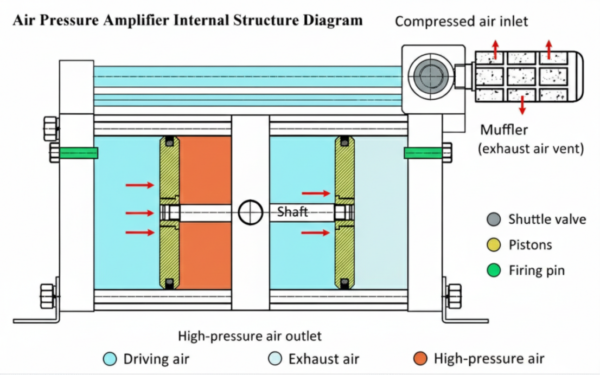
Air Booster Pump Internal Structure Diagram
Key Features of Air Booster Pumps
- High-pressure output: Increases the pressure of an existing compressed air supply without requiring a separate high-pressure air compressor for every application.
- Pneumatic drive: Uses compressed air to power the boosting process, making it suitable for applications where an electrically driven booster is not preferred.
- Automatic pressure control: With a suitable control system and air receiver, the pump can stop when the set pressure is reached and restart when pressure drops.
- Adjustable output: Outlet pressure can be regulated according to the model and system configuration.
- Flexible configurations: Different pressure ratios, flow capacities, and control options are available to suit specific operating requirements.
- Straightforward maintenance: The relatively simple piston design allows routine inspection and seal replacement when required.
Applications of Air Booster Pumps
PET Bottle Blow Molding
PET bottle production requires high-pressure compressed air to form bottles inside molds. An air booster pump can raise the pressure of an existing compressed air supply to meet the requirements of compatible blow molding equipment.
Industrial Pressure Testing
Air booster pumps supply the required pressure for testing pressure vessels, pipes, fittings, and other components. The appropriate setup depends on the test pressure, workpiece specifications, and applicable testing procedures.
Pneumatic Leak Testing
For pneumatic leak testing, an air booster pump can raise the air pressure to the required test level. The test system then monitors pressure changes or uses suitable leak detection methods to assess sealing performance. Appropriate safety measures are essential when testing with compressed gas.
Other Industrial Applications
Air booster pumps can also be used in pneumatic equipment, pressure testing systems, and other industrial processes that require a higher compressed air pressure than the existing supply provides.
How to Set Up an Air Booster System
A typical air booster system consists of an air compressor, a drive-air regulator, an air booster pump, and the necessary pressure control and safety components.
The compressed air supply is divided into two paths: one provides drive air to operate the pump, while the other supplies the air to be boosted. The regulator controls the drive-air pressure, and the booster increases the pressure of the process air before delivering it to the application.
The required components and operating settings depend on the target pressure, air consumption, and intended use. Always follow the manufacturer’s specifications and use suitable pressure-rated components, gauges, and overpressure protection.
Contact BONOR with your inlet pressure, required outlet pressure, and flow requirements to discuss a suitable air booster pump configuration.
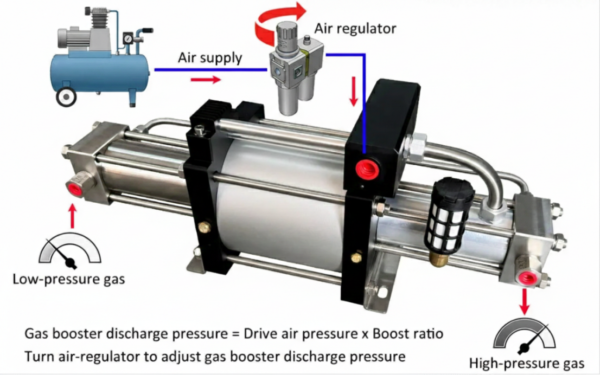
Pneumatic Air Booster Pump
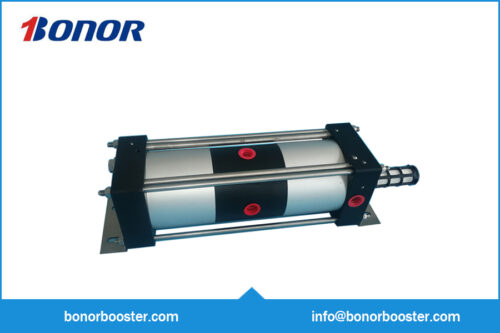
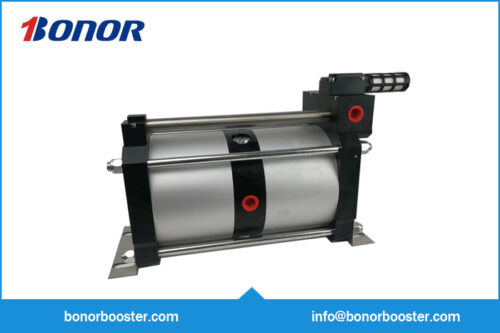
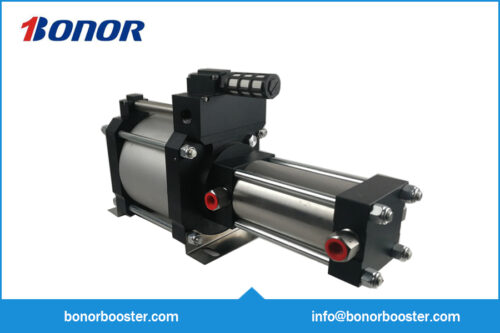
Air Booster Pumps: Raising Shop Air Pressure Without a Compressor
An air booster pump is a reciprocating, air-driven device that takes the compressed air you already have and delivers it at a multiple of that pressure. A plant running at 6 to 8 bar can reach 20, 40 or 80 bar at the point of use without buying a high-pressure compressor, without a pressure vessel inspection regime and without running a high-pressure line across the factory.
The pump is a large piston driven by shop air, connected to a smaller piston that compresses the same air. The ratio of the two areas is the boost ratio. Because the pump stalls and holds when outlet pressure balances drive pressure, it works naturally as a pressure maintainer: it cycles only when pressure falls, and it stops consuming air once the set point is reached.
Selection points that actually change the model
- Boost ratio, not headline pressure A 1:2, 1:4 or 1:5 ratio behaves very differently on a 5 bar line than on an 8 bar line. State your real drive pressure — the number on the gauge at the end of the shift, not the compressor nameplate.
- Flow at working pressure Free-air delivery figures flatter a booster. Ask for the flow curve against outlet pressure and pick the point where your process actually runs.
- Receiver volume A small receiver smooths the pulsing delivery of a reciprocating pump and reduces cycle frequency. Without one, pressure at the tool oscillates and the pump runs hot.
- Seal and body material Standard nitrile seals are fine for dry plant air. Oil carry-over, moisture or a corrosive atmosphere call for different seals, and an air dryer upstream usually pays for itself.
- Noise and mounting Boosters exhaust air on every stroke. If the unit sits next to an operator, specify a silenced exhaust and plan a mounting point that is not on thin sheet steel.
- Control package A regulator, gauge, relief valve and shut-off valve on a small panel turn a pump into an installation. Buying them separately is usually more expensive and harder to document.
Common air booster configurations
| Configuration | Characteristic | Good for |
|---|---|---|
| Single-stage, single-acting | Simplest, lowest cost, pulsed delivery | Intermittent use, clamping, single actuator |
| Single-stage, double-acting | Smoother delivery, higher flow for the same size | Continuous supply to a small receiver |
| Two-stage | Higher total ratio from a modest drive pressure | High outlet pressure where drive air is limited |
| Booster with receiver and controls | Stable pressure, ready to connect | Point-of-use pressure elevation in production |
Where air boosters earn their place
Typical duties are raising line pressure for a single machine that needs 12 or 16 bar, holding pressure on a clamping fixture, supplying air-assisted leak test fixtures, driving pneumatic presses that need more force than line pressure allows, and blow moulding or bottle filling where a short high-pressure pulse is required. In all of these the booster is a point solution: it converts an existing utility into a higher-pressure one at the place it is needed, which is usually cheaper and faster than changing the plant air system.
Frequently asked questions
What outlet pressure can I get from 6 bar drive air?
Can the pump run continuously?
Is the output air oil-free?
Can I use it for nitrogen instead of air?
Air booster models and background
Need help specifying? Send us your test pressure, specimen range and the standard you work to — talk to our engineers or use the inquiry form on any product page.