- Driving air pressure range: 0.1–0.69 MPa; output pressure is directly proportional to driving air pressure.
- Air consumption: 1 Nm³/min
- Test pressure range: 0–280 MPa, customized pressure range available according to customers’ actual demands.
- Applicable working media: water, hydraulic oil, emulsion fluid, etc.
- Portable automatic recorder can be optionally configured upon customer request.
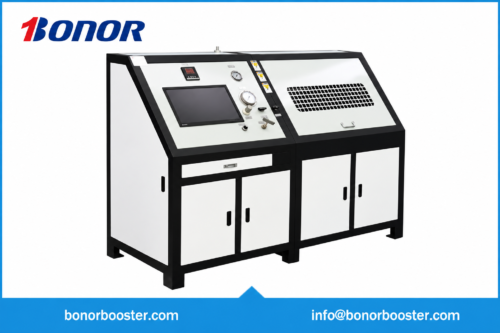
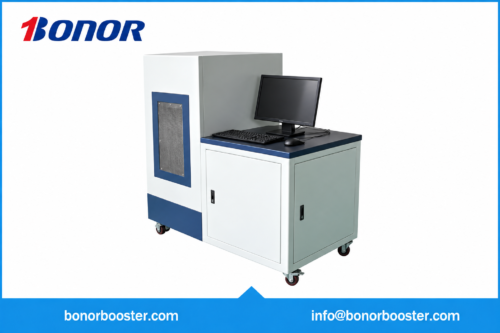
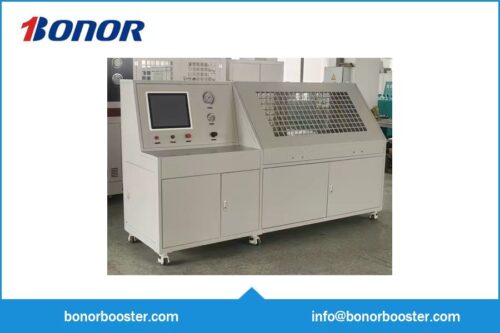
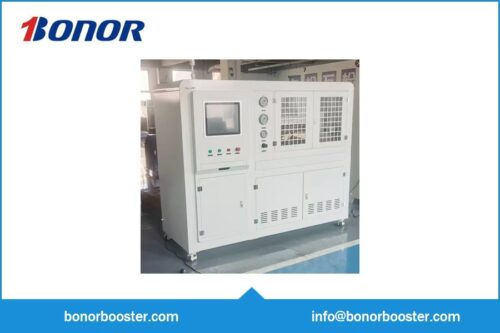
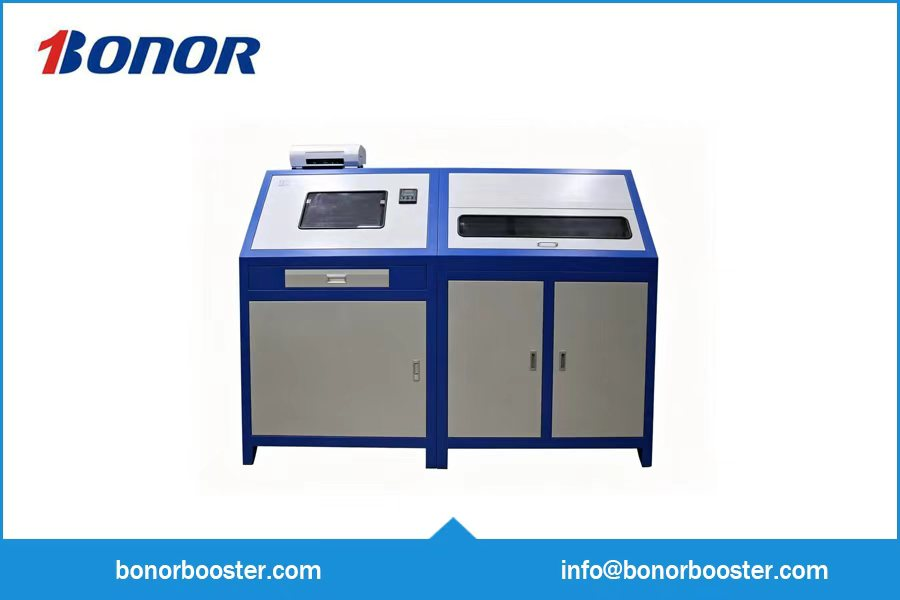
Fire Extinguisher Burst Testing Machine
Description
I. Application Scope
The fire extinguisher burst tester is designed for hydraulic burst strength testing of fire extinguisher cylinders. It is widely adopted by fire extinguisher manufacturers, product quality inspection institutions, scientific research institutes and other organizations for production inspection, product development and research of various fire extinguishers.
II. Control Mode
The whole test process is controlled by a microcomputer. The tester can display real-time pressure-time curves during testing. Test data can be automatically saved and printed out, and data will not be lost in case of power failure. Parameters including output pressure and pressure holding time can be freely set within the allowable range. Equipped with self-developed dedicated control software which is mature and stable, the equipment ensures the entire test process fully complies with relevant national standards.
III. Equipment Features
- Equipped with booster pump, the unit can reach the target test pressure precisely and support stepless regulation and stable control of output pressure.
- Featuring advanced technology and rational structural layout, the tester is compact, lightweight with neat and elegant appearance.
- All pressure-bearing components adopt standard parts from world-renowned brands with integral welding-free structure. The structure is easy to disassemble, equipped with high safety factor, long service life and low maintenance cost.
- Supported with computerized control, automatic data acquisition and pressure curve recording system, the operation is simple and safe.
IV. Technical Parameters
- Driving air pressure range: 0.1–0.69 MPa; output pressure is directly proportional to driving air pressure.
- Air consumption: 1 Nm³/min
- Test pressure range: 0–280 MPa, customized pressure range available according to customers’ actual demands.
- Applicable working media: water, hydraulic oil, emulsion fluid, etc.
- Portable automatic recorder can be optionally configured upon customer request.
 |
 |
What a burst pressure test bench does in production
Failure data ages quickly: a resin lot change, a new hose crimp or a different brazing cycle can move the burst point by tens of percent. The Fire Extinguisher Burst Testing Machine lets you re-check the margin whenever an input changes, in minutes rather than days. On this configuration the emphasis is fire extinguisher: the fixture, the ramp profile and the recording settings are arranged around that job first, and other specimen families can be added later.
- Third-party inspection and R&D — test houses and material laboratories that need a traceable pressure-versus-time curve for a report or a design iteration.
- Automotive hose and tubing lines — brake, fuel, power steering, air-conditioning and coolant assemblies, tested to the burst and hold-pressure values on the drawing.
Every Fire Extinguisher Burst Testing Machine is laid out around its duty cycle, and here that means fire extinguisher. The controls, the guards and the record format follow from that.
What to specify before we build yours
- Test medium — water, oil, glycol mixture or air; the choice changes the pump, the plumbing and the safety enclosure. The setting here follows the part you run most.
- Specimen envelope and clamping — hose bore and length, pipe diameter, cylinder height and the fixture that holds the part without crushing it. The setting here follows the part you run most.
- Air consumption — 1 Nm³/min (confirmed for this unit).
The way this particular bench is set up: As configured, air consumption is 1 nm³/min.
Currently configured as: Air consumption: 1 Nm³/min. Other ranges and fixture sets are available to order.
What to look for in a burst pressure test bench
Most dissatisfaction with burst benches traces back to a specification written from a catalogue instead of from the specimen. These checks keep the order honest:
- Look at how the fixture treats the specimen ends. Crushed hose, slipped plugs and scratched faces produce failures that say more about the clamp than the part. A good fixture spreads the grip and keeps the ends free to move the way they will in service.
- Match the pressure range to the specimen, not to the catalogue. A bench rated at 200 MPa running at 25 MPa loses resolution in both the gauge and the control loop. Ask for a range that puts your normal part test point in the middle third of the scale.
- Records for the part. The report is laid out with the fields your part standard asks for, so a result leaves the shop as a certificate rather than a rewrite job.
Frequently asked questions
What is the difference between radial and axial clamping for hoses?
Radial gripping squeezes the hose cover and can allow a small slip at very high pressure; axial loading pulls the fittings apart the way service does. The right choice depends on what you need to learn — fitting retention or wall strength. Many labs keep both and pick per sample. For the part work this bench is quoted for, that answer is written into the acceptance protocol.
What is the difference between a burst test and a proof-pressure test?
A proof test holds the part at a defined pressure — usually 1.5 times the working pressure — for a set time and checks that it neither leaks nor deforms permanently. A burst test keeps raising the pressure until the part fails, so the result is the failure pressure itself. The same bench can normally do both; the difference is the control programme and whether the specimen survives. Our quotation for the Fire Extinguisher Burst Testing Machine states this explicitly, so there is nothing to discover at acceptance.
Related equipment and further reading
- Plastic Ball Valve Pressure and Burst Testing Machine
- Radiator Burst Test Bench
- High-pressure hose burst testing machine
- The complete Burst Pressure Test Bench line-up
- How a burst test bench works
- Uses of a burst bench
Every bench is quoted around a real specimen list. Send yours with the working pressure and you will have a costed proposal, not a brochure, within one working day.