Description
1. Product Overview
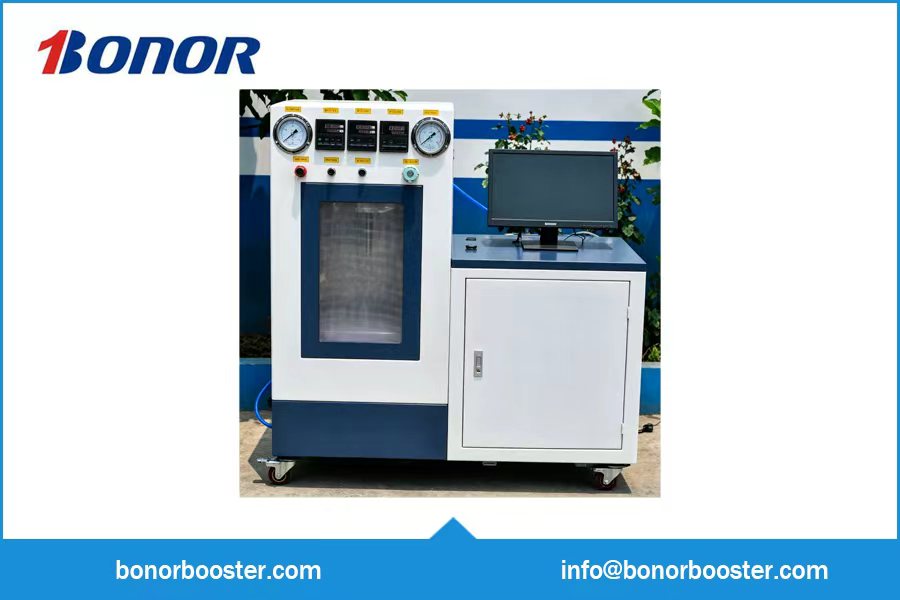
Tinplate, also known as tin-coated iron, refers to iron sheet plated with a thin tin layer on the surface with excellent rust resistance. The tin can burst pressure tester manufactured by Jinan Bonor Machinery Co., Ltd. is computer-controlled to conduct pressure tests and burst pressure measurement for tin cans.
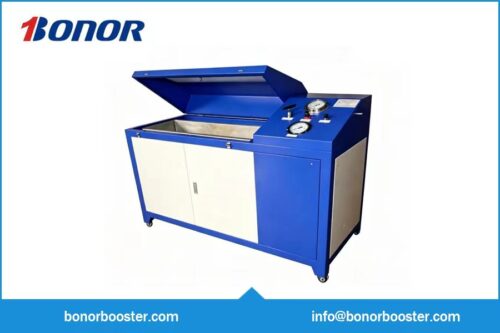
During testing, the tin can is fixed on the test bench. The pressurizing pump injects liquid pressure medium into the can until structural burst occurs, with the system recording the accurate burst pressure value. This equipment is widely applied for pressure deformation tests and ultimate burst pressure verification of tin packaging cans.

2.Equipment Features
Equipped with an explosion-proof cabinet to guarantee operator safety and prevent liquid splashing during the bursting process.
Adopts computerized control system to output real-time pressure test curves.
All pressure-bearing components are standard parts sourced from internationally renowned brands. The weld-free structural design enables easy disassembly, high safety factor, long service life and convenient maintenance.
3. Technical Parameters
- Clamping force of clamping cylinder: 0.2–0.8 MPa
- Air consumption: 1 m³/min
- Rated burst test pressure range: 4 MPa
- Test medium: Clean water
- Computer-based data acquisition system is optional upon customer requirements
Where a burst pressure test bench is used
Between a part that passed a hold test and a part that actually burst, there is a margin somebody is betting a shipment on. The tin can burst test bench turns that bet into a measurement: pressure rises under control until the specimen gives, and the exact value is logged. This unit is laid out primarily for tin can. If your sample list also covers other families, tell us — the pressure section is shared, only the fixture changes.
- Rubber and polymer product development — diaphragms, bladders and reinforced membranes where the fabric layout decides the failure mode.
- Automotive hose and tubing lines — brake, fuel, power steering, air-conditioning and coolant assemblies, tested to the burst and hold-pressure values on the drawing.
- Tinplate and aerosol can makers — seam and base burst values logged per material lot.
Every tin can burst test bench is laid out around its duty cycle, and here that means tin can. The controls, the guards and the record format follow from that.
What to specify before we build yours
- Specimen envelope and clamping — hose bore and length, pipe diameter, cylinder height and the fixture that holds the part without crushing it. On this unit it is arranged for the canister.
- Recording requirement — whether you need a printed curve per sample, a database record, or only a pass/fail lamp. It is set up here for the canister.
- Air consumption — 1 m³/min (confirmed for this unit).
The way this particular bench is set up: Here air consumption is set to 1 m³/min. As configured, test medium is clean water.
Currently configured as: Air consumption: 1 m³/min. Other ranges and fixture sets are available to order.
Choosing the right burst pressure test bench
Two quotations can quote the same maximum pressure and still be built for different jobs. Before you compare prices, pin down the points below:
- Budget for the instrumentation, not just the pump. The pressure source is half the story; the transducer, sampling rate and the way the curve is stored decide whether a failure point is an engineering result or a guess. Instrumentation is cheap next to a re-test programme.
- Look at how the fixture treats the specimen ends. Crushed hose, slipped plugs and scratched faces produce failures that say more about the clamp than the part. A good fixture spreads the grip and keeps the ends free to move the way they will in service.
- Fixture fit for the canister. The clamping set is drawn around your canister drawings first, so the part sits square without shimming — and the same fixture family extends to other sizes later.
Frequently asked questions
Can you test two specimens at the same time?
Only if they fail at similar pressures and you accept that the first failure ends the test for both. Parallel circuits with independent valves remove that limit but add cost. For most labs, serial testing gives cleaner data per sample. With tin can as the main duty, we verify this point on your parts before the machine ships.
What happens to the data if the power fails mid-test?
The controller writes samples continuously rather than at the end, so a power cut costs you the specimen but not the portion of the curve already recorded. The log is marked as interrupted so nobody mistakes a partial file for a complete test. Every tin can burst test bench we ship is commissioned against this point with your own samples present.
Related equipment and further reading
Every bench is quoted around a real specimen list. Send yours with the working pressure and you will have a costed proposal, not a brochure, within one working day.