- Driving air pressure range: 0.1–0.69 MPa
- Air consumption: 1 m³/min
- Pressure testing range: 0–280 MPa
- Working medium: Water / Hydraulic oil
- Optional control modes: Manual control & automatic control
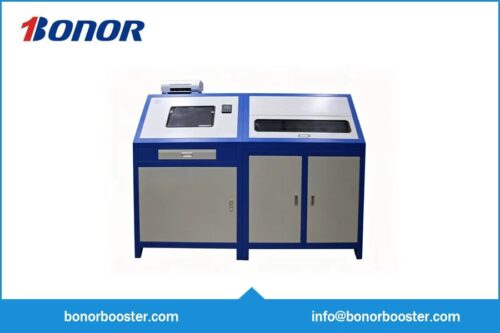
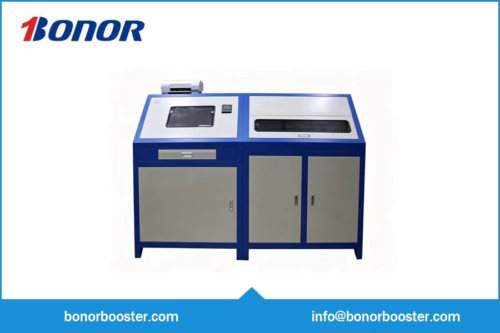
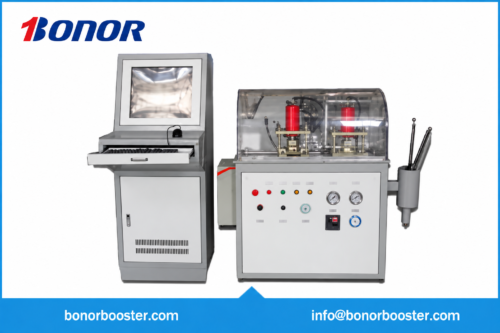
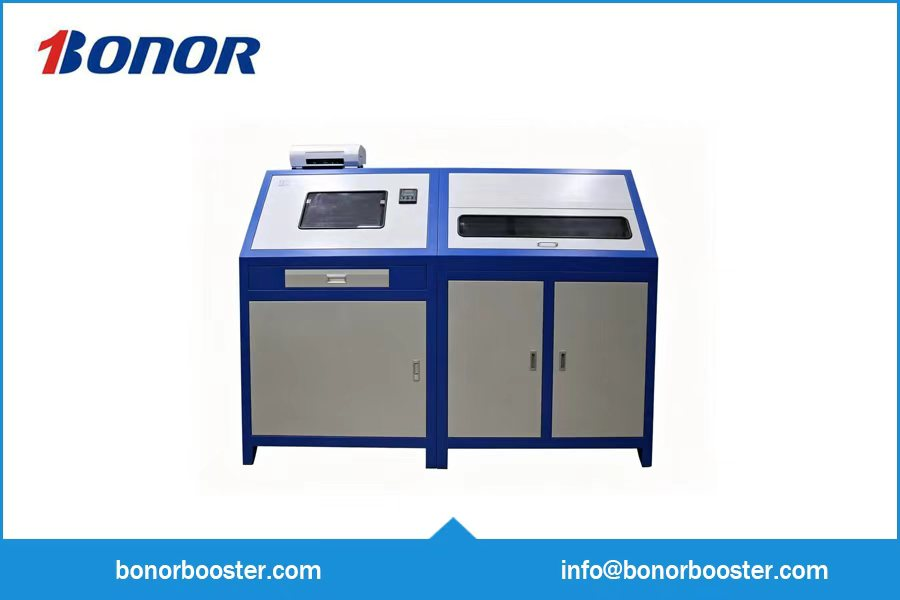
Bursting Disc Burst Test Machine
Description
Ⅰ. Application Scope of Rupture Disc Burst Pressure Tester
The rupture disc burst pressure tester manufactured by Jinan Bonor is designed for burst pressure tests of rupture discs. The pressure is stepless adjustable with Simtete booster pump, which supports staged pressure testing, bursting and fracture experiments. Controlled by computer, the equipment realizes full-automatic test operation and automatic measurement, featuring strong professionalism and high reliability.
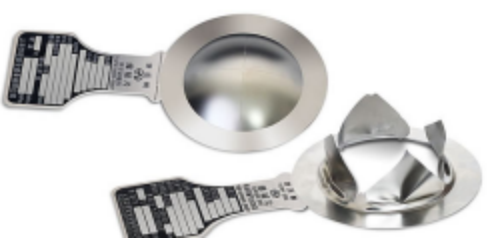
Ⅱ. Equipment Features of Rupture Disc Burst Tester
- Equipped with pneumatic-hydraulic booster pump to realize adjustable and controllable pressure output.
- Adopts non-welded structure; steel pipes are applied for internal pipelines, compatible with media such as clean water and hydraulic oil.
- Automatically record the actual burst pressure value in the test process.
Ⅲ. Technical Parameters
- Driving air pressure range: 0.1–0.69 MPa
- Air consumption: 1 m³/min
- Pressure testing range: 0–280 MPa
- Working medium: Water / Hydraulic oil
- Optional control modes: Manual control & automatic control
What a burst pressure test bench does in production
A burst number on a datasheet is only worth what the test behind it is worth, and the test is only as good as the bench that ran it. The Bursting Disc Burst Test Machine gives your laboratory or production line one fixed reference: same clamp, same rate, same report, every sample. This unit is laid out primarily for bursting disc. If your sample list also covers other families, tell us — the pressure section is shared, only the fixture changes.
- Rubber and polymer product development — diaphragms, bladders and reinforced membranes where the fabric layout decides the failure mode.
- Pipe and fitting extrusion — PE, PVC, PP-R and composite pipe sampled from each production run to confirm the hoop stress assumption behind the pressure rating.
- Bursting-disc production — actual rupture pressure of each lot verified against the stamped rating.
In daily use the Bursting Disc Burst Test Machine sees mostly bursting disc. That decides the fixture style, the approach rate and what the operator actually does between tests.
What to specify before we build yours
- Maximum test pressure and pressure-holding time — the bench is sized around your highest specimen rating plus a safety margin, not around the average. The setting here follows the bursting disc you run most.
- Specimen envelope and clamping — hose bore and length, pipe diameter, cylinder height and the fixture that holds the part without crushing it. On this unit it is arranged for the bursting disc.
- Air consumption — 1 m³/min (confirmed for this unit).
Configuration on the current build: The specification calls for air consumption of 1 m³/min.
Currently configured as: Air consumption: 1 m³/min. Other ranges and fixtures are built to order.
Choosing the right burst pressure test bench
Two quotations can quote the same maximum pressure and still be built for different jobs. Before you compare prices, pin down the points below:
- Match the pressure range to the specimen, not to the catalogue. A bench rated at 250 MPa running at 30 MPa loses resolution in both the gauge and the control loop. Ask for a range that puts your normal bursting disc test point in the middle third of the scale.
- Think about who operates it. A laboratory bench used by engineers can be manual and flexible; a production fixture used by rotating operators should be one-button with automatic pass/fail and interlocks. Specify for the actual operator, not the ideal one.
- Fixture fit for the bursting disc. The clamping set is drawn around your bursting disc drawings first, so the part sits square without shimming — and the same fixture family extends to other sizes later.
Frequently asked questions
What is the difference between a burst test and a proof-pressure test?
A proof test holds the part at a defined pressure — usually 1.5 times the working pressure — for a set time and checks that it neither leaks nor deforms permanently. A burst test keeps raising the pressure until the part fails, so the result is the failure pressure itself. The same bench can normally do both; the difference is the control programme and whether the specimen survives. In practice, the bursting disc dictates the answer here — and that is what the quotation is built around.
Is water always the medium for burst testing?
Water is the default because it is incompressible and safe, but it is not universal. Air or nitrogen is required when the part must stay dry, and oil when corrosion matters. Each medium changes the pump, the instrumentation and the safety provisions, which is why the medium is fixed at the design stage. Our quotation for the Bursting Disc Burst Test Machine states this explicitly, so there is nothing to discover at acceptance.
Related equipment and further reading
- Plastic Ball Valve Pressure and Burst Testing Machine
- High-pressure hose burst testing machine
- PET Bottle Bursting Tester
- Burst Pressure Test Bench — models and specifications
- Inside a burst test bench
- Uses of a burst bench
Bench or fixture questions we have not answered here? Write us the specimen and the standard — a configuration with pricing follows within one working day.