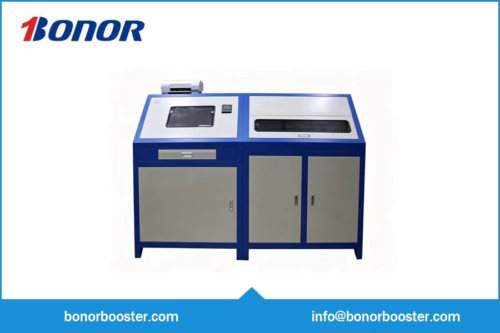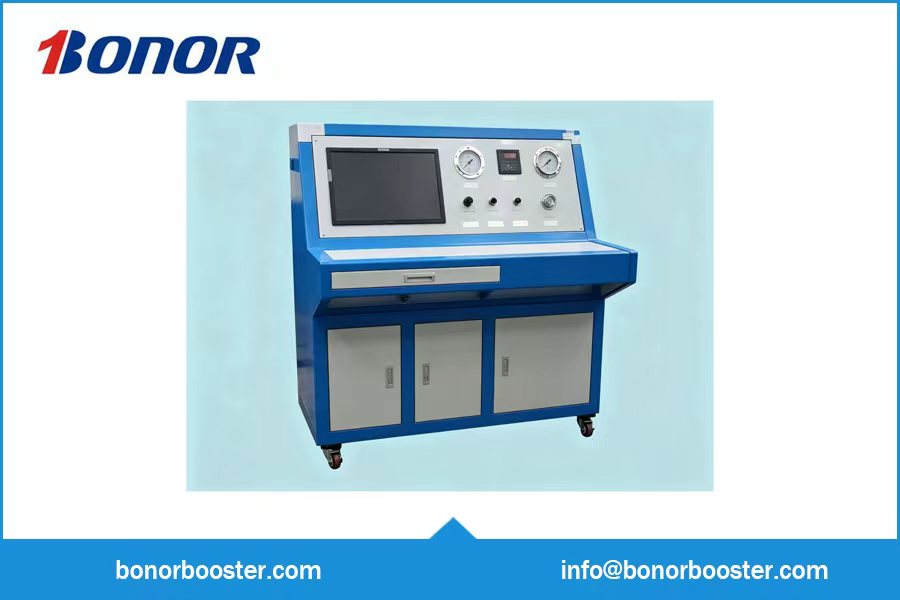
The Tire Hydrostatic Burst Testing Machine is built for burst and proof-pressure testing. Clamping fixtures are quoted around the specimen, and the pressure curve is stored with the test ID.
Description
I. Application Scope
The tire hydrostatic pressure & bursting test equipment developed by Jinan Bonor is applicable to hydrostatic bursting and pressure resistance tests for sedan tires, heavy-duty tires, motorcycle tires, electric bicycle tires, engineering machinery tires and accumulator tires. It complies with test standards including GB/T4501-2008, GB/T4502-2009 and HG 2186-1991. Test data can be automatically collected into a computer without manual intervention to facilitate product quality traceability.
II. Characteristics of Tire Hydrostatic Bursting Tester
- Powered by booster pump as the core driving unit; output pressure and pressurization duration are fully adjustable and controllable.
- Multiple control modes available: manual control or computer software control.
- All components adopt non-welded connections for convenient maintenance, safe and stable operation.
- Equipped with an efficient vacuum pump.
- The tester collects real-time tire pressure data during testing, which is processed and displayed graphically by the computer. Additional functions include automatic timing, automatic recording of bursting pressure and real-time rendering of pressure curves, delivering comprehensive test data reports.
III.Technical Parameters of Tire Hydrostatic Bursting Tester
- Data recording mode: manual recording or computer recording (optional)
- Rated working pressure: 10 MPa (customizable), adjustable within a specified range
- Pressure display options: pressure gauge, digital display meter, computer software display (optional)
- Pressure control accuracy: +2% / -1% relative to the upper limit of the set test pressure
- Test medium: Water
- Installation mode: Manual
What a burst pressure test bench does in production
Failure data ages quickly: a resin lot change, a new hose crimp or a different brazing cycle can move the burst point by tens of percent. The Tire Hydrostatic Burst Testing Machine lets you re-check the margin whenever an input changes, in minutes rather than days. On this configuration the emphasis is tire hydrostatic: the fixture, the ramp profile and the recording settings are arranged around that job first, and other specimen families can be added later.
- Aerospace and defence small components — compact actuators, reservoirs and tubing bundles with tight burst-margin documentation.
- Heat exchangers and radiators — tanks, headers and tubes pressure-tested after brazing or welding to catch joint defects that leak only above working pressure.
- Tire and bladder testing — hydrostatic burst verification of casings and curing bladders.
In daily use the Tire Hydrostatic Burst Testing Machine sees mostly tire hydrostatic. That decides the fixture style, the approach rate and what the operator actually does between tests.
What to specify before we build yours
- Recording requirement — whether you need a printed curve per sample, a database record, or only a pass/fail lamp. It is set up here for the tire casing.
- Maximum test pressure and pressure-holding time — the bench is sized around your highest specimen rating plus a safety margin, not around the average. On this unit it is arranged for the tire casing.
How the standard build is set up here: As configured, test medium is water.
Selecting a burst pressure test bench for your line
Most dissatisfaction with burst benches traces back to a specification written from a catalogue instead of from the specimen. These checks keep the order honest:
- Budget for the instrumentation, not just the pump. The pressure source is half the story; the transducer, sampling rate and the way the curve is stored decide whether a failure point is an engineering result or a guess. Instrumentation is cheap next to a re-test programme.
- Ask for the ramp profile in writing. A burst value depends on how fast pressure rises — a fast ramp can hide a weak seam and a slow one can fatigue it. A bench that stores and re-plays the ramp is the only way two tests can be compared fairly.
- Handling for the tire casing. Loading height, clamping force and the drain path are arranged for the tire casing you run most, which is where the daily minutes are won or lost.
Frequently asked questions
Do burst results change with temperature?
They can, sometimes by a lot — polymers lose strength quickly as temperature rises, and metals shift more slowly. If your parts serve hot, test hot or at least document the temperature of every test. The bench can log specimen temperature alongside pressure so the two curves stay together in the record. In practice, the tire casing dictates the answer here — and that is what the quotation is built around.
What safety measures are needed for air or gas testing?
Gas testing stores far more energy than liquid testing at the same pressure, so the bench needs a vented enclosure, an interlocked door, and a remote start. If your standard allows liquid testing, liquid is always the safer route and needs no enclosure. On the Tire Hydrostatic Burst Testing Machine, that is part of the standard delivery, not an option.
Related equipment and further reading
- Burst Pressure Test Machine for Hydraulic Hose
- High-pressure hose burst testing machine
- PVC Hose Hydrostatic Pressure Burst Test Machine
- The complete Burst Pressure Test Bench line-up
- How a burst test bench works
- Where burst benches are used
If the parts you need to burst-test are not covered above, send a drawing or a photo with the test pressure and our engineers will come back with a fixture proposal within one working day.