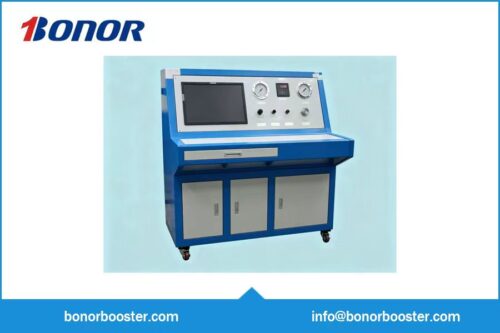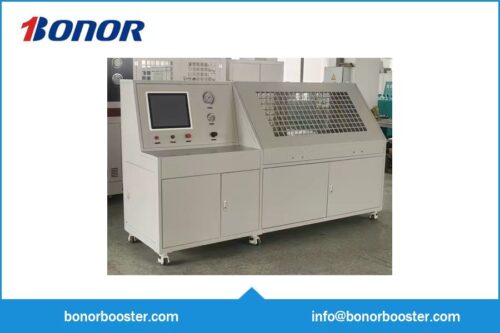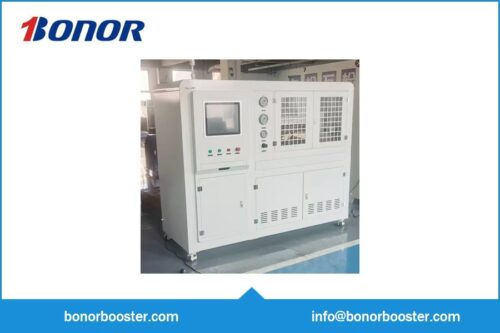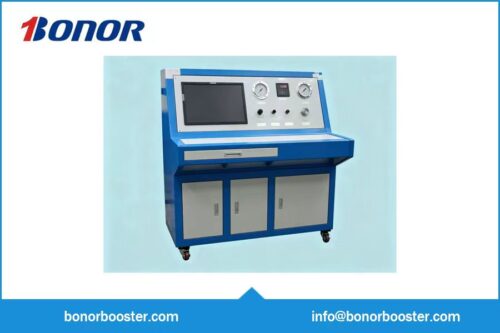
- Test pressure range: 0–2 MPa
- Volume expansion test unit: mL
- Operating temperature: 0–60°C
- Tap water supply pressure: 0.1–0.3 MPa
- Test gas cylinder volume: 3 L
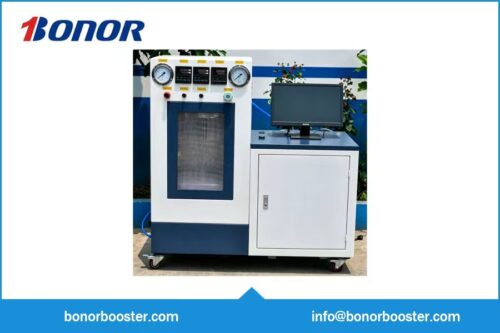
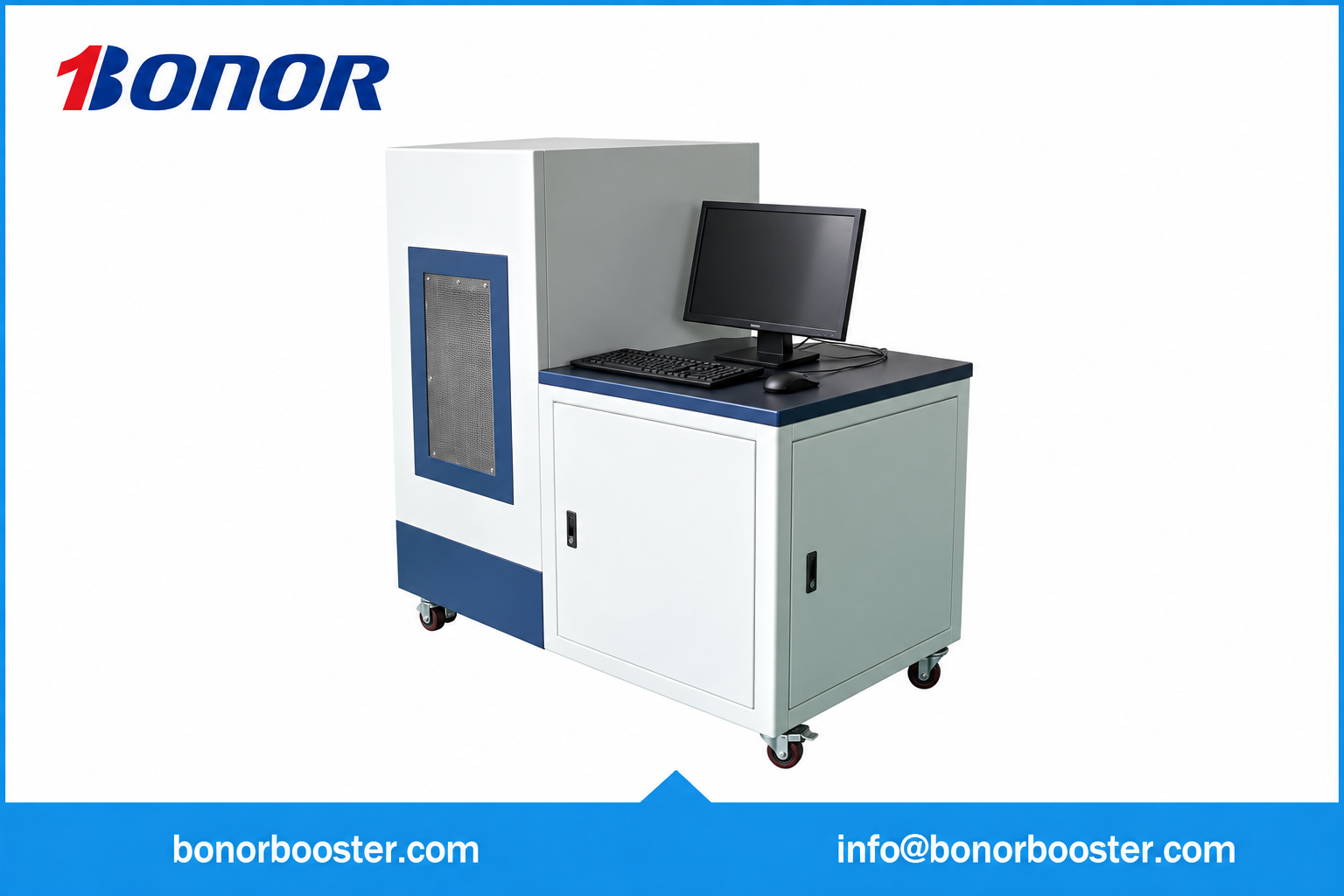
PET Bottle Burst Testing Machine
Description
I. Application Scope
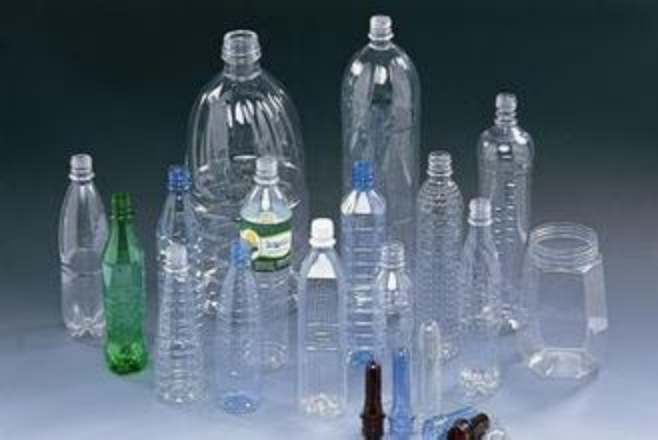
The PET bottle bursting tester manufactured is designed to test the pressure bearing capacity of gas bottles by simulating actual filling working conditions. This equipment supports stepless pressure regulation and constant-speed pressurization. The PET bottle will be rapidly pressurized to the preset pressure value set by the operator and held for 13 seconds. Afterwards, the pressure rises continuously at a rate of 0.7 bar per second until the container ruptures or reaches the preset threshold of pressure or volume expansion.
Available input parameters include the initial preset pressure as well as limit values for pressure and volumetric expansion. Adopting computerized automatic control, the machine can automatically clamp test samples via air cylinders and perform automatic water filling.
II. Technical Parameters
- Test pressure range: 0–2 MPa
- Volume expansion test unit: mL
- Operating temperature: 0–60°C
- Tap water supply pressure: 0.1–0.3 MPa
- Test gas cylinder volume: 3 L
III. Features of PET Bottle Test Bench
- Adopts computerized control to guarantee stable and reliable test performance.
- Equipped with high-precision control system and data acquisition system, which records and analyzes various test parameters (pressure, time, deformation, etc.) in real time. It is also integrated with multiple safety protection mechanisms including overload protection and overpressure protection to ensure safe test operation.
- Real-time curve display: pressure-time curve, expansion volume-time curve as well as pressure-expansion volume curve are available for visual monitoring.
- Supports real-time water temperature collection during testing.
- Test reports can be exported and all experimental data can be saved upon test completion.
Typical uses of a burst pressure test bench
Destructive testing only pays for itself if the results are comparable between shifts, operators and weeks. The PET Bottle Bursting Tester removes the human variables — clamping force, pressurisation rate and detection threshold are all set by programme, not by feel. The typical workload here is pet bottle bursting, so the clamping and detection settings are tuned for that from the factory; commissioning includes running your own samples to prove it.
- Packaging and containers — PET bottles, tin cans and aerosol bodies tested for bottom burst and seam strength as part of packaging qualification.
- Third-party inspection and R&D — test houses and material laboratories that need a traceable pressure-versus-time curve for a report or a design iteration.
- PET and packaging plants — container bottom burst and seam strength measured as part of packaging qualification.
- PET bottle lines — burst and drop-strength verification on samples from each blow-moulding shift.
Day-to-day, the PET Bottle Bursting Tester works around one thing: the container. Loading, clamping and the report format are arranged so that a container goes from bench entry to signed result without re-work.
What to specify before we build yours
- Specimen envelope and clamping — hose bore and length, pipe diameter, cylinder height and the fixture that holds the part without crushing it. It is set up here for the container.
- Recording requirement — whether you need a printed curve per sample, a database record, or only a pass/fail lamp. The setting here follows the container you run most.
- Test pressure range — 0–2 MPa (confirmed for this unit).
This unit is configured as follows: On this machine test pressure range is 0–2 mpa.
Currently configured as: Test pressure range: 0–2 MPa. Different ranges or fixtures — built to order.
Selecting a burst pressure test bench for your line
Most dissatisfaction with burst benches traces back to a specification written from a catalogue instead of from the specimen. These checks keep the order honest:
- Check how the result is captured. A manual gauge and a peak-hold pointer are enough for a pass/fail check. If the customer asks for a curve, you need a transducer, a sampling rate fast enough to catch the fracture, and software that exports the file in a format your report can use.
- Verify the detection logic on site. Ask the supplier to demonstrate a false-drop test — a slow leak that must not be mistaken for a burst — during commissioning, and record the threshold settings in the acceptance protocol.
- Records for the container. The report is laid out with the fields your container standard asks for, so a result leaves the shop as a certificate rather than a rewrite job.
Frequently asked questions
How many samples does a burst test normally need per batch?
That is set by your standard or by the agreement with your customer, not by the bench. What the bench contributes is repeatability: when the clamp and the ramp are identical, three samples tell you more than ten scattered ones. Most of our customers run one to five samples per production batch plus a full programme per design change. In practice, the container dictates the answer here — and that is what the quotation is built around.
How long does a typical burst cycle take?
For most hose and pipe work, a few minutes: fill, ramp at the standard rate, failure, drain. Large vessels with big volume take longer mainly on fill and stabilisation. When you tell us the specimen volume and the target rate, we quote the realistic cycle time rather than the best case. On the PET Bottle Bursting Tester, that is part of the standard delivery, not an option.
Related equipment and further reading
- Plastic Ball Valve Pressure and Burst Testing Machine
- tin can burst test bench
- Fire Extinguisher Burst Testing Machine
- All Burst Pressure Test Bench models and specifications
- Uses of a burst bench
- Inside a burst test bench
Tell us what you burst, at what pressure, and how many per day — send the specimen list and we will reply with a layout, a cycle time and a price within one working day.