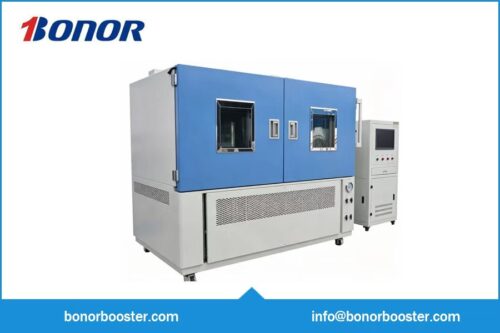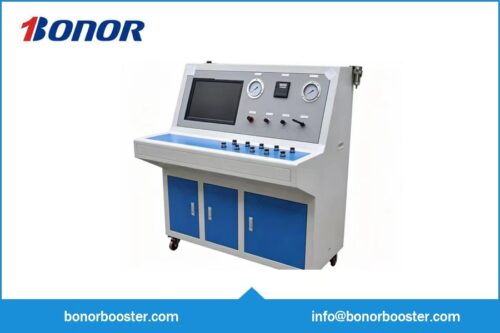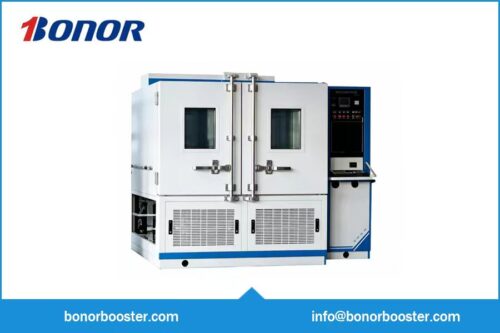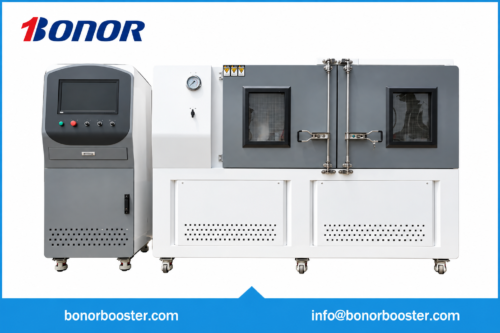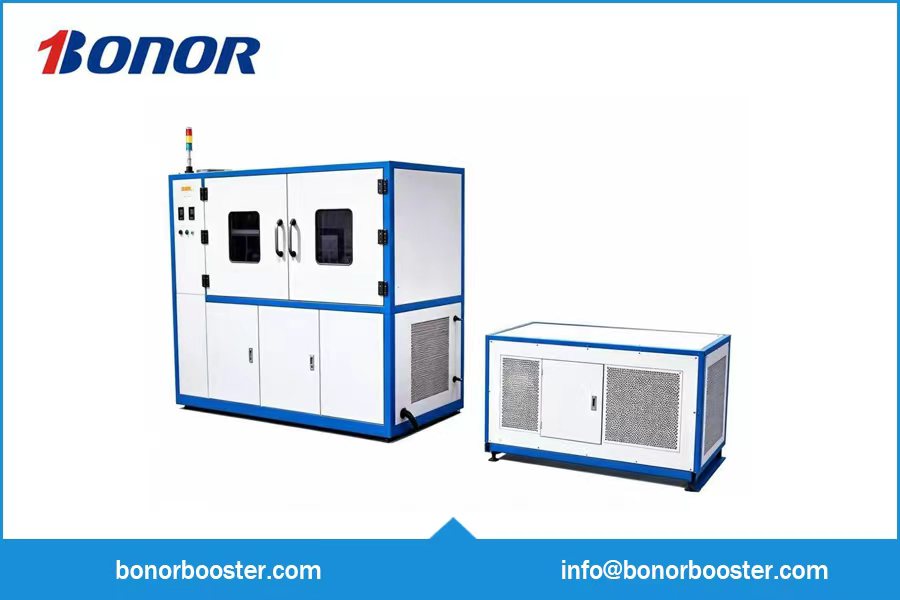
The Cyclic Fatigue Testing Machine is built for pressure pulse and fatigue cycling. Configured here as air consumption: 1 Nm/min. Cycle rate, waveform and shutdown logic are set for the protocol your product has to pass.
Description
1. Application Scope
Developed by Jinan Bonor, this cyclic fatigue tester is designed for pressure resistance and fatigue tests of gas cylinders and pressure vessels. It is widely adopted by quality inspection institutions, product testing stations, research institutes and manufacturers engaged in the production, development and research of gas cylinders & pressure vessels.
The pressure test system consists of a pressurization system and a control & display system:
- The pressurization system is mainly composed of liquid booster pumps to realize long-term pressurization and pressure holding during tests.
- The control & display system controls driving gas pressure, pressure relief and real-time pressure display.
Compliant Standards: GB/T9251-1997 Methods for Hydraulic Pressure Test of Gas Cylinders GB/T9252-2001 Methods for Fatigue Test of Gas Cylinders ISO 11439-2000 High-pressure Cylinders for On-board Natural Gas Vehicles
2. Control Mode & Data Acquisition Software
Two control modes are available: manual control and computer automatic control. The computer control system adopts a two-layer control framework composed of a microcomputer and PLC, featuring advanced control logic and independent control units to realize modular control. It delivers high-precision pressure control, stable pressure holding and automatic pressure replenishment in real time. Multiple independent test channels can run simultaneously without mutual interference. All test data and curves are automatically recorded and stored in the computer.
3. Equipment Advantages
- Equipped with Siminte gas-driven automatic booster pump for stepless adjustable and controllable output pressure.
- Adopts mature technology and reasonable structural layout, with compact size, light weight and elegant appearance.
- All pressure-bearing components adopt standard parts from well-known international brands with no welded joints, which brings convenient disassembly, high safety factor, long service life and easy maintenance.
4. Technical Parameters
Working Principle:The high-pressure pump generates high-pressure fluid according to the required test pressure of containers. The fluid is delivered to test specimens via high-pressure hoses after being regulated by the pressure control system, so as to carry out long-term static hydraulic tests and burst tests for containers.The computer is able to set and control pressure rising rate, target pressure and pressure holding duration.
- Driving air pressure range: 0.1–0.69 MPa; output pressure is proportional to driving air pressure
- Air consumption: 1 Nm/min
- Pressure test range: 0–70 MPa (customizable according to customer requirements)
- Working medium: water, hydraulic oil, emulsion
- Pressure Control Accuracy:+2% of upper pressure limit, -1% of lower pressure limit
- Pressure Resolution:1 MPa
- Pressure Sensor:Pressure sampling interval: 0.5 seconds
- Test Medium:Water or hydraulic oil
- Pressure Driving Mode:Pneumatic drive or hydraulic drive
- Operation ModeManual control + computer automatic control
- Specimen Channels:Single channel for pressure & test time control; multi-channel optional
- Temperature Control Precision:Mean deviation ±1℃, overall deviation ±2℃
- Specimen Clamping:Manual clamping or automatic clamping
- Structural Composition:Power system, circulation system, pressure control system, workpiece clamping device, manual control unit, computer control unit
- Application Scope:All types of gas cylinders and pressure vessels
Applications of the pulse fatigue test bench
A hose or pipe that survives one burst test can still fail after ten thousand pressure cycles, because fatigue damage accumulates at the reinforcement, the fitting or the weld. The Cyclic Fatigue Testing Machine reproduces those cycles at accelerated rate so the service life can be estimated before the product reaches a customer.
- Hydraulic and pneumatic hose assemblies — SAE J343, ISO 6803 and similar pulse protocols on brake, power steering and high-pressure lines.
- Pipe and tube assemblies — pressure cycling of welded and brazed joints in automotive and refrigeration circuits.
- Filters, accumulators and pressure vessels — diaphragm and shell fatigue verification.
What to specify before we build yours
- Pressure range and cycle waveform — square, saw-tooth or sine, with rise and hold times defined by the standard.
- Cycle rate — cycles per minute determines how long a 100,000-cycle test will take, and whether you need one station or several.
- Media and temperature — oil, water, glycol or gas, at ambient or elevated temperature; hot oil changes the pump and seal selection.
- Failure detection and shutdown — pressure-loss detection, burst detection and an automatic stop with the cycle count preserved.
Currently configured as: Air consumption: 1 Nm/min. Other ranges and fixtures are built to order.
How to choose a pulse fatigue test bench
Fatigue benches are judged by how many cycles they complete without attention, not by their peak pressure:
- Calculate the calendar time first. A 200,000-cycle test at 30 cycles per minute runs for five days. If your qualification plan has ten variants, one station will not finish this quarter — plan the number of stations before the pressure rating.
- Ask how the failure is caught. A hose that bursts at cycle 40,000 must stop the test and log the count, otherwise the run continues against a dead specimen and the data is wasted.
- Check the oil temperature control. Continuous cycling heats the medium; without a cooler the test drifts away from the specified temperature and the result is not comparable to the standard.
Frequently asked questions
How many cycles per minute can the bench reach?
Typical industrial benches run between 10 and 60 cycles per minute depending on pressure range, specimen volume and waveform. Higher rates need a larger pump and an accumulator; we size the rate against the total cycle count in your test plan.
Can the test run with hot oil or at low temperature?
Yes, with a temperature-conditioning loop. Hot oil is the common requirement for automotive hose protocols; low-temperature testing needs a cooled enclosure and a medium that stays fluid at the set point.
What happens when the specimen leaks or bursts?
The controller detects the pressure loss, stops the pump, closes the isolation valve and records the cycle count at failure. A burst shield or enclosure protects the operator, and the record is exported with the test ID.
Related equipment and further reading
- High-Pressure Water Pulse Testing Machine
- Fully Automatic Hydraulic Pulse Testing Machine
- pipe hose pulse test bench
- All Pulse Fatigue Testing Machine models and specifications
- How long should a hydrostatic pressure test machine last
- The complete hydrostatic pressure test machine spare parts guide 2026
Need a pressure range, fixture or test standard that is not listed here? Send the specimen list and the standard you test to and we will come back with a configuration and a price within one working day.