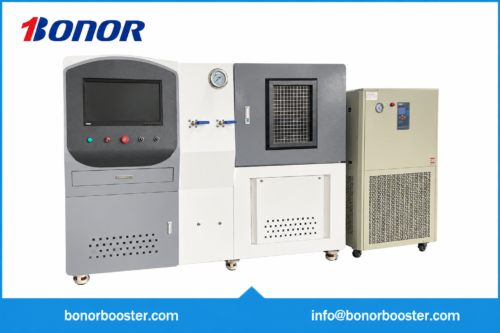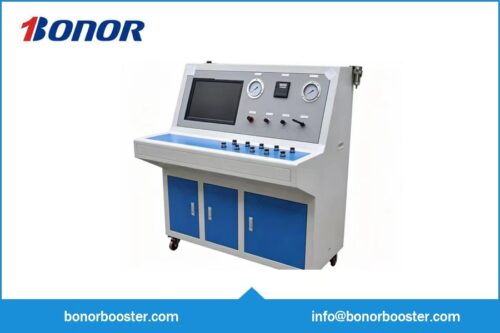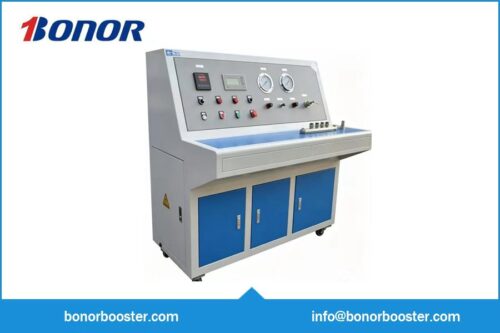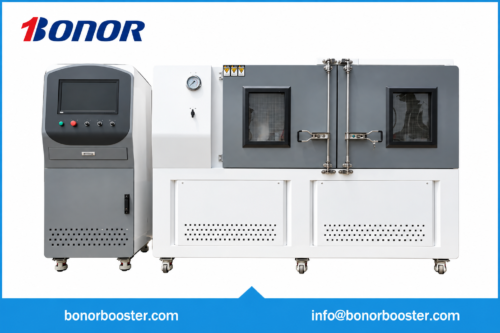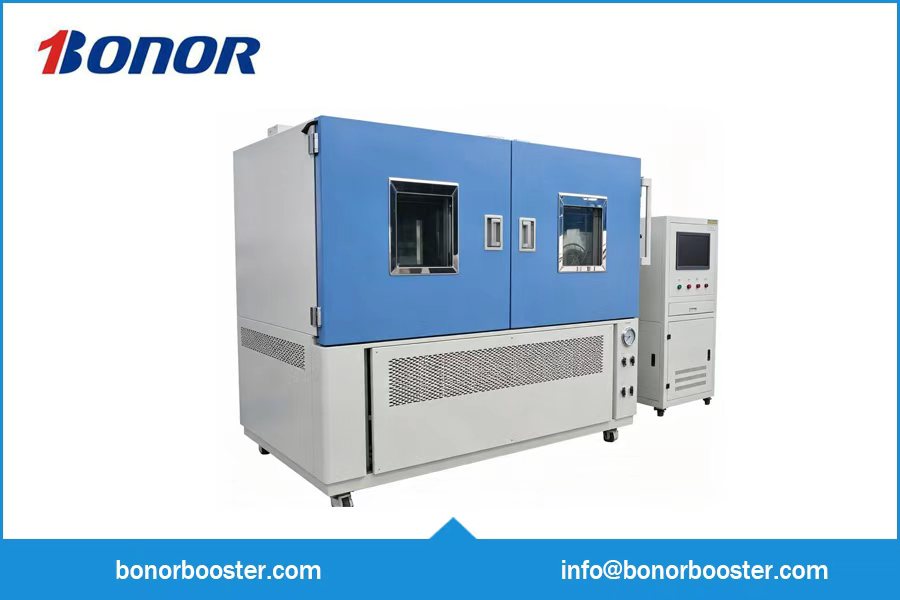
The Valve Life Cycle Test Bench is built for pressure pulse and fatigue cycling. Cycle rate, waveform and shutdown logic are set for the protocol your product has to pass.
Description
1. Product Introduction
This life cycle test bench is independently developed by Jinan Bonor Machinery Co., Ltd. It meets the life cycle test requirements of water valves under specified working conditions, and supports automatic recording of test data as well as historical data query function.
2. Technical Parameters
- Applicable test pieces: 2-way valves, 3-way valves (1-in 2-out), 4-way valves (2-in 2-out), 5-way valves (3-in 2-out) and other multi-way water valves
- Test medium: Ethylene glycol aqueous solution (replaceable with other solvents). The pipeline is corrosion-resistant, easy to clean and replace medium.
- Medium temperature control range: -40℃ ~ 127℃ (±2℃), adjustable on demand
- Ambient temperature control range: -40℃ ~ 120℃ (±2℃), adjustable on demand
- Test stations: Multi-station design
- Drive bus: LIN2.1
Specimen technical indicators
- Single station flow rate: 25 L/min
- Pressure range: 0 ~ 300 kPa; pressure sensors are installed at both inlet and outlet, close to the ports
- Test power supply: 30 VDC / 20 A
Measurement precision
- Pressure gauge: Accuracy class ≥0.5, fluctuation ≤±1%
- Flow meter: Accuracy class ≥1.0, fluctuation ≤±2%
- Temperature gauge: Accuracy class ≥0.5 (±0.5℃), fluctuation ≤±2℃
Test parameter setting: Users can set inlet pressure, flow tolerance range, medium temperature, cycle times and other parameters on the operation interface. The system displays set values, real-time values, real-time curves, test duration, product model & specification, valve opening degree and other data.
Alarm & recording: The device will trigger timely alarms when flow or pressure abnormality occurs, and store all alarm records.
3. Test Items
- Fatigue life endurance test
- Optional overall test pressure: 140 kPa
- Cycle counting will be paused when temperature or pressure value is modified during testing
- Rated input voltage for valves during test: 12.4 V
Applications of the pulse fatigue test bench
A hose or pipe that survives one burst test can still fail after ten thousand pressure cycles, because fatigue damage accumulates at the reinforcement, the fitting or the weld. The Valve Life Cycle Test Bench reproduces those cycles at accelerated rate so the service life can be estimated before the product reaches a customer.
- Hydraulic and pneumatic hose assemblies — SAE J343, ISO 6803 and similar pulse protocols on brake, power steering and high-pressure lines.
- Pipe and tube assemblies — pressure cycling of welded and brazed joints in automotive and refrigeration circuits.
- Filters, accumulators and pressure vessels — diaphragm and shell fatigue verification.
What to specify before we build yours
- Pressure range and cycle waveform — square, saw-tooth or sine, with rise and hold times defined by the standard.
- Cycle rate — cycles per minute determines how long a 100,000-cycle test will take, and whether you need one station or several.
- Media and temperature — oil, water, glycol or gas, at ambient or elevated temperature; hot oil changes the pump and seal selection.
- Failure detection and shutdown — pressure-loss detection, burst detection and an automatic stop with the cycle count preserved.
How to choose a pulse fatigue test bench
Fatigue benches are judged by how many cycles they complete without attention, not by their peak pressure:
- Calculate the calendar time first. A 200,000-cycle test at 30 cycles per minute runs for five days. If your qualification plan has ten variants, one station will not finish this quarter — plan the number of stations before the pressure rating.
- Ask how the failure is caught. A hose that bursts at cycle 40,000 must stop the test and log the count, otherwise the run continues against a dead specimen and the data is wasted.
- Check the oil temperature control. Continuous cycling heats the medium; without a cooler the test drifts away from the specified temperature and the result is not comparable to the standard.
Frequently asked questions
How many cycles per minute can the bench reach?
Typical industrial benches run between 10 and 60 cycles per minute depending on pressure range, specimen volume and waveform. Higher rates need a larger pump and an accumulator; we size the rate against the total cycle count in your test plan.
Can the test run with hot oil or at low temperature?
Yes, with a temperature-conditioning loop. Hot oil is the common requirement for automotive hose protocols; low-temperature testing needs a cooled enclosure and a medium that stays fluid at the set point.
What happens when the specimen leaks or bursts?
The controller detects the pressure loss, stops the pump, closes the isolation valve and records the cycle count at failure. A burst shield or enclosure protects the operator, and the record is exported with the test ID.
Related equipment and further reading
- High-Pressure Water Pulse Testing Machine
- Cyclic Fatigue Testing Machine
- Fully Automatic Hydraulic Pulse Testing Machine
- All Pulse Fatigue Testing Machine models and specifications
- How long should a hydrostatic pressure test machine last
- The complete hydrostatic pressure test machine spare parts guide 2026
Need a pressure range, fixture or test standard that is not listed here? Send the specimen list and the standard you test to and we will come back with a configuration and a price within one working day.