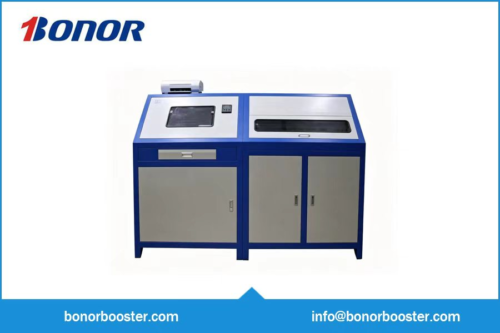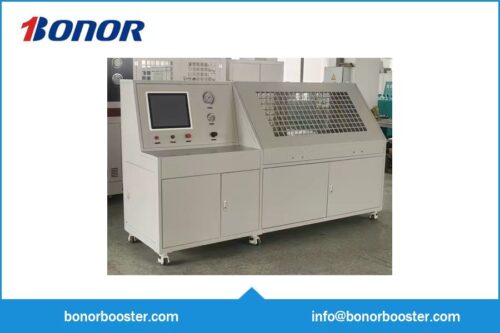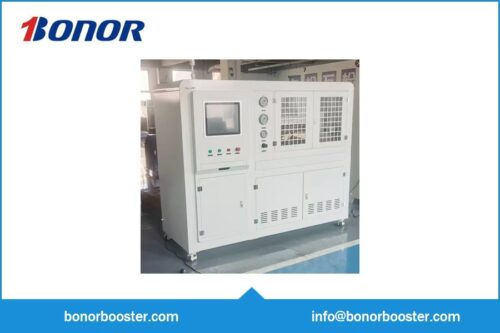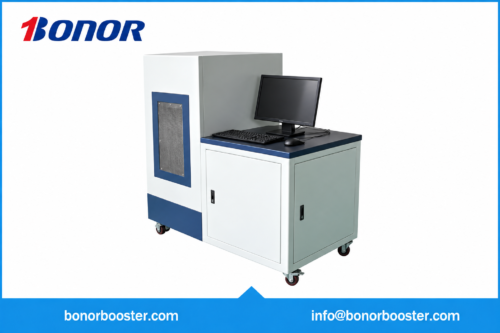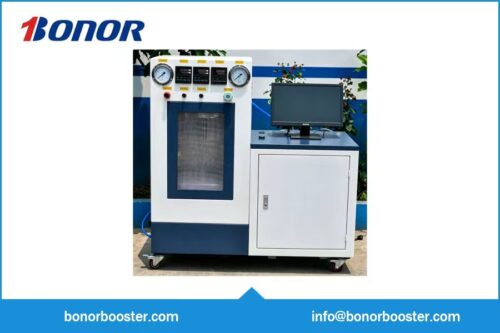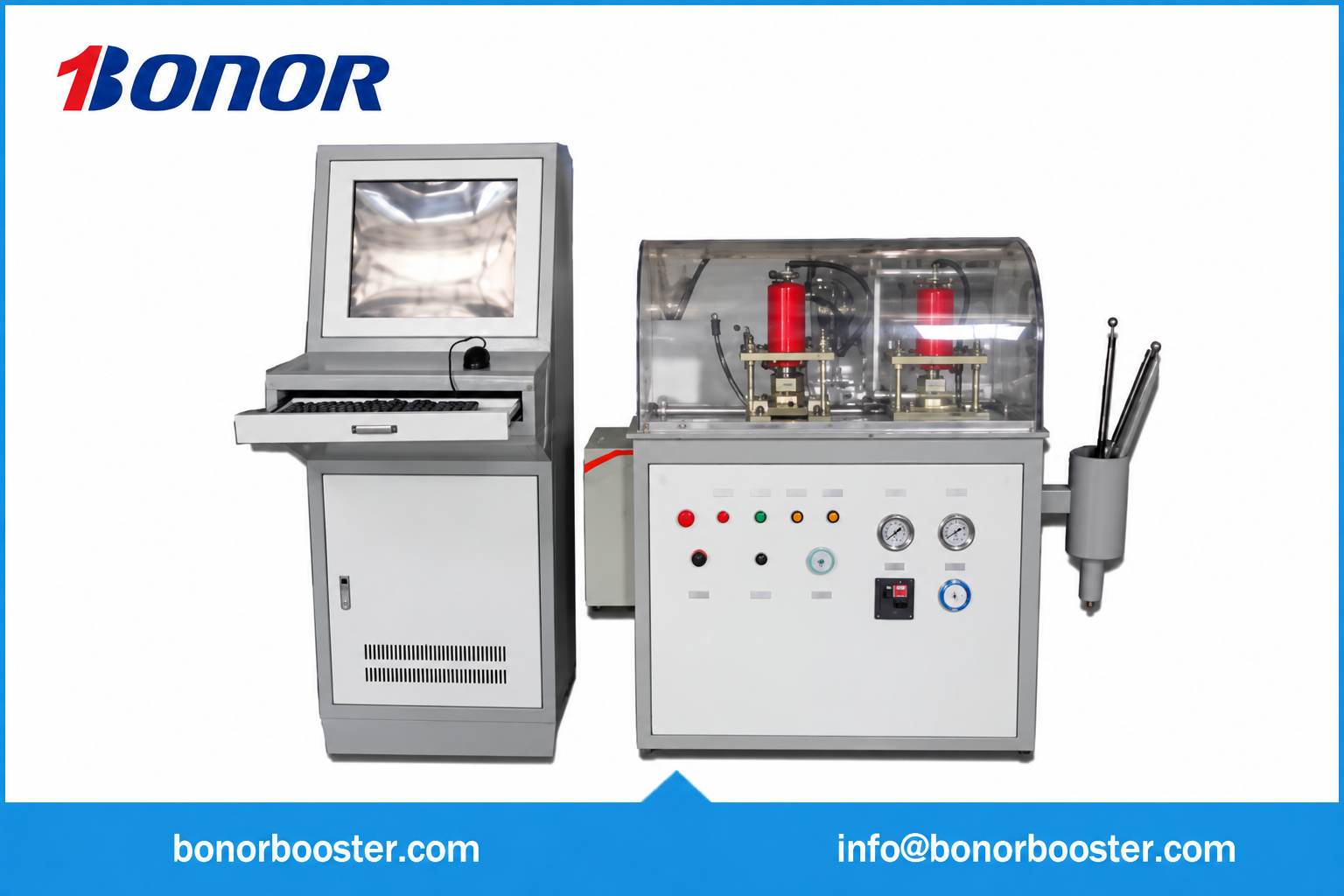
The Burst Test Bench for High-Frequency Welded Harmonica Tubes is built for burst and proof-pressure testing. Configured here as air consumption: 1 Nm³/min. Clamping fixtures are quoted around the specimen, and the pressure curve is stored with the test ID.
Description
I. Application Scope
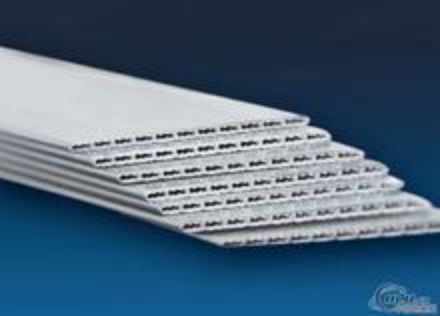
The harmonica tube burst test bench manufactured is mainly applied to pressure resistance and burst tests for automobile radiator flat tubes, widely used by manufacturers producing high-frequency welded harmonica flat tubes. Adopting computerized control, this tester supports parameter setting, data acquisition, automatic recording of test pressure & time, real-time monitoring and independent pressure control for each channel, as well as data curve analysis. During testing, the bench can precisely regulate pressure, record test pressure and time, and realize real-time data collection & automatic storage.
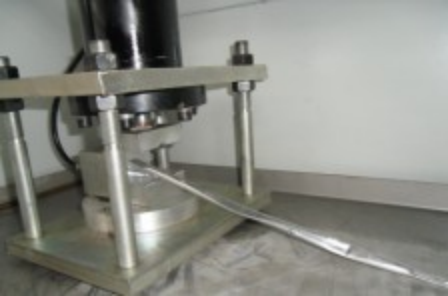
II. Pipe Clamping & Data Acquisition Software
 |
 |
III. Features of Harmonica Flat Tube Burst Test Equipment
- Fitted with gas-driven automatic booster pump, enabling convenient adjustable and controllable output pressure.
- Adopts advanced technology and rational structural design with compact size, light weight and elegant appearance.
- All pressure-bearing components are standard parts from world-renowned brands with welding-free connections, bringing easy disassembly, high safety factor, long service life and simple maintenance.
IV. Technical Parameters
- Driving air pressure range: 0.1–0.69 MPa; output pressure is proportional to driving air pressure
- Air consumption: 1 Nm³/min
- Test pressure range: 0–40 MPa, customizable pressure range according to customer demands
- Working medium: water, hydraulic oil, emulsion
- Matched with data acquisition software for automatic data collection, report printing and pressure curve display
Applications of the burst pressure test bench
When a customer or a certification body asks how much margin your part has above its working pressure, the only honest answer is a measured failure point. The Burst Test Bench for High-Frequency Welded Harmonica Tubes produces that number with a controlled pressurisation ramp and a curve you can hand over. The typical workload here is high-frequency welded harmonica tubes, so the clamping and detection settings are tuned for that from the factory; commissioning includes running your own samples to prove it.
- Hydraulic press and power-pack builders — accumulators, tubing runs and manifold blocks burst-verified before leaving the works.
- Aerospace and defence small components — compact actuators, reservoirs and tubing bundles with tight burst-margin documentation.
- Welded tube lines — high-frequency welded and drawn tubes checked for seam integrity all the way to failure.
Every Burst Test Bench for High-Frequency Welded Harmonica Tubes is laid out around its duty cycle, and here that means high-frequency welded harmonica tubes. The controls, the guards and the record format follow from that.
What to specify before we build yours
- Specimen envelope and clamping — hose bore and length, pipe diameter, cylinder height and the fixture that holds the part without crushing it. On this unit it is arranged for the tube.
- Test medium — water, oil, glycol mixture or air; the choice changes the pump, the plumbing and the safety enclosure. On this unit it is arranged for the tube.
- Air consumption — 1 Nm³/min (confirmed for this unit).
The way this particular bench is set up: For this build, air consumption is 1 nm³/min.
Currently configured as: Air consumption: 1 Nm³/min. Any other range or fixture is a custom build.
Choosing the right burst pressure test bench
The bench you need is decided less by the pressure number and more by what happens around it — media, fixturing and records. Work through this list before ordering:
- Check what the software exports. If your customer wants a curve with time stamps and the raw transducer file, confirm the format before the order, not during acceptance. A PDF screenshot is not a record.
- Check how the result is captured. A manual gauge and a peak-hold pointer are enough for a pass/fail check. If the customer asks for a curve, you need a transducer, a sampling rate fast enough to catch the fracture, and software that exports the file in a format your report can use.
- Handling for the tube. Loading height, clamping force and the drain path are arranged for the tube you run most, which is where the daily minutes are won or lost.
Frequently asked questions
How is the test pressure rate standardised?
Most codes specify a rate in bar or MPa per second, or a time-to-failure window. The controller holds the commanded ramp within a tolerance band and records the actual rate, so a reviewer can see that the rate stayed inside the specification for the whole test. On this build the tube is the reference case, and the setting is proven with your samples at commissioning.
Can you test two specimens at the same time?
Only if they fail at similar pressures and you accept that the first failure ends the test for both. Parallel circuits with independent valves remove that limit but add cost. For most labs, serial testing gives cleaner data per sample. Every Burst Test Bench for High-Frequency Welded Harmonica Tubes we ship is commissioned against this point with your own samples present.
Related equipment and further reading
- Bursting Disc Burst Test Machine
- Air Conditioner Accumulator Burst Test Machine
- PVC Hose Hydrostatic Pressure Burst Test Machine
- Browse the full Burst Pressure Test Bench range
- How the burst bench works
- Uses of a burst bench
Every bench is quoted around a real specimen list. Send yours with the working pressure and you will have a costed proposal, not a brochure, within one working day.