Description
1. Application Scope
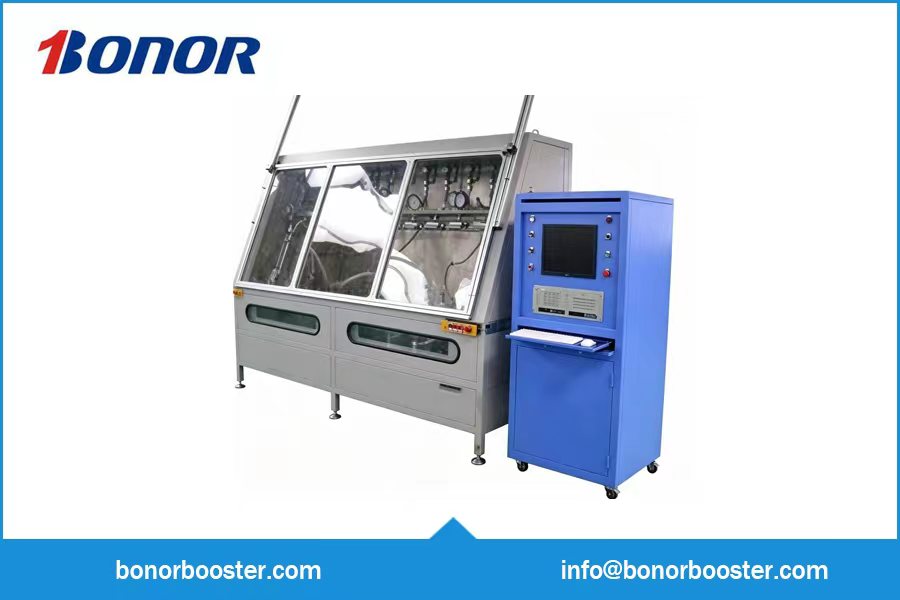
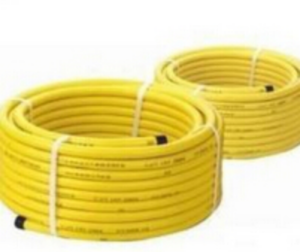
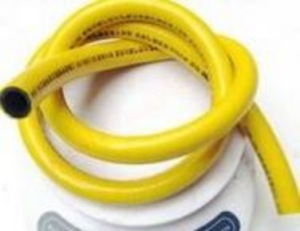
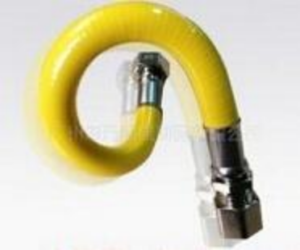
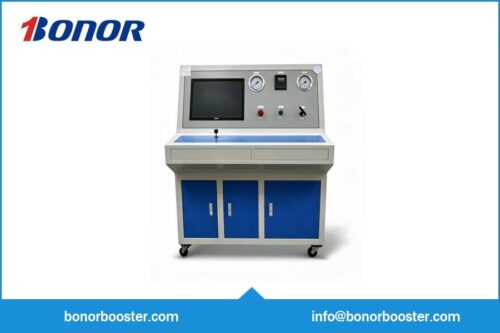
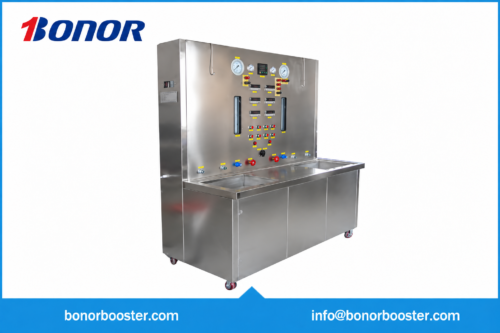
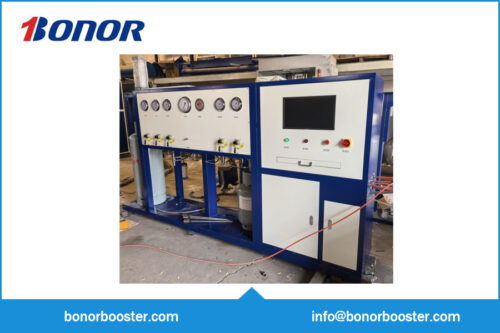
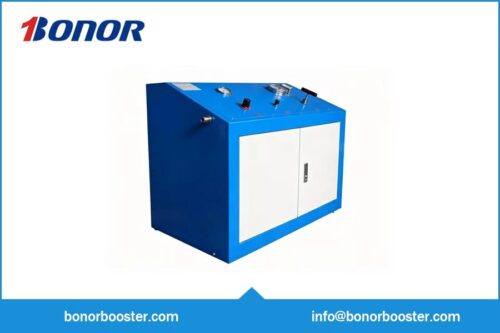
This hydrostatic testing equipment is designed for gas hose and coal gas hose with outer diameter Φ16~Φ32 and wall thickness 3~4 mm, including common sizes Φ16, Φ20, Φ25, Φ32. The system is controlled by PLC with touch screen programming, equipped with cylinder automatic clamping fixtures. The machine applies preset water pressure to test pipes to check pressure resistance and judge leakage or rupture; meanwhile, it records real-time pressure data for subsequent data analysis and evaluation.
2. Test Requirements
- Test Pressure: 0.8±0.05 MPa
- Test Medium: Water mixed with anti-rust liquid
- Pressure Holding Time: more than 5 seconds
- Testing Efficiency: 1500 pieces per 8 working hours
3. Equipment Features
- Four-station layout with production efficiency of 180~240 pieces per hour. Manual loading & unloading mode reserves sufficient operation time to reduce labor intensity for operators.
- Matched for 4-meter fixed-length hoses. Pipe ends shall be deburred in advance for easy installation with fixtures.
- Nominal test pressure: 0.8 MPa with water as medium; holding time 5~15 seconds, total single operation cycle: 50~60 seconds.
- Automatic running sequence: Manual feeding → Test start → Automatic clamping → Automatic water filling & air venting → Pressure boosting & holding → Automatic pressure drop judgment → Pressure relief → Fixture reset.
4. Technical Parameters
| Items |
Specifications |
| Max Working Pressure |
1.0 MPa |
| Pressure Accuracy |
≤±1% |
| Constant Pressure Range |
5% – 100% FS |
| Constant Pressure Precision |
-2% ~ +2% FS |
| Timing Range |
0.1 min – 10000 h |
| Timing Accuracy |
≤±0.1% |
| Specimen Diameter |
Φ16 mm ~ Φ32 mm (4 standard sizes) |
| Standard Specimen Length |
4 m |
| Test Channels |
4 independent pipelines |
| Test Medium |
Clean tap water with anti-rust additive |
| Power Supply |
380V, 3KW |
| Air Source Requirement |
Compressed air ≥0.6 MPa with stable air supply |
Applications of the hydrostatic pressure test bench
Between the workshop and the certificate there is always the same sequence — fill, vent, stabilise, pressurise, hold, drain — and the cost is in doing it the same way every time. The Gas Pipe (Coal Gas Hose) Hydrostatic Test Machine automates that sequence and logs it, so the paperwork writes itself. With gas pipe coal gas hose as the daily workload, the fill, stabilisation and hold settings are tuned from the factory — commissioning proves them on your own parts.
- Heat exchangers and boilers — tube-to-tubesheet joints and shell circuits pressure-tested after fabrication or re-tubing.
- Autoclave and process-tank service companies — periodic in-situ testing with portable pump sets.
- Pipe and spool fabricators — hydro proof after welding and before coating or dispatch.
- Hose assembly shops — proof and leak testing at working pressure with a hold-time record per assembly.
In daily use the Gas Pipe (Coal Gas Hose) Hydrostatic Test Machine sees mostly gas pipe coal gas hose. That decides the fixture style, the approach rate and what the operator actually does between tests.
What to specify before we build yours
- Test pressure and hold time — often 1.5 times the design rating, with the hold period set by the applicable standard. On this unit it is arranged for the hose assembly.
- Output needed — a gauge reading, a printed certificate per part, or a data file with the full pressure curve. It is set up here for the hose assembly.
- Test Pressure — 0.8±0.05 MPa (confirmed for this unit).
How the standard build is set up here: This unit works with test pressure at 0.8±0.05 mpa. On this machine test medium is water mixed with anti-rust liquid. For this build, test medium is clean tap water with anti-rust additive. Here power supply is set to 380v, 3kw.
Currently configured as: Test Pressure: 0.8±0.05 MPa. Other ranges and fixture sets are available to order.
Choosing the right hydrostatic pressure test bench
Before comparing suppliers, settle the four questions below — they determine most of the price and all of the usability:
- Check what happens when a part fails the test. A real workshop needs a safe dump, a clear fail indication and a record that shows where the pressure went. Benches designed only for passing parts make failures awkward.
- Plan for the wet parts afterwards. Testing leaves water inside and outside the part. Drainage racks, drip trays and drying air are afterthoughts that become daily annoyances if they are not in the original layout.
- Fixture fit for the hose assembly. The clamping set is drawn around your hose assembly drawings first, so the part sits square without shimming — and the same fixture family extends to other sizes later.
Frequently asked questions
What pressure do we test at if the standard says 1.5 times design?
The multiplier applies to the design pressure of the specific part, not to the working pressure of the system it belongs to. For mixed production we store a recipe per part family with its own target, hold time and pass criteria, so the operator cannot apply the wrong multiplier. In practice, the hose assembly dictates the answer here — and that is what the quotation is built around.
What documentation comes with each test?
Whatever your process needs: a pass/fail lamp for the shop floor, a printed ticket per part, or a data file with the full pressure-versus-time curve and the part identity. The same test can produce all three because the recording is continuous. The Gas Pipe (Coal Gas Hose) Hydrostatic Test Machine is commissioned on your site with this point demonstrated on your own parts.
Related equipment and further reading
If your parts are not among the applications above, send a photo or drawing with the test pressure and our engineers will propose a fixture and a cycle time within one working day.