- Driving air pressure range: 0.1–0.69 MPa; the output pressure is directly proportional to the driving air pressure.
- Air consumption: 0.6 Nm³/min
- Test pressure range: 0–15 MPa; the specific pressure grade can be customized according to customers’ actual requirements.
- Available working media: water, hydraulic oil, emulsion liquid, etc.
- A portable automatic recorder can be optionally configured as requested by customers.
Radiator Burst Test Bench
Description
I. Burst Test Bench Application Scope
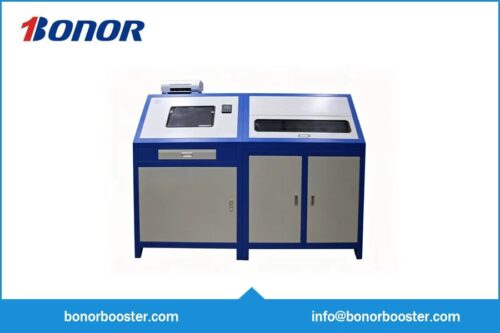
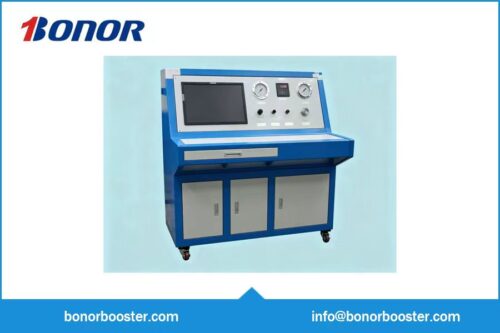
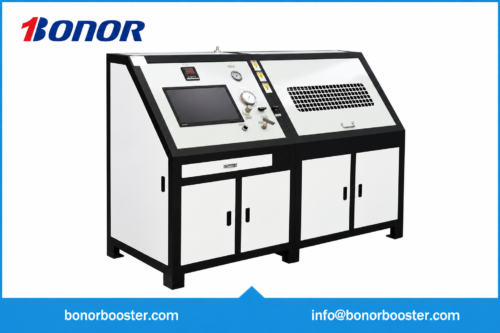
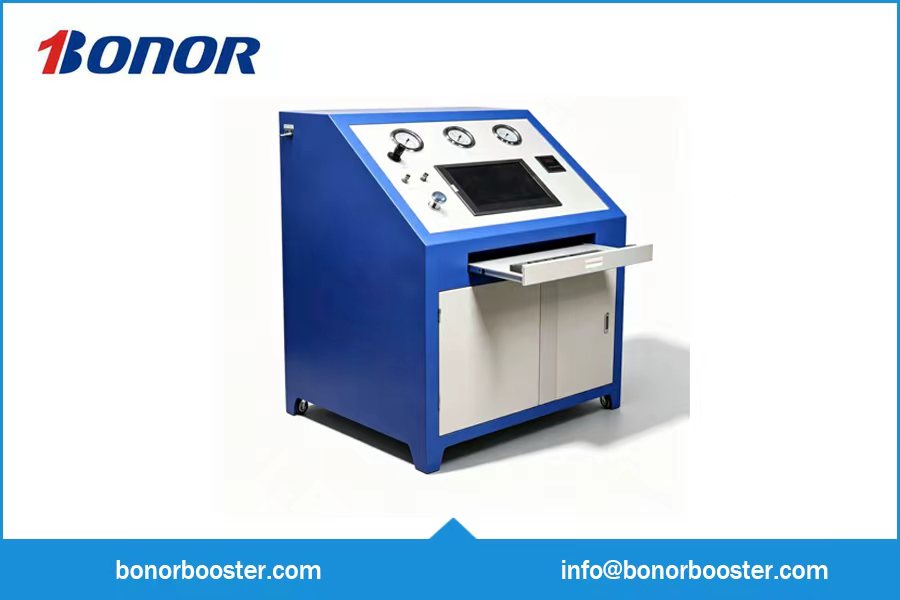
This equipment supports hydraulic testing within the pressure range of 0–15 MPa, which meets the burst pressure test requirements for copper radiators, aluminum radiators, intercoolers, oil coolers, evaporators, condensers and other similar products. The system supports real-time curve display, automatic data recording and test report printing via computer control.
II. Burst Test Bench Equipment Features
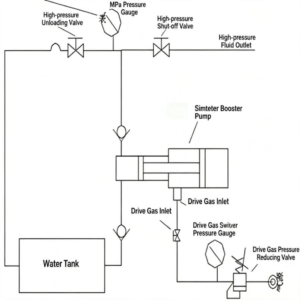
- Equipped with booster pump to realize stepless adjustment and precise control of output pressure. A memory gauge is configured to record the instantaneous burst pressure value.
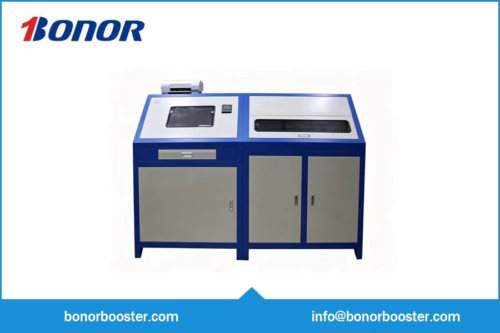
- Adopting advanced technology and optimized structural design, the equipment features small footprint, light weight and elegant appearance.
- All pressure-bearing components are standard parts sourced from world-famous brands with fully welding-free connections. The structure is easy to disassemble, featuring high safety factor, long service life and convenient maintenance.
- Multiple operation modes are optional, including manual control with digital pressure gauge display and computer automatic control.
III. Burst Test Bench Technical Parameters
- Driving air pressure range: 0.1–0.69 MPa; the output pressure is directly proportional to the driving air pressure.
- Air consumption: 0.6 Nm³/min
- Test pressure range: 0–15 MPa; the specific pressure grade can be customized according to customers’ actual requirements.
- Available working media: water, hydraulic oil, emulsion liquid, etc.
- A portable automatic recorder can be optionally configured as requested by customers.
Where a burst pressure test bench is used
Failure data ages quickly: a resin lot change, a new hose crimp or a different brazing cycle can move the burst point by tens of percent. The Radiator Burst Test Bench lets you re-check the margin whenever an input changes, in minutes rather than days. This unit is laid out primarily for radiator testing. If your sample list also covers other families, tell us — the pressure section is shared, only the fixture changes.
- Fire equipment and extinguisher bodies — cylinder shells proof- and burst-checked as part of periodic requalification programmes.
- Gas equipment manufacturers — regulators, manifolds and flexible connections verified above the maximum supply pressure.
- Radiator and heater-core factories — tanks, tubes and headers pressured past working level after brazing.
Every Radiator Burst Test Bench is laid out around its duty cycle, and here that means radiator testing. The controls, the guards and the record format follow from that.
What to specify before we build yours
- Test medium — water, oil, glycol mixture or air; the choice changes the pump, the plumbing and the safety enclosure. It is set up here for the radiator core.
- Specimen envelope and clamping — hose bore and length, pipe diameter, cylinder height and the fixture that holds the part without crushing it. The setting here follows the radiator core you run most.
- Air consumption — 0.6 Nm³/min (confirmed for this unit).
The way this particular bench is set up: For this build, air consumption is 0.6 nm³/min.
Currently configured as: Air consumption: 0.6 Nm³/min. Any other range or fixture is a custom build.
What to look for in a burst pressure test bench
Most dissatisfaction with burst benches traces back to a specification written from a catalogue instead of from the specimen. These checks keep the order honest:
- Check how the result is captured. A manual gauge and a peak-hold pointer are enough for a pass/fail check. If the customer asks for a curve, you need a transducer, a sampling rate fast enough to catch the fracture, and software that exports the file in a format your report can use.
- Think about who operates it. A laboratory bench used by engineers can be manual and flexible; a production fixture used by rotating operators should be one-button with automatic pass/fail and interlocks. Specify for the actual operator, not the ideal one.
- Handling for the radiator core. Loading height, clamping force and the drain path are arranged for the radiator core you run most, which is where the daily minutes are won or lost.
Frequently asked questions
How is the burst point detected automatically?
The controller samples pressure at a fixed rate and stops the test when pressure falls by more than a set percentage inside a short window, which is the signature of a fracture. A pressure-relief valve and a burst shield sit behind that logic so the test cell stays safe if the detection is late. On this build the radiator core is the reference case, and the setting is proven with your samples at commissioning.
Can one bench test hoses, pipes and cylinders?
The pressure system can be shared, but the clamping fixture cannot. A hose bench grips both ends and may allow free length change; a pipe bench closes the ends with plugs; a cylinder bench usually works inside a water jacket to measure permanent deformation. BONOR quotes the bench with the fixtures for your part family, and additional fixtures can be added later. On the Radiator Burst Test Bench, that is part of the standard delivery, not an option.
Related equipment and further reading
- Tire Hydrostatic Burst Testing Machine
- Pipe Pressure Resistance and Burst Test Machine
- Burst Test Bench for Pipes
- Burst Pressure Test Bench — models and specifications
- Inside a burst test bench
- Burst bench applications
Every bench is quoted around a real specimen list. Send yours with the working pressure and you will have a costed proposal, not a brochure, within one working day.